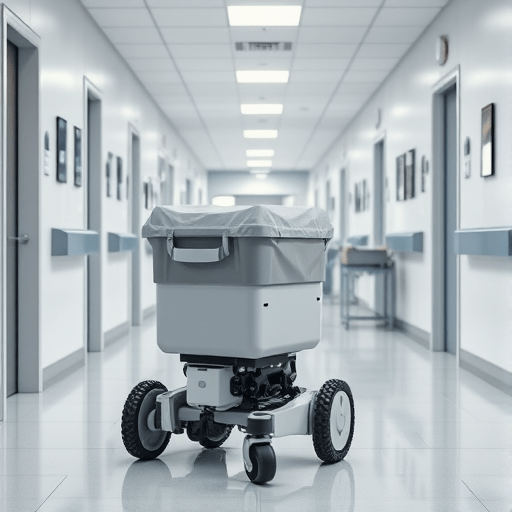
Choosing between mobile robots vs. conveyors in hospital logistics is no longer just an engineering decision—it is a clinical, financial, and operational strategy that affects patient outcomes. In 2026, hospitals face unprecedented pressure to move supplies faster, reduce worker strain, and contain healthcare-associated infections. While both automated transport technologies have matured, they solve fundamentally different problems. This article provides a fresh comparison checklist, grounded in real-world hospital workflows, to help you decide which system—or combination—deserves a place in your facility.
Why Hospital Logistics Is at a Crossroads
Central sterile supply departments, pharmacies, and nursing units generate hundreds of transport tasks daily. Traditional pneumatic tube systems and manual carts are increasingly inadequate for bulky items, linen, and regulated medical waste. Meanwhile, two automation families have risen to prominence: autonomous mobile robots (AMRs) and fixed conveyor systems. AMRs navigate dynamically using sensors and maps, while conveyors use fixed tracks, lifts, and elevators to move totes and bins along predetermined pathways.
The 2026 healthcare landscape adds new variables: fluctuating patient volumes, surge-ready infrastructure requirements, and stricter infection prevention protocols. The right choice depends on your facility’s physical layout, workflow variability, and long-term capital strategy. The following checklist breaks down the three pillars that matter most: cost, flexibility, and infection control.
Cost Considerations: Upfront, Operational, and Hidden
Cost is rarely just the sticker price. For a fair comparison, evaluate the total cost of ownership over a five- to ten-year horizon, including installation downtime, maintenance contracts, power consumption, and the cost of adapting building infrastructure.
Capital Expenditure
- Mobile robots (AMRs): Lower initial investment per unit, with no major infrastructure changes. Most AMRs require only Wi-Fi coverage, a charging dock, and software configuration. In 2026, fleet pricing has become modular—you can start with two robots and scale later.
- Conveyors: Higher upfront cost due to structural modifications, fire-rated barriers, drive units, and integration with existing lifts and horizontal transport corridors. A hospital-wide conveyor system can run into the millions, especially in retrofit projects.
Hidden costs matter too. Conveyors often require dedicated maintenance personnel and specialized parts. AMRs have simpler maintenance but may need battery replacement after a few years. Also, consider the opportunity cost of construction disruption in active clinical areas—conveyor installation can shut down corridors for weeks.
Operating Costs and Scalability
AMRs offer near-linear scaling. If throughput increases, you can add robots without altering the physical plant. However, each robot requires charging infrastructure and software licensing fees, and fleet management becomes more complex as you add units. Conveyors have high fixed operating costs regardless of volume, but their marginal cost per additional load is very low. For consistently high volume between two fixed points—for example, from a central supply to a surgical floor—conveyors can be cheaper per trip.
A 2026 trend is the “robotics-as-a-service” model for AMRs, which shifts capital expenditure to predictable monthly fees. That can be attractive for hospitals wanting to avoid large capital requests. Meanwhile, conveyor suppliers now offer performance-based maintenance contracts, but the structural investment remains.
Flexibility: Adapting to Changing Hospital Layouts and Demand
Hospitals are living organisms. Departments move, wings are renovated, and patient care models change. Flexibility is where mobile robots excel—and where fixed conveyors show their age.
AMRs navigate dynamically, using lidar, cameras, and AI to avoid people, IV stands, and wheelchairs. In 2026, fleet software can reroute robots in real time based on elevator availability and door access. You can change a robot’s mission in minutes, add new docking stations, or repurpose a robot from transporting meal trays to handling lab samples just by swapping its cart. This makes AMRs ideal for facilities undergoing phased redevelopment or those with decentralized storage.
Conveyors are the opposite. Once installed, the path is set. Expanding a conveyor system requires new track segments, additional lifts, and often significant civil engineering. However, conveyors are reliable and unaffected by crowded hallways or elevator outages. For highly standardized, high-frequency routes—such as soiled linen returns from patient floors to the laundry—a conveyor can provide deterministic capacity with minimal human interaction.
In 2026, many hospitals use a hybrid approach: conveyors for the vertical backbone of the building, and AMRs to connect the “last hundred meters” to nursing units and treatment rooms. That combination avoids the inflexibility of a full conveyor network while preserving its efficiency.
Infection Control: The Critical Differentiator
Infection prevention is more than a checklist item—it is a public health priority. The choice between mobile robots and conveyors has direct implications for pathogen transmission, cleaning protocols, and air handling.
AMRs move through patient zones, elevators, and corridors, which means they come into contact with the same environmental surfaces as staff. They can become fomites if not properly disinfected. Fortunately, 2026 AMR models feature antimicrobial coatings, sealed housings, and automated disinfection stations that use UV-C light or hydrogen peroxide vapor between shifts. Still, a robot’s wheels and underside can carry contaminants, requiring robust cleaning schedules. For infection-sensitive areas, use dedicated AMRs with color-coded carts that never cross from soiled to clean zones.
Conveyors have a different risk profile. Because they operate in enclosed tracks with minimal human contact, they inherently reduce contamination by limiting touchpoints. Soiled and clean flows can be separated using dedicated tracks or pressure differentials. However, conveyor totes and carriers require regular washing; and if the system uses air blowers or vacuum lifts, there is a risk of aerosolization. In 2026, conveyor manufacturers offer antimicrobial belt materials and self-cleaning tote washers, but these add to operating costs.
The key consideration is not “which is sterile” but “how easy is it to verify and control contamination?” AMRs are visible and easy to wipe down, but they travel everywhere. Conveyors confine traffic to predefined channels, making it easier to isolate clean vs. soiled flows architecturally. For facilities planning new construction, a conveyor system can be integrated into a sealed logistics core, providing superior infection control by design. For existing buildings, AMRs with well-defined disinfection workflows are often the more practical and equally effective alternative.
Making the Choice: A Comparison Checklist for Your Facility
Use the following checklist during your next capital planning meeting. Score each factor from 1 to 5 based on your hospital’s priorities, then compare totals.
- Route stability: Are your transport routes permanent for at least 10 years? (Higher score for conveyors if yes)
- Volume variability: Does demand spike unpredictably (e.g., during pandemic surges or seasonal flu)? (Higher score for AMRs)
- Infrastructure for charging or tracks: Is your facility willing to undertake major construction, or do you need a non-invasive solution? (AMRs win for retrofit)
- Infection control requirements: Do you need absolute physical separation between clean and soiled logistics flows? (Conveyors can be designed into new buildings)
- Operational complexity: Does your staff have the technical capacity to manage fleet software, or would a fixed conveyor with manual override be simpler?
- Budget model: Do you prefer operating expenses (AMR as a service) or capital investment with predictable depreciation (conveyors)?
- Vertical vs. horizontal transport: For moving loads across floors, conveyors integrated with elevators can be faster; for horizontal movement within a floor, AMRs are often more flexible.
- Future expansion: Is your campus likely to grow with new wings or satellites? AMRs can move to new buildings; conveyors cannot.
- Maintenance resilience: Can you tolerate a conveyor shutdown for repairs, or is it easier to temporarily reassign AMR missions?
Final Thoughts for 2026
Neither mobile robots nor conveyors is universally better. The most resilient hospital logistics systems in 2026 are those designed around the “zone” concept: conveyors handle reliable, high-volume arteries, while AMRs provide adaptive distribution to the clinical edge. Start by mapping your actual transport tasks over a week, then run the checklist above with input from nursing, infection prevention, and engineering. The goal is not to choose a technology, but to build a logistics ecosystem that can bend as easily as it runs.