Highlining has grown far beyond its desert-tower roots. Rigging lines in forests, parks, and even backyard groves is now common, which means the question is no longer Can we walk this line? It is: Can we take down the line and leave the anchor trees exactly as we found them? The answer begins with moving beyond old-fashioned rope wraps and embracing rigging techniques that eliminate tree damage. These methods treat bark as a living membrane, reduce pressure to near-zero levels, and allow highliners to enjoy the canopy without trading away its health.
Traditional tree anchors are usually a simple wrap of the highline around a trunk, sometimes padded with a backpack or a piece of carpet. That approach was never designed for highline forces. Modern highline tensions can exceed 10 kilonewtons during a fall, and a narrow rope wrapped tightly around a trunk concentrates all of that force into a thin horizontal band. Even if the bark stays intact, the living cambium layer underneath can be crushed. The tree does not fail immediately; it shows signs of decline months later, often after the rigger has moved on.
Why Ordinary Tree Wraps Are a Slow-Motion Injury
Bark is not a protective shell. It is a complex tissue that transports nutrients and defends the tree from infection. When a highline presses hard against a small area, the outer bark may break, but the more subtle damage is the compression of phloem and cambium cells. That compression can stop the flow of sugars and water, causing sections of the canopy to thin out, bark to peel, and fungi to enter.
The biggest issue is not friction; it is pressure. A 2-centimeter static rope carrying 8 kilonewtons creates a pressure far greater than what a wide, soft sling can produce. Rigging techniques that eliminate tree damage therefore focus on load-spreading and surface-area distribution. They turn a point load into a broad cushion that the tree can absorb without harm.
The Load-Spreading Anchor Blueprint
Any tree-anchor system used for highlining should meet three criteria: wide contact, no sharp edges, and no concentrated pressure. A good system spreads the load over at least 30 centimeters of vertical trunk, uses only soft materials against bark, and allows the anchor to move slightly under dynamic loads. This is what professional riggers call a tree-friendly anchor, and it is the backbone of responsible highlining.
Choose the Right Sling Material and Width
Start with a wide, low-stretch tubular sling rather than a thin rope or webbing. A 3-inch (75 mm) tubular webbing sling is the industry standard for tree protection because it conforms to the bark surface and spreads force across a generous area. Avoid chain, steel cable, or anything with metal hardware contacting the trunk. Even a carabiner pressed against bark can cause a bruise that becomes a permanent scar.
Use a Basket or Continuous Loop Configuration
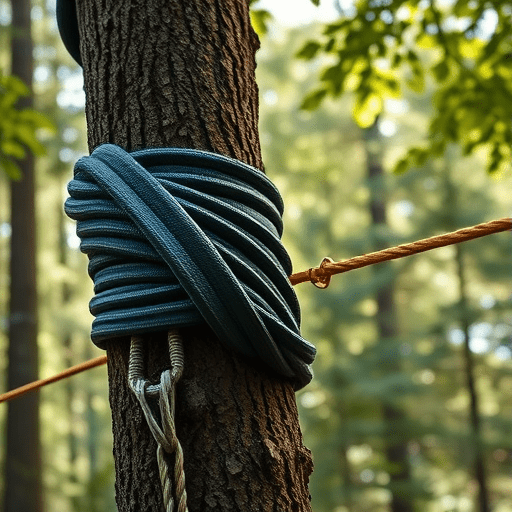
A single wrap around the tree with both ends connected to a carabiner can still create a high-pressure line. A better method is a basket configuration: place the midpoint of a long sling around the tree, bring both legs together, and connect them to a load ring or carabiner. This doubles the sling’s contact area and creates a smooth, equalized hitch. Adding a second sling above or below it, connected with a soft shackle, further distributes the load over a larger section of trunk.
For hardwood trees with wide trunks, some riggers use a closed-loop system made from a 1-inch polyester flat sling. The loop is girth-hitched around the tree and then padded with an open-cell foam sleeve designed for arborist use. This method is compact, removable, and leaves no visible pressure marks. The key is to ensure that no part of the sling twists into a narrow cord-like form when tension is applied.
Pad the Trunk, Not the Rigging
Adding a piece of camping foam under the sling is not enough. The foam compresses and creates wrinkles, which produce stress concentrations. Instead, use a dedicated tree pro pad: a thick, flexible shield made of high-density rubber or layered polyurethane that wraps around the trunk and has a smooth outer surface. The sling sits on this pad, and the pad carries the load into the bark evenly. Professionals often use custom-cut pads with a width of at least 20 centimeters, ensuring the load is distributed over a tall band of bark rather than a thin strip.
If you are rigging on a mission with a group, make tree protection part of the system, not an afterthought. Build a simple anchor kit that includes two tree pro pads, several 3-inch slings, soft shackles, and a small tarp to keep the equipment clean. Reusing dirty webbing can grind grit into the bark, causing microscopic wounds that invite infection.
Measuring and Managing Anchor Loads
No amount of padding can prevent tree damage if the tension is wildly excessive. Rigging techniques that eliminate tree damage also require a sense of the forces involved. A compact digital tension meter or load cell placed along the highline can show you the baseline tension before the line is even walked. For trees with a diameter under 30 centimeters, baseline tension should stay about 5 kilonewtons. Larger trees can handle a bit more, but there is no reason to tension a highline to its absolute maximum just to make it feel tight.
Pay attention to how the tree moves during the rig. A healthy tree should sway slightly at the canopy, but the trunk itself should not visibly flex. If you see the anchor sling dig into the bark or hear creaking sounds, stop and release tension immediately. Creaking comes from micro-fractures in the wood fibers, not from a reassuringly strong anchor.
The Role of Dynamic Dampening in Tree Protection
Static tension is only half of the story. The real damage happens when a falling highliner creates a sudden impact load. Even with a padded sling, that spike can be several times the baseline tension and is far more likely to injure the tree. Modern highline anchors use dynamic dampening elements to smooth out these pulses.
One approach is to place a short section of dynamic climbing rope, or a rope that is specifically rated for high shock absorption, between the tree anchor and the main highline. This dynamic link acts like a shock absorber. It stretches slightly under impulse loads, spreading the force over a longer period and reducing peak pressure on the tree. Another technique is to install a force-compensating pulley that allows the anchor to rotate and extend a few centimeters during a fall. This small amount of movement is enough to prevent the violent snap that stresses both the tree and the hardware.
Some rigging teams now use an energy-absorbing lanyard connected to the tree anchor as a secondary link. The lanyard contains folds of tear-webbing that open under high loads, absorbing kinetic energy while keeping the anchor intact. These devices, originally designed for industrial fall protection, have found a natural home in highline rigging because they protect both the athlete and the tree.
Reading the Tree: Before You Throw a Line
Protective rigging starts long before the sling touches bark. The most advanced anchor system cannot save a tree that is already dead, hollow, or fragile. Before rigging, examine the trunk for cracks, peeling bark, fungal brackets, and evidence of root damage. A tree with a diameter of 25 centimeters or less is generally too thin for highline loads unless it is a particularly dense hardwood species. Avoid trees with a large lean, because the load direction will pull along the weakest axis.
If possible, use an arborist’s inspection hammer to tap the trunk and listen for hollow sounds. A hollow or softened trunk can fail without warning when loaded. You should also clear the area around the root flare of loose soil or debris so you can see any surface roots that might be crushed by the setup. Even with a perfect anchor, a tree with poor root health can be damaged by the leverage of a highline.
Building a Routine That Leaves No Trace
Responsible highlining is a practice, not a one-time decision. Before you start rigging, take a photo of the tree and its surroundings. After taking down the line, take another photo from the same angle. Compare the bark, the leaf density, and the condition of the root zone. If anything looks different, document it and share it with the local land manager. This kind of accountability is what pushes the sport forward and proves that highline anchors do not have to scar the trees.
When removing the anchor, untie slings carefully instead of yanking them off the trunk. Abrasion from pulling webbing across bark can strip away the outer layer. Use a soft brush to sweep away any dirt that may have been pressed into the bark, and leave the tree base clear of gear, tape, and chalk. The goal is to make the only evidence of your highline the memories of a great line and a plate of untouched bark.
Conclusion
Highlining can coexist with healthy forests when riggers treat tree protection as a technical skill rather than an extra chore. By using wide tubular slings, dedicated tree pro pads, load-monitoring devices, and dynamic shock-absorbing links, you can build anchors that are both strong and reversible. These rigging techniques that eliminate tree damage are not theoretical ideals; they are proven tools available to any highliner who cares about the trees that support the line. The next time you throw a throwbag into a canopy, remember that a responsible anchor is not just the strongest one — it is the one that leaves the tree exactly as it was found.