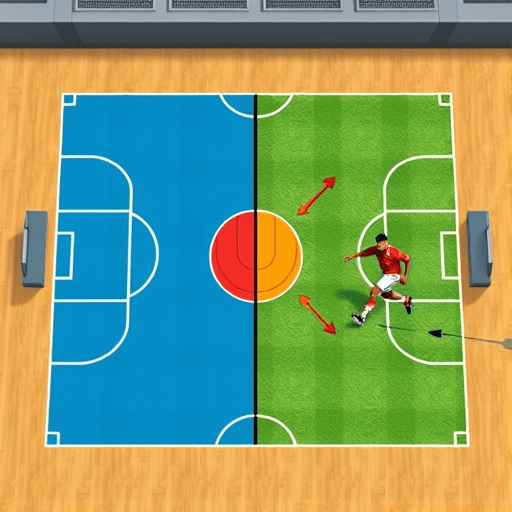
If you live and breathe basketball, you already know that spacing decides games. A loaded weak side, a well-timed screen, a corner three that opens a driving lane — it’s all geometry. Football, or soccer if you prefer, has its own spatial language, and few roles confuse newcomers more than the “false nine.” But here’s the secret: the false nine is just a spacer. Understanding this one concept unlocks a new way to watch both sports, because spatial roles across sports follow the same underlying principles. This guide connects the dots from the hardwood to the pitch, giving you a beginner-friendly framework that feels intuitive.
Why the False Nine Feels Alien to Basketball Eyes
In basketball, every player is on the floor with one collapsed geometry. You see the paint, the wings, the corners, and the arc. The center protects the rim or stretches the floor. The point guard orchestrates. Roles are clear. Football, however, has a fluid field with 22 players roaming across 1.7 acres. The name “false nine” implies a striker who isn’t really a striker. That sounds like a paradox, until you strip away position labels and think purely in terms of space and time.
A traditional false nine drops deep from the striker line into midfield, pulling a center-back with them. This creates a vacated central zone behind the defense. The player who “isn’t there” is actually the most valuable asset. In basketball, that’s analogous to a dive cut that clears the weak side, or a “hockey assist” that starts a chain of passes. The action itself doesn’t score; it manipulates defensive attention to create better angles elsewhere.
Spacing: The Shared Vocabulary Between Hoops and Pitch
Basketball coaches constantly scream “space!” because a crowded floor makes every move harder. The same logic applies in football, but the larger pitch and offside rule make spacing more dynamic. A false nine creates a temporary superiority by dragging an opponent out of their preferred position. You likely recognize this from the pick-and-roll: the big man pops to the three-point line, and the rim protector must decide whether to help or stay home. That decision-making under spatial stress is the core of both sports.
Consider the “dime” in basketball versus the “through ball” in football. The passer doesn’t just deliver to a person; they deliver to a space where the receiver will arrive. A false nine excels at creating those “passing windows” by shifting the defensive block. When you watch a team like Barcelona or Arsenal, look at how the center-backs step forward when the false nine drops. You’ll see a chain reaction identical to a basketball defense rotating off a drive.
The Stretch Four Parallel
In basketball, the stretch four — a power forward who shoots threes — pulls their defender out of the paint to the perimeter. This opens up driving and cutting lanes for others. The false nine does the same to a center-back, but with a twist: they drop backward into midfield rather than moving to the wing. This movement confuses man-marking systems. If the center-back follows, they abandon the defensive line’s depth. If they don’t, the false nine gets free to receive and turn, forcing another defender to rotate. That is pure spatial coercion.
You’ve seen this in transition offense: a player stops at the three-point line instead of cutting to the basket, freezing the help defender. The false nine’s drop aims to drag a tall, ball-winning defender into an area they hate — wide open midfield. Suddenly, the team’s playmaker has acres of grass in front of them, much like a point guard with a confused defense after a successful pick-and-pop.
Reading the Court vs. Reading the Pitch: Two Visual Cues
To enjoy football as a basketball fan, shift your eyes from the ball to the empty spaces. In basketball, you monitor the weak side corner and the dunker spot. In football, watch for the half-space — the diagonal corridor between the central midfield and the wing. A false nine often drifts into these half-spaces to create 3v2 overloads. This mirrors a basketball team that runs a constant “horns” set to bait the defense into choices.
Here are three specific cues to look for when a false nine is on the pitch:
- The Drop: The striker moves toward the ball carrier, dragging an opponent out of position. Note how the defense’s back line drops five yards, similar to a sagging zone defense.
- The Turn: When the false nine receives with open hips, they can play a first-time pass behind the defense. This is the equivalent of a point guard threading a skip pass to a shooter.
- The Run: A winger or attacking midfielder makes a diagonal run into the space the false nine just vacated. That’s a give-and-go in slow motion, but with more geometry.
The 2026 Tactical Shift: Spacers Become the Norm
Tactics evolve season to season. In 2026, the modern game increasingly treats the entire outfield as a fluid constellation of spacers, not fixed positions. Data analytics, just like in basketball, now track “threat zones” and “spatial control.” That’s why the false nine is not a novelty; it’s a logical response to packed defenses. When opponents defend in a low 5-4-1 block, the last thing you need is a striker standing between two center-backs. You need a spacer who can stretch the block vertically and horizontally without holding a position.
This is the same reason why small-ball lineups dominate the NBA. By removing a traditional rim protector, coaches trade interior height for perimeter spacing and passing velocity. The false nine does exactly that: it removes a goal-hanging poacher in favor of a mobile playmaker who populates the midfield and forces defenders into no-win decisions. Both sports are converging on a core principle — space creation beats direct occupation.
A Defensive Cheat Sheet for the Uninitiated
If you’re watching your first full football match with a false nine, here’s how to enjoy it:
- Ignore the jersey number. A number 9 dropping deep is not a mistake; it’s a design.
- Watch the center-backs. They must decide to release or stay. In basketball, that’s the “drop coverage” vs. “switch” dilemma.
- Track the right back. When the false nine draws a midfielder forward, the fullback gets 1v1 on the wing — exactly like a closeout in transition.
Once you internalize that the false nine is just a spacer, you’ll start seeing spacers everywhere: the hockey player who forechecks to create a turnover, the volleyball setter who fakes a set to open a hitter, even the American football receiver who runs a clearout route. Every sport is a choreography of intentionally leaving areas empty to punish the defense’s attention. That’s the universal truth that makes spatial roles so thrilling.
From the Stands: How to Spot a False Nine in Action
Next time you watch a football match, focus on one central striker. If they repeatedly retreat to the halfway line to receive the ball, they’re likely a false nine. Watch how the team’s attacking midfielder surges forward into that empty pocket. That movement is called a “third-man run,” and it’s the same as a basketball player cutting backdoor after their defender helps on a screen. The pass that finds them may look simple, but the space was engineered seconds earlier.
You can also simulate this mentally in basketball terms. Imagine a zone defense that shifts to the ball. The smart passer doesn’t attack the shifted side; they reverse the ball to the weak side, where the defense is scrambling. A false nine who drops deep creates a numerical overload in midfield, which forces the entire defense to shift. That shift rotates the center-backs away from the goal, opening the space that the winger attacks. It’s not magic; it’s physics.
Why You Already Understand Modern Football Tactics
Most football tactics coaches talk about today — positional play, half-space exploitation, inverted fullbacks — have direct analogies in basketball. You’ve seen “pace and space” transform the NBA. Football is undergoing its own revolution, but the vocabulary of spacing is the same. You don’t need to learn new terms; you need to adjust the scale. A basketball court is 94 by 50 feet. A football pitch is roughly six times that, but the logic of pulling opponents and attacking vacated zones scales perfectly.
So the next time someone yells “you’re standing too far from the goal!” to a false nine, laugh. That player is exactly where they need to be: not as a scorer, but as a spacer who tips the geometric balance of the entire match. For a basketball fan, that’s the most natural thing in the world.
In short, the false nine isn’t a mysterious football invention. It’s a spatial role that any basketball fan can grasp by remembering one rule: the most important player is often the one creating the empty space, not the one occupying it. Apply that lens to both sports, and you’ll never watch a game the same way again.