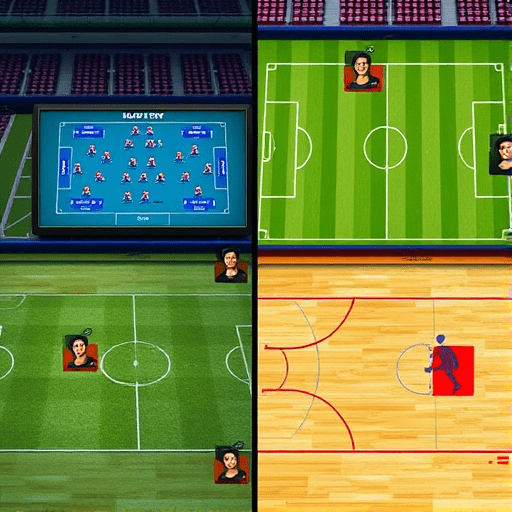
It’s easy to dismiss FIFA and NBA 2K as digital distractions. Yet for anyone curious about how the modern game works, these titles have become surprisingly effective tactical sandboxes. The same stats that pop up after a match, formation clouds, player instructions, and play diagrams, are closer to real scouting reports than most casual players realize. If you want to know how FIFA and NBA 2K games teach real football and basketball tactics, the first step is simple: stop playing them only to win and start reading them like a coach. When approached with intention, virtual stats become real tactical insights that can sharpen your understanding of actual matches.
Read the Game Like a Coach: FIFA’s Tactical Screen Is a Mental Model
FIFA’s pre-match and in-game tactical menu is essentially a compressed real-world scouting report. It shows formation shape, defensive line height, pressing intensity, width, and player roles in a single glance. That same information is what a broadcaster uses to explain why a team is conceding space in midfield or why their fullbacks are continually exposed.
The most useful transferable concept is build-up structure. When a real team plays out from the back, a coach might ask: “Are we trying to draw the opposition press before playing forward?” In FIFA, this is why your team instructions can set the goalkeeper to start short passes, your centre-backs to push wider, and your holding midfielder to drop into the channel. Watching real football with this mindset helps you notice the same patterns: a fullback staying deep to make a back three, or a striker curving a run to open space for a winger.
Player Instructions Mirror Real Football Roles
FIFA allows you to set individual instructions such as “stay forward,” “come back,” “get into the box,” or “cut inside.” These are not just gameplay modifiers. They are descriptions of real tactical assignments. When a modern winger is asked to “stay wide and isolate the fullback,” you see the attack’s shape. When a false nine is told to “drop deep and link play,” you understand why a centre-forward appears so often in midfield during live matches. Read these settings as a glossary of football roles, and match analysis becomes far easier to absorb.
NBA 2K’s Playbook Is a Crash Course in Spacing and Timing
NBA 2K’s playbook mode displays set plays as clean diagrams: circles, lines, screens, cuts, and finishing actions. For anyone learning basketball tactics, that is a gift. The game turns the subtle movement of a real NBA possession into a step-by-step sequence. It forces you to think about space, not just dribbling.
One of the most overlooked teaching tools is the shot feedback system. After a shot, the game tells you whether it was “open,” the quality of the release, and the percentage probability based on pressure and distance. That mirrors real analysis. A corner three after a drive-and-kick is worth more than a contested mid-range jumper, not because of some arcade formula, but because the geometry of the defense determines the real chance of scoring. If you play 2K with the playbook open, you begin to see how a simple horns set creates multiple reads. That same recognition helps when watching a real basketball game: noticing one defender helping off the strong-side corner and understanding exactly why the offense moves the ball to that corner.
Defensive Rotations Become Visual Habits
NBA 2K punishes lazy closeouts and aimless help defense. The game’s timeout menus, defensive matchup settings, and coaching adjustments show that every switch, trap, and rotation has a consequence. When you set “switch all screens” in 2K, you are learning a defensive scheme. When you watch a real team switch on every ball screen, you know why a smaller player sometimes ends up on a center: because the scheme accepts mismatch risk to remove the screen’s initial advantage. That is a tactical insight that comes directly from simulated play, not from a textbook.
Turn Virtual Stats Into Real Tactical Insights With the Right Filters
The easiest way to turn virtual stats into real tactical insights is to compare in-game metrics with real-world performance indicators. FIFA’s post-match stats include possession percentage, pass accuracy, shots from outside the box, tackles, and sprint distance. Real football analysts use similar data with more context: expected goals, progressive passes, final third entries, and pressing triggers. The connection is obvious if you ask better questions.
For example, if FIFA tells you that you lost because you had twenty shots but only two from high-value areas, that is a simplified xG lesson. In a real match, the same issue appears when a team dominates possession but produces low-quality chances. Once you see this in the virtual scoreboard, you start looking at real shot maps instead of just the final score. The game does not give you true analytics, but it teaches you the logic behind them.
NBA 2K’s stats panel offers similar lessons. It tracks fast-break points, points in the paint, second-chance points, and points off turnovers. Those are exactly the categories used in professional basketball breakdowns. If your 2K team keeps losing because opponents score eighteen fast-break points, the tactical lesson is transition defense. Watch any real basketball game with that in mind, and you will notice which guards crash the offensive glass and which ones sprint back for defensive balance.
Spot the Patterns: From Screen to Sideline
Video games condition you to recognize repeated scenarios quickly. In FIFA, the opponent’s centre-back stepping forward triggers a pressing cue. In NBA 2K, a guard going under a screen signals a certain type of defense. Those cues exist in real matches, but they happen faster and with more noise. Playing virtual games helps slow the decision-making process down enough to build recognition memory.
Football: The Three Patterns to Watch
- The high press trigger: When a striker starts curving his run to block a pass to the fullback, the press is coming. In FIFA, this is a visible cue. In real games, it is a tactical wave.
- The overload: If your game plan sends both the left winger and left fullback down the same side, you create numerical superiority. Watch how modern wide teams use triangles to force defenders into impossible choices.
- The low block: FIFA’s “drop back” defensive style teaches you the trade-off: you concede space between the lines but protect the box. Real teams use the same shape when protecting a lead.
Basketball: The Three Reads to Train
- Help movement: After a guard drives to the rim, the nearest defender steps into the paint. In 2K, you see the open shooter on the weak side. In real basketball, that recognition is the difference between a smart rotation and a breakdown.
- Screen navigation: NBA 2K’s on-ball screen defense teaches you to decide: drop, switch, hedge, or go over. Watching real NBA defenses becomes a game of identifying which scheme is being used on every possession.
- Transition math: The game constantly rewards players who sprint back before the rebound even lands. That is not an arcade quirk; that is modern basketball’s obsession with preventing easy advantages.
Use Virtual Tactics as a Hallway Test, Not a Substitute
No video game can fully replicate the chaos of real football or basketball. Fatigue, emotion, and in-game adjustments matter in ways that are impossible to simulate perfectly. But that does not make the tactical knowledge less useful. Treat FIFA and NBA 2K as a hallway test of tactical ideas. You can test a high press in FIFA and then watch a real team press with more understanding. You can observe in 2K how a quick swing pass leads to an open corner three and then notice the same sequence during an actual NBA quarter.
The real magic is in the repetition. Virtual stats give you immediate feedback. You see the result of a bad tactical choice within seconds. Real sports often reveal their lessons in hindsight, after a goal or a run is already over. The games simply make the feedback loop faster.
Conclusion
FIFA and NBA 2K are more than entertainment. They are interactive tactical boards that turn complex concepts into visible patterns. When you read formations, understand spacing, and question the stats your own virtual performance produces, you develop a sharper eye for the real sport. The screen is not a replacement for the pitch or court, but it can be a surprisingly rewarding starting point for anyone who wants to learn football and basketball tactics one possession at a time.