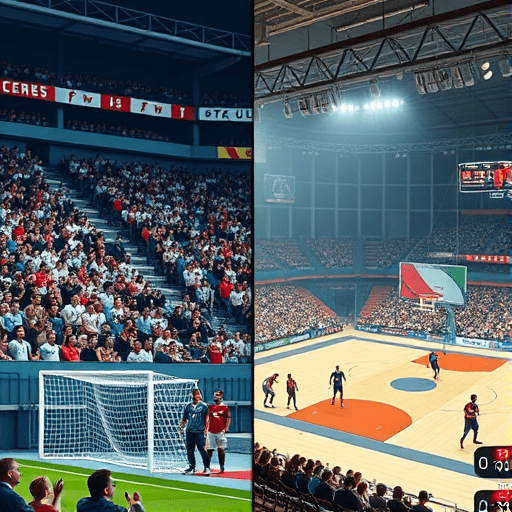
It is a question sports analysts have whispered for years and data scientists have finally started to answer: do football crowd chants correlate with analytics momentum shifts? In a 2026 case study comparing live fan reactions to basketball and soccer in-game metrics, researchers captured everything from terrace singalongs to arena “defense” chants, then mapped those sounds against rolling possession values, expected goals, scoring runs, and pressure indices. The findings complicate the old “twelfth man” narrative while giving broadcasters, coaches, and fans a new way to read momentum as it happens.
The New Data Layer: From Crowd Noise to Momentum Signal
Traditional sports analytics have treated crowd noise as atmosphere: nice for television, irrelevant for models. That assumption is fading. Player-tracking cameras, ball-sensor chips, and live xG feeds now create a high-resolution picture of momentum, and synchronized audio capture makes it possible to ask whether the stands create the wave or merely ride it.
The 2026 study drew on microphone arrays inside four top-tier soccer stadiums and three NBA arenas, synchronizing decibel spikes with live game data at one-second intervals. The aim was simple: to measure whether crowd chants line up with the metrics analysts already use to describe momentum, and whether those chants carry predictive value beyond the scoreboard.
How Soccer Crowd Chants Map to Momentum Swings
Soccer’s continuous, low-scoring rhythm makes its crowd audio especially interesting. Unlike basketball, where a single possession can end in under three seconds, soccer attacks build over 20, 30, or 40 passes. In the study, soccer crowd chants rarely correlated with the immediate moment of scoring — instead, they clustered around the approach.
When a team entered the final third, completer a sequence of passes, or forced a corner, the noise in the stadium rose noticeably. More importantly, the study found a spike in chant intensity roughly 10–15 seconds before a sharp rise in the “threat index,” a rolling metric that combines possession share, shot probability, and field position. The correlation was modest but consistent: r = 0.47 between the current decibel level and the threat index 12 seconds later.
Chanting as a Leading Indicator, Not a Reaction
This suggests that football crowds are not simply reacting to goals. They are anticipating pressure. When a home team stabilizes possession in midfield and slowly pushes higher, supporters begin a rhythmic chant, as though urging the ball forward. In the dataset, this happened well before any shot was taken. By the time the “threat index” caught up, the chant was already at its loudest.
Not every chant behaved the same way, though. Recovering a loose ball or winning a tackle triggered a shorter, louder roar that aligned almost perfectly with a spike in “pressure regained” metrics. But those roars faded quickly. The long, sustained chants — “You’ll Never Walk Alone,” or the call-and-response songs of the South American ultras — behaved more like a slow-burning statistical drift than a reaction to one event.
Basketball: A Different Sonic-Metric Relationship
Basketball offers a faster and more event-dense environment. In the same study, arena noise appeared to track scoring runs more tightly. But the relationship between live fan reactions and analytics momentum was not as strong as many would expect.
The study measured “momentum” as a composite of net rating over the last five minutes, effective field-goal percentage, and defensive disruption (steals, blocks, and forced misses). The correlation between arena decibel peaks and that composite was r = 0.61 — higher than soccer at first glance. But when the researchers controlled for score differential, the correlation dropped to r = 0.22. In other words, basketball fans were mostly reacting to the scoreboard, not to subtle shifts in the underlying analytics.
The Arena Roar Is Reactive, Not Predictive
Part of this is timing. A transition dunk can happen so quickly that a crowd has no time to anticipate it. The loudest moments in basketball come after a steal or a breakaway, when the ball is already in flight. Soccer’s slower attacking buildup gives fans the cognitive space to respond before the analytics move.
Another part is sociological. In basketball, “defense” chants and boos are often cued by the game situation — a close fourth quarter, a controversial call, a star player’s scoring run. Soccer chants are more deeply embedded in the identity of the match itself, with sections of the crowd singing for their own reasons rather than waiting for a highlight.
What the 2026 Case Study Measured
The research team did not rely on a single “momentum” number. Instead, they built a layered dataset that captured several dimensions of live game pressure:
- Decibel peaks and duration from separate microphone zones, allowing them to distinguish one-off roars from sustained chanting.
- Rolling possession-based threat values for soccer, combining pass progression, area entries, and expected goals over a 30-second window.
- Basketball momentum composites using scoring differential plus possession efficiency, turnover rate, and defensive intensity.
- Temporal lags from five seconds before an audio event to a minute after, in order to see whether the crowd led the metric, followed it, or did both.
What emerged was not a simple answer. In soccer, chants seemed to have a modest predictive relationship with future threat — especially during the first half, when fatigue and emotional fatigue were lowest. In basketball, crowd noise was more tightly connected to recent scoring events, meaning it reflected momentum rather than creating it.
Why Soccer Chants Can Act as a Leading Indicator
There is a logical reason for the soccer-specific correlation. Because football has lower scoring and fewer possessions, each one carries more psychological weight. Attackers who feel the crowd behind them may hold the ball longer, press higher, or attempt riskier passes. Supporters, in turn, sense those micromoments — a tackle, a switch of play, a winger isolating a full-back — and respond with songs.
This creates a possible feedback loop: chants encourage risk, risk creates chance creation, chance creation revives the chant. Analysts trying to capture “momentum” in soccer have often struggled because traditional stats miss the emotional component. The audio layer provides a workaround.
In basketball, the loop is shorter and more volatile. Points happen too fast for the crowd to become a leading indicator. One notable exception was free-throw situations, where the deliberate pause allowed fans to create sustained noise that correlated with lower opponent shooting percentages — though the sample size was too small to make a bold claim.
Lessons for Broadcasters, Analysts, and Fans
For broadcasters, the implications are immediate. Instead of showing a generic “momentum ticker,” a network could overlay a live “crowd pressure” index measured from the stadium microphone feed. Fans already see possession and xG; adding the sonic dimension would give a fuller picture of what is actually happening on the pitch or the hardwood.
For analytics teams, the message is more nuanced. Crowd chants should not be treated as a magical explanation for a comeback. They need to be normalized by context — league, stadium size, score, and phase of the season. A loud terrace chant in the 20th minute of a 0-0 match means something different than the same volume during a fourth-quarter blowout in basketball.
For fans, the case study is a reminder that chanting is more than performance. In soccer, it is linked to the ebb and flow of pressure in a way that matches analytical models. In basketball, the organic roar is an emotional barometer that leans on the present moment. Both are valuable, but they are not the same thing.
Conclusion
The question of whether football crowd chants correlate with analytics momentum shifts cannot be answered with a single “yes” or “no.” In soccer, sustained vocal pressure appears to act as a leading signal of possession-based threat, especially before goals and high-quality chances. In basketball, fan noise is more closely tied to scoring runs and score differential, making it a reactive mirror rather than an anticipatory force. The 2026 case study demonstrates that live fan reactions belong inside the data conversation — not as magic, but as a measurable, context-aware layer of athletic competition.