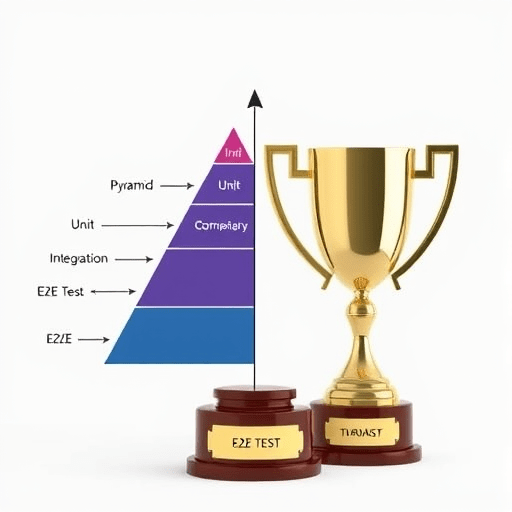
The Test Pyramid vs Testing Trophy debate has never been just about shapes. For engineering leaders and DevOps teams planning a modern test strategy, the real question is which model minimizes pipeline latency while maximizing defect detection — and neither answer is as straightforward as it once seemed. The Test Pyramid has guided teams for nearly two decades, while the Testing Trophy has gained ground among developers who are tired of fragile end-to-end suites. In 2026, with AI-assisted test generation, ephemeral preview environments, and increasingly distributed architectures, the trade-offs between cost, speed, and ROI across unit, integration, and E2E layers deserve a fresh look.
The Test Pyramid in a Cloud-Native Era
Mike Cohn’s Test Pyramid prescribes a wide base of fast unit tests, a middle layer of service-level tests, and a narrow apex of slow UI-driven tests. The underlying principle remains sound: tests that are cheap to write and run should outnumber tests that are expensive and brittle. But the architecture it was designed for has shifted. Microservices, event-driven workflows, and serverless functions have blurred the definition of a “unit.” Is a single Lambda function a unit? Is a Kafka consumer with a database dependency a service test or an integration test?
In 2026, the pyramid’s rigid layers feel increasingly abstract. Teams still need the discipline it enforces, but applying it mechanically to a distributed system often produces a false sense of confidence. A million passing unit tests mean little if the contracts between services are broken, or if the data flow across a distributed transaction is compromised. That is why many teams, particularly those building with API-first or cloud-native patterns, have started looking at the Testing Trophy as a more realistic model for modern pipeline efficiency.
The Testing Trophy: An Integration-First Mindset
Coined by Kent C. Dodds, the Testing Trophy flattens the conversation. It places static analysis and unit tests at the base, elevates integration tests as the largest and most valuable segment, and keeps E2E tests as a small but critical cap. The core argument is that integration tests — tests that exercise multiple modules, services, or layers together — deliver the best return on confidence per unit of speed. For a typical web application in 2026, that means testing React components with their hooks, API routes against a real database, and inter-service communication with lightweight test doubles.
Why Integration Tests Win the Speed Battle
Integration tests sit at the sweet spot of the speed-versus-fidelity curve. A well-written integration test runs in tens or hundreds of milliseconds, far faster than a browser-based E2E test, yet it covers far more real behavior than a mocked unit test. Modern tooling has made this layer more accessible than ever. Testcontainers, database snapshots, and in-memory message brokers allow developers to spin up realistic environments in milliseconds. The trophy shifts the burden of confidence away from the slow, flaky apex and onto tests that can run on every pull request without slowing the feedback loop to a crawl.
But the Trophy Has Blind Spots
The trophy model assumes your most critical risks live in the integration layer. That holds true for many web applications, but it falters for systems where the hard problems lie in UI state management, visual regression, or complex multi-user workflows. In those cases, the small cap of E2E tests at the top of the trophy may not be enough. The best teams treat the trophy not as a replacement for the pyramid, but as a corrective lens that rebalances the ratio toward integration tests and reduces the over-investment in both unit-only mocks and slow E2E suites.
Cost and Speed Across the Three Layers
When comparing test strategies, it helps to quantify the real operational burden. Unit tests remain the cheapest asset in the toolbox. They compile quickly, target a single function or class, and rarely require external dependencies. In 2026, AI-assisted code generation has made writing them faster, but it has also inflated the number of low-value snapshot tests that assert implementation details rather than behavior.
Integration Tests Are Becoming Cheaper
Five years ago, integration tests required heavyweight orchestration. Today, Docker-based test containers and ephemeral cloud databases have cut their setup time dramatically. Cost now lives primarily in maintenance: every schema change, API contract update, or queue topology change forces updates across integration suites. Still, the cost per meaningful assertion is far better than E2E. A pragmatic integration test can validate three or four components and their interactions in under a second.
E2E Tests Are Getting Smarter, Not Necessarily Faster
End-to-end tests remain the slowest and most expensive layer. A suite of fifty E2E tests can easily push a pipeline from five minutes to twenty. The rise of AI-driven selectors and self-healing test scripts in 2026 has reduced flakiness, but it has not eliminated the fundamental cost of spinning up a full browser, navigating a real user flow, and waiting for network responses. The wise approach is to budget E2E tests for revenue-critical journey paths — checkout, authentication, user onboarding — and leave edge cases to lower layers.
ROI: Measuring What Actually Matters in CI/CD
ROI in testing is not just about number of bugs caught. It is about pipeline throughput, developer frustration, and time-to-feedback. A test suite that catches eighty percent of regressions but takes forty minutes to run will be skipped, mocked, or disabled by developers who need to ship. A suite that catches seventy percent but runs in under ten minutes will be run constantly. In 2026, the winning metric is defect detection per pipeline minute, not defect detection per test.
The classic ratio — seventy percent unit, twenty percent service, ten percent UI — no longer holds universal truth. Teams that embrace the trophy mindset often arrive at a distribution closer to twenty percent unit, seventy percent integration, and ten percent E2E. But the exact percentage matters less than the constraint it places on speed. If your entire pipeline, excluding build and deploy, can finish in under fifteen minutes, you have room to adjust the ratio based on risk. If your E2E suite alone consumes the entire budget, the pyramid has become a burden.
A Practical Framework for 2026
Choosing between the Test Pyramid and Testing Trophy should be a decision driven by architecture, risk profile, and developer behavior. For backend-focused systems with significant business logic, the pyramid remains a strong template. You need many fast unit tests to validate domain invariants and business rules. The integration layer matters, but it can be selectively applied to repositories, services, and event handlers.
For frontend-heavy, API-driven applications, the trophy delivers better ROI. The critical behavior lives in the interaction between components, the orchestration of API calls, and the state transitions that occur when a user clicks, types, or drags. Mocking all of that at the unit level produces a suite that tests your test doubles rather than your product. Mounting the full application against a real backend is too slow. The integration layer — rendering a component tree with real state management and calling live endpoints — is where confidence and speed converge.
Adopting a Hybrid Approach
The strongest teams in 2026 are not dogmatic. They start with the trophy’s integration-centric core, then scale the pyramid’s unit-test discipline around critical domain logic. They place a strict cap on E2E tests and protect that cap with a smart stability budget: if an E2E test flakes more than twice in twenty runs, it is quarantined. They also use static analysis to catch trivial errors before the test suite even executes. This hybrid model adapts to the system instead of forcing the system into a predefined shape.
The real move in 2026 is to stop treating the test suite as a single artifact and start treating it as a portfolio. Each layer has a different risk profile, cost structure, and feedback latency. Unit tests protect the small pieces, integration tests protect the connections, and E2E tests protect the promise the user experiences. The question is not which model you choose in the abstract, but how much confidence each layer gives you per second of pipeline time.
As AI-generated tests, ephemeral environments, and contract testing continue to mature, the distinction between the Test Pyramid and Testing Trophy will fade. The winning strategy will be the one that aligns the shape of your test suite with the shape of your system’s risk. Spend where the defects hide, keep the pipeline fast, and let the rest of the ratio take care of itself.