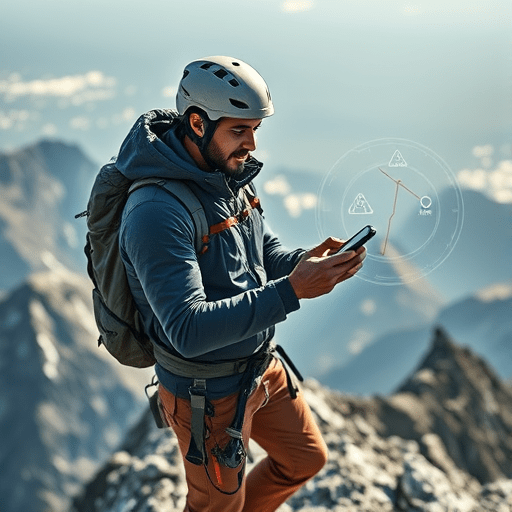
The solo adventurer’s toolkit has always been deceptively simple: a map, a plan, and the willingness to make a call when it matters. But in 2026, that toolkit is expanding. AI risk coaches for extreme sports are emerging as a digital safety net — machine-learning apps that continuously analyze, warn, and sometimes override a solo traveler’s instincts. These intelligent systems don’t just forecast weather anymore. They synthesize data from wearable sensors, satellite imagery, historical accident reports, and real-time environmental feeds to deliver highly personalized risk assessments that would have seemed like science fiction just a few seasons ago.
How Machine-Learning Apps Are Changing Risk Assessment
Traditional risk assessment in extreme sports has been largely static. A climber checks the weather, reviews an avalanche forecast, studies a route topo, and makes a Judgment call based on experience. That process still matters, but it has fundamental blind spots. Human memory is biased, attention is limited, and conditions change faster than a printed forecast can track. Machine-learning apps close those gaps by turning risk assessment into a living, updating process.
Modern risk coach apps are built on models trained on thousands of incident reports and sensor readings. Instead of giving a generic “high risk” warning, they can recognize the specific combination of factors that led to past accidents: a sudden drop in barometric pressure, a specific slope angle in soft snow, elevated heart rate combined with cold-induced hand tremor, or a heliostat reflection pattern that signals glare ice ahead. The result is not a static number, but a dynamic risk score that updates with every new data point.
What a Risk Score Actually Includes
- Environmental conditions: Weather, temperature, wind, solar radiation, and ground conditions from live data streams.
- Route and terrain analysis: Slope angle, exposure, distance to bailout points, and known hazard zones from open geospatial data.
- Biometric state: Heart rate variability, skin temperature, sleep history, and fatigue proxies from a smartwatch or chest strap.
- Equipment telemetry: Ski binding settings, ice screw placement records, airbag canister pressure, or even a kayak’s hull moisture sensor.
- Historical context: Similar past trips by other users, accident reports from analogous routes, and near-miss data that a human would never recall.
From Data Overload to Personalized Danger Signals
The biggest danger with new technology is information fatigue. A solo kayaker cannot stop every five minutes to interpret five charts and four probability graphs. This is why the best AI risk coaches are not data dashboards; they are translators. They take the raw complexity of hundreds of variables and reduce it to something a tired, cold, anxious brain can actually use: a simple alert, a threshold crossing, or a suggested route adjustment.
For example, a trail runner on a remote ridgeline might receive a notification that the probability of lightning within the next 20 minutes has jumped from 8% to 42%, based on an atmospheric electric field measurement and a moving cumulonimbus cell. The app says, “Exit the exposed ridge now. There is still time to reach the treeline.” That advice is grounded in a model that learned from previous lightning-related incidents, not just a generic radar image.
In another scenario, a solo alpinist on a technical mixed climb might get a different kind of warning: “Your reaction time is 18% slower than your baseline, and your last two gear placements took significantly longer than normal. Consider bailing before the crux.” This is biometric risk assessment combined with performance analytics.
A Second Set of Eyes for Solo Adventurers
For most extreme sports enthusiasts, going solo is not about ignoring risk. It is about taking full ownership of it. There is no partner to notice early signs of hypothermia, no mentor to say “this is not your day,” and no guide to veto a bad line. That freedom is deeply valuable. It also makes solo adventurers especially vulnerable to cognitive biases — overconfidence, sunk-cost thinking, and goal fixation. An AI risk coach is not a wilderness expert in your pocket. It is more like a tireless, unbiased observer that has no ego and no reason to push forward.
That kind of neutral voice matters most in the moments that matter most. When an athlete has spent hours moving toward a summit, the brain tends to underestimate new hazards and overestimate the cost of turning back. Machine-learning models are immune to that. They can mathematically weigh the likely consequences of continuing versus retreating, using data from thousands of similar trips.
Use Cases in the Growing Solo Community
- Backcountry skiers receive slope-specific avalanche warnings that combine current snowpack data with their exact path and speed.
- Solo open-water swimmers get real-time current drift and cold-water shock risk estimates, along with a recommended swim path that adapts to changing tides.
- Big-wall climbers have their climbing pace and fatigue levels monitored to detect the early onset of unsafe decision-making.
- Long-distance runners and bikepackers are rerouted dynamically around weather hazards, landslide-prone sections, or dangerous animal activity.
The Limits of Machine Judgment in the Backcountry
It is tempting to think of an AI risk coach as an infallible safety net, but that would be a dangerous misunderstanding. Machine-learning models are probabilistic, not perfect. They are trained on data that is always incomplete, and they can miss rare but catastrophic events that do not resemble past patterns. A flash flood from an upstream dam break, an unusual rockfall from a seismic tremor, or a fast-moving wildfire generated by an unexpected wind shift can all bypass a model’s understanding of normal conditions.
There is also the real problem of false confidence. An adventurer who sees a low risk score on an app might ignore the very human signals of unease, or take a shortcut because the algorithm says the conditions are favorable. The most effective AI risk coaches are designed to prevent this. They present risk as a range, not a certainty, and they deliberately include language that encourages the athlete to check their own experience and intuition. They are decision-support tools, not decision-makers.
Overreliance Is a Risk Factor
Researchers who study outdoor accidents increasingly point to “automation bias” as a growing concern. When a person trusts a recommendation too much, they can stop gathering their own sensory information. The solution is not to make AI risk coaches less accurate. It is to design them with friction, like requiring a user to explain a route choice before the app will clear a warning, or prompting a self-check on how they feel physically and emotionally before overriding a recommendation.
The Future of Risk Coaching: Offline, On-Device, and Unobtrusive
One of the biggest complaints about current AI risk coach apps is their dependence on cellular connectivity. A deep canyon, a remote icefield, or a stormy ridge can easily remove that safety net exactly when it is needed most. The next generation of machine-learning risk coaching is moving away from cloud-only architecture and toward edge computing. Newer phones and wearable devices are already capable of running compressed neural networks on-device, which means a solo adventurer can get real-time risk analysis in the middle of nowhere without sending any data to a server.
This shift has another benefit: privacy. Solo travelers often do not want their location, vital signs, and route decisions stored in a company database. On-device models keep all of that personal information local. Only the most serious anomalies — an emergency alert, a sudden drop in heart rate, a crash detection — would trigger a satellite communication link to rescue services.
Another promising trend is collective learning without explicit data sharing. Federated learning allows different adventurers’ devices to improve a shared failure-detection model without uploading their raw tracks or biometrics. The system learns from the collective experience of many trips while keeping individual journeys private. That means the safety net becomes smarter over time without becoming more intrusive.
Designing for the Human in the Loop
The next wave of AI risk coaches will not try to replace human judgment. Instead, they will work with it. They will ask questions before an expedition, confirm choices during a risky section, and debrief afterward to help adventurers understand what they missed and what they did well. The best machine-learning app is not the one that makes all decisions for you. It is the one that helps you become a better judge of risk yourself.
The emergence of AI risk coaches for extreme sports is not about removing danger from adventure. Danger is a necessary ingredient in solo pursuit. It is about making that danger more legible, more manageable, and more personal. The machine-learning apps changing risk assessment today are not replacing the human spirit of exploration; they are protecting it. They offer a new kind of safety net — one that does not try to keep you from falling, but gently reminds you when the path ahead is no longer worth the risk.