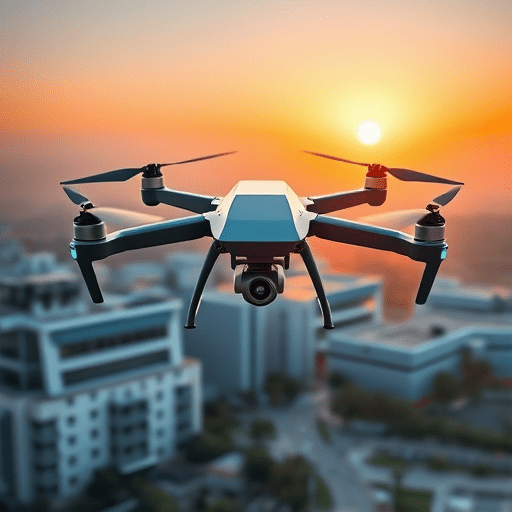
The term Quantum Swarm Intelligence captures a near-future vision where quantum-enhanced computation helps fleets of drones and autonomous vehicles coordinate, route, and make collective decisions faster and more robustly than classical methods alone. In this article, the potential roles of near-term quantum processors (NISQ-era machines and quantum annealers) are examined through practical architectures, algorithmic primitives, concrete use cases, and the engineering trade-offs required to bring quantum-assisted swarm control into the field.
What is Quantum Swarm Intelligence?
Quantum Swarm Intelligence blends two ideas: swarm intelligence—the distributed algorithms that let many agents act like a single adaptive organism—and quantum computing, which offers new ways to explore large combinatorial spaces, sample complex probability distributions, and solve certain optimization problems more efficiently. For real-time fleets, the promise is not to replace classical control but to augment specific bottlenecks such as dynamic routing, task assignment, and probabilistic consensus with quantum subroutines that can produce high-quality solutions under tight time budgets.
Why near-term quantum processors matter
Fully error-corrected quantum computers remain years away, but near-term quantum processors can already be useful when paired with classical systems. These devices excel at particular tasks relevant to swarms:
- Combinatorial optimization: Quantum annealers and variational algorithms (e.g., QAOA) can explore many candidate assignments for routing and task allocation in parallel-like ways.
- Sampling and uncertainty: Quantum devices can produce samples from complex distributions that help with probabilistic belief propagation and robust decision-making under uncertainty.
- Rapid reconfiguration: When the environment changes—blocked roads, no-fly zones, or sudden demand spikes—quantum-enhanced solvers may yield better near-optimal reassignments within tight latency windows.
Practical architectures for quantum-assisted swarms
Hardware constraints mean quantum processors will initially be co-processors rather than stand-alone controllers. Several practical architectures are immediately plausible:
- Edge-cloud hybrid: Low-latency classical controllers at the edge orchestrate vehicles while delegating hard optimization subproblems to nearby quantum cloud instances.
- Ground-station quantum co-processor: Mobile fleets communicate with a dedicated ground hub containing a quantum annealer or gate-based device; latency is acceptable for minutes-to-seconds re-planning tasks.
- Quantum-inspired accelerators: Classical hardware running quantum-inspired algorithms (e.g., simulated annealing with quantum-inspired heuristics) provides many benefits today and smooths the path toward full quantum integration.
Key algorithmic building blocks
Several algorithms are particularly relevant for quantum swarm tasks:
- QAOA and variational circuits: For assignment and routing objectives with complex constraints, parameterized circuits tuned by classical optimizers can find strong candidate solutions quickly.
- Quantum annealing: Good for weighted matching, k-server problems, and vehicle routing problem (VRP) instances mapped to Ising models.
- Quantum sampling: Producing diverse high-quality samples enables robust multi-hypothesis tracking and stochastic consensus among agents.
- Amplitude amplification / Grover-like routines: In niche scenarios these can speed up search-like operations when structured oracles are available.
Concrete use cases
1. Dynamic multi-vehicle routing and rebalancing
Urban delivery fleets and ride-hailing networks constantly solve VRP-like problems with time windows and stochastic demand. Offloading rebalancing subproblems—e.g., assigning idle vehicles to predicted demand hotspots—to a quantum co-processor can produce better redistributions under strict time budgets, reducing empty miles and wait times.
2. Coordinated drone swarms for inspection and disaster response
In disaster zones, teams of UAVs must cover prioritized areas while avoiding collisions and preserving battery life. Quantum-enhanced sampling can quickly generate diversified coverage plans that collectively maximize information gain, enabling resilient coverage when parts of the swarm fail or communications degrade.
3. Real-time traffic-level decision making for autonomous vehicles
Platoons and urban AV fleets can use quantum-assisted solvers to optimize intersection scheduling and lane-change coordination across many agents, smoothing flows and reducing stop-and-go behaviors during brief re-planning intervals.
Integration challenges and mitigation strategies
Practical deployment will require addressing limitations of near-term quantum hardware:
- Noisy, small-scale devices: Current qubit counts and high error rates limit problem sizes; mitigation: hybrid decomposition—solve a global plan classically and use quantum subroutines for the hardest subproblems.
- Latency and connectivity: Cloud-based quantum access introduces round-trip delay; mitigation: cache candidate solutions at the edge and use asynchronous updates, reserving quantum calls for tasks with loose sub-second requirements.
- Mapping and embedding overhead: Translating real-world constraints to device-native representations costs time; mitigation: precompiled embeddings for common problem templates and adaptive heuristics to reduce encoding overhead.
- Explainability and safety: Stochastic quantum outputs need verification; mitigation: always validate quantum recommendations with safety-aware classical checks and fallback controllers.
Roadmap to deployment
A realistic rollout path emphasizes incremental impact, rigorous testing, and clear performance baselines:
- Phase 1 — Quantum-inspired integration: Use classical quantum-inspired solvers in simulations to identify high-impact problem kernels.
- Phase 2 — Hybrid pilot: Run co-processor pilots in controlled environments (industrial campuses, test corridors); measure latency, solution quality, and failure modes.
- Phase 3 — Operational augmentation: Integrate quantum calls into production pipelines for non-safety-critical planning, gradually expanding scope as hardware and orchestration mature.
Business and societal considerations
Beyond technical readiness, operators must weigh cost, reliability, and regulatory factors. Quantum access models (on-prem vs. cloud) influence capital and operational costs, while public safety regulators will require deterministic safety envelopes around any quantum-assisted control decisions. Carefully designed human-in-the-loop and explainable fallback mechanisms ease certification and public acceptance.
Final thoughts
Quantum Swarm Intelligence is not a single silver-bullet technology but a new computational layer that, when applied judiciously, can materially improve how fleets of autonomous agents coordinate and adapt in real time. Near-term quantum processors will be most useful as targeted accelerators for high-value subproblems—combinatorial assignments, rapid sampling, and diversified plan generation—deployed within hybrid classical-quantum architectures that prioritize safety, latency, and interpretability.
Conclusion: With careful engineering and staged deployment, quantum-enhanced swarms could reduce response times, improve resource utilization, and enable new collective behaviors that are infeasible with classical compute alone.
Ready to explore how Quantum Swarm Intelligence can fit into your autonomous fleet roadmap? Contact a quantum-integration specialist to run a tailored pilot.