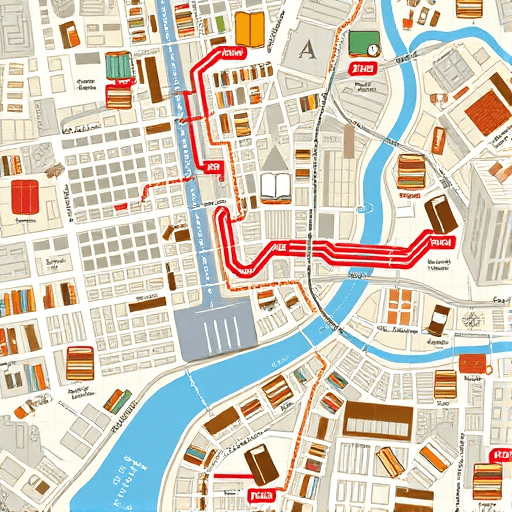
Mapping New York’s hidden underground libraries with free GIS may sound like a niche hobby, but it’s a surprisingly accessible way for tech‑savvy hobbyists to explore the city’s secret cultural heritage. This tutorial walks you through the basics of QGIS and OpenStreetMap, showing how to locate, verify, and visualize underground library sites in Manhattan and Brooklyn without spending a dime.
1. Why Map Hidden Libraries?
Underground libraries—whether abandoned subways, repurposed basements, or secret tunnels—hold unique stories that enrich New York’s cultural tapestry. Mapping them offers:
- A visual record of forgotten knowledge hubs.
- Data that can inform urban planners, historians, and preservationists.
- An engaging project that blends GIS skills with investigative research.
2. Essential Tools and Data Sources
Before you start, download these free resources:
- QGIS – an open‑source GIS desktop application (latest stable release).
- OpenStreetMap (OSM) Data – free map layers for streets, buildings, and underground utilities.
- NYC Open Data Portal – public datasets on building footprints, subway stations, and historical landmarks.
- Google Earth or Bing Maps (optional) – for visual reference, though not required.
Additionally, browse local archives such as the New York Public Library Digital Collections and the NYC Historical Society for photographs and documents that hint at hidden library sites.
3. Setting Up Your GIS Project
Open QGIS and start a new project. Save it with a descriptive name, such as NYC_Underground_Libraries.qgz. Set the project CRS to EPSG:2263 (NAD83 / New York Long Island) to match most NYC datasets.
3.1 Add Base Layers
- In the Layers panel, click Data Source Manager.
- Select OpenStreetMap under Vector and add the default layer.
- Next, add the NYC Building Footprints shapefile from the NYC Open Data portal.
- Use the Style tab to color buildings in a subtle gray so they don’t overpower other features.
3.2 Create a Working Layer for Underground Sites
Right‑click the project name, choose Create Layer → New Shapefile Layer, set the geometry type to Point, and add fields such as site_name, status, and description. Save this layer as Underground_Libraries.shp.
4. Importing and Visualizing Data
For initial hypotheses, import known underground library locations from reputable sources:
- Manhattan’s Library of Congress’ Rare Books Collection sometimes references underground reading rooms.
- The Brooklyn Public Library archive lists a disused basement reading hall.
- Community forums like Reddit r/NYC occasionally share personal discoveries.
Drag each CSV into QGIS, join them to your Underground_Libraries layer using the Join tool, and verify the coordinates. If a dataset lacks coordinates, geocode using the MMQGIS → Geocoding plugin by entering the street address.
4.1 Styling Your Points
Open the Properties → Symbology for your points. Use a bold icon—perhaps a small stack of books or a keyhole—colored in a deep blue to contrast with the base map. Enable labels displaying site_name and set a font size of 10pt for readability.
5. Identifying Potential Library Sites
Hidden libraries often appear where old transit lines, storage basements, or repurposed warehouses intersect. Use the following workflow:
- Overlay Subterranean Infrastructure: Add the NYC Underground Utility Map from the Open Data portal. Highlight sections of the former NYC Subway System that are no longer active.
- Search for Historical Building Footprints: Filter buildings built before 1920 with Isolated status tags. These structures are more likely to have underground spaces.
- Apply a Heatmap: Use QGIS’s Heatmap (Kernel Density Estimation) to identify clusters of potential underground features, focusing on high-density areas for field verification.
Mark provisional sites on your Underground_Libraries layer by adding a new point and filling the status field with Potential. Keep detailed notes in the description field for later research.
6. Validating Locations on the Ground
After narrowing down candidates, field verification is essential. Assemble a small team of volunteers and plan a walk‑through:
- Use a handheld GPS or the GPS Tracker plugin in QGIS to record the exact location.
- Photograph entrance markers, signage, or structural clues that suggest an underground space.
- Interview local residents or historians for oral histories that may confirm the library’s existence.
Update your GIS layer with a new field verified and set it to True for confirmed sites. Include a verification_date for record‑keeping.
7. Enhancing Your Map with Themes
Once verified, you can create thematic layers that add context:
7.1 Historical Context Layer
Overlay the NYC Historical Landmarks shapefile and symbolize landmarks that are within 200 meters of a confirmed library. This helps viewers understand the library’s cultural significance.
7.2 Accessibility Layer
Mark the nearest public transit stops and wheelchair access points to indicate how visitors can reach the underground library. Use distinct icons (e.g., a train symbol and a wheelchair symbol).
7.3 Story Map Elements
Use the Print Layout to create a storyboard. Add callouts with images, quotes, and interesting facts. Export this as a PDF or interactive web map using QGIS’s qgis2web plugin.
8. Sharing and Collaborating
Open source communities thrive on collaboration. Consider the following steps to share your findings:
- Publish the vector data on the OpenStreetMap platform, using appropriate tags like
subway:underground_library. - Upload the project file to GitHub or GitLab with a detailed README.
- Create a basic web map using Leaflet or Mapbox GL JS to showcase the sites to a broader audience.
When contributing to OSM, follow the community guidelines and provide evidence for each claim—photos, citations, and field notes.
9. Future Directions
Mapping hidden underground libraries is just the beginning. Expand the project by:
- Integrating LiDAR data to detect subtle elevation changes that could reveal subterranean passages.
- Using Machine Learning to analyze street-level imagery for hidden entrances.
- Collaborating with local universities for archaeological surveys and preservation plans.
Such multidisciplinary approaches will deepen our understanding of the city’s hidden literary culture and protect it for future generations.
Conclusion
By combining free GIS software, public datasets, and community knowledge, anyone can uncover and document New York City’s secret underground libraries. This beginner’s guide offers a practical roadmap—from setting up QGIS to field validation and sharing—making the mystery of hidden reading rooms accessible to tech‑aware explorers.