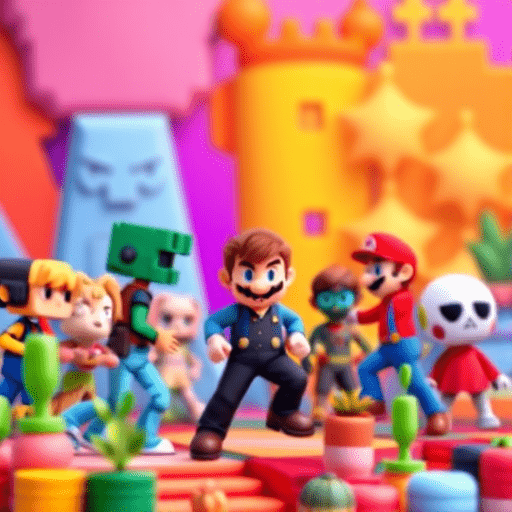
Retro pixel art has reclaimed a spotlight in mobile game design, offering nostalgia, charm, and a distinctive visual language. Yet marrying this style with modern touch interfaces on iOS and Android presents a unique challenge: keeping the crisp pixel fidelity while ensuring the UI remains responsive and legible across devices. This guide walks you through practical, device‑agnostic techniques— from canvas selection to texture atlas construction— that let you maintain pixel integrity without compromising usability.
1. Understand the Core Challenge
Mobile screens vary from 320 px to 1440 px wide, and pixel density ranges from 1× to 6×. If a pixel sprite designed for a 64×64 grid is stretched to fit a 1080×1920 screen, the edges soften, and UI elements can become misaligned. The goal is to treat pixel art like a modular unit: scale the entire canvas uniformly, avoid fractional pixels, and separate UI from gameplay art. This mindset keeps your game looking intentional rather than like a rushed, stretched template.
2. Choose the Right Canvas and Resolution
Start by defining a base resolution that matches your sprite grid—most developers choose 256×256 or 512×512 pixel canvases for simplicity. Use this base for all artwork, including UI icons. Create a pixel‑perfect layer for each sprite, ensuring the grid aligns with the pixel dimensions. When exporting, set the export resolution to a multiple of the base (e.g., 512×512 ×2 = 1024×1024) to maintain sharpness on high‑DPI screens. Avoid scaling individual sprites; instead, let the engine handle scaling of the entire layer.
3. Design Pixel Assets That Scale
When crafting your art, keep in mind how it will transform across resolutions:
- Edge Padding: Add a one‑pixel transparent border around each sprite. This prevents aliasing when the sprite is enlarged.
- Consistent Grid: Maintain the same number of tiles per screen on all devices. If you choose a 20×20 grid for a 512×512 canvas, the same grid fits on a 1024×1024 canvas without distortion.
- Icon Variants: For UI icons, produce two sets: a base 32×32 pixel version and a scaled 64×64 version. The engine will pick the appropriate size based on screen density.
4. Use Vector Overlay for UI Elements
While the gameplay area remains pixel art, the UI should be vector‑based or high‑resolution bitmap. This separation ensures that UI elements such as buttons, health bars, and menus scale smoothly. Implement a UI canvas that sits above the game canvas and uses scalable vector graphics (SVG) or high‑DPI bitmaps. Align UI controls to the same pixel grid as the game world; this keeps interactions consistent and prevents misalignment on different device sizes.
5. Implement Dynamic Texture Atlases
Texture atlases bundle multiple sprites into a single image file, reducing draw calls and improving performance. Create atlases at multiple resolutions (e.g., 1×, 2×, 4×) and let the engine load the appropriate atlas based on the device’s pixel density. Keep each sprite’s UV coordinates aligned to the pixel grid, and avoid padding that could cause bleeding when textures are sampled. Use tools like TexturePacker or Unity’s Sprite Atlas system, which support pixel art modes that disable smoothing.
When building the atlas, set the texture filtering mode to Point (no interpolation). This guarantees that the pixels remain crisp, regardless of scaling. If your engine supports Pixel Perfect Camera components (as Unity does), enable them to lock the world to the pixel grid automatically.
6. Smooth Touch Interactions with Pixel Precision
Touchscreens introduce another layer of complexity. The touch input should map accurately to the pixel grid. Implement a hitbox system that rounds touch coordinates to the nearest pixel grid coordinate. For example, if a sprite occupies grid cell (5,7), any touch within that cell should trigger the sprite, even if the touch is slightly off due to finger jitter. Consider adding a small tolerance (e.g., ±0.5 pixels) to improve responsiveness without compromising precision.
7. Test Across Devices Early and Often
Deploy a device matrix that covers a representative set of iOS and Android devices: iPhone SE (1×), iPhone 13 (3×), Galaxy S21 (4×), and Pixel 5 (3×). Use automated screenshot comparison tools to detect visual anomalies such as pixel bleeding, UI misalignment, or font truncation. Integrate a regression test that compares the rendered UI against a reference grid overlay. Early detection prevents costly redesigns later in the development cycle.
8. Common Pitfalls and Fixes
Pixel Bleeding: Occurs when texture filtering mixes pixels across atlas boundaries. Fix by ensuring sprites are tightly packed with a one‑pixel padding border and disabling filtering.
UI Stretching: Happens when the UI canvas is not anchored to the pixel grid. Resolve by setting anchors to full-screen and using a scaling mode that preserves aspect ratio.
Inconsistent Font Sizes: Small fonts become unreadable on high‑DPI screens. Use scalable font systems (e.g., bitmap fonts with multiple resolutions) and test legibility on each target device.
Performance Bottlenecks: Large atlases can increase memory usage. Mitigate by splitting atlases by scene or by using dynamic atlas updates that load only necessary sprites.
9. Wrap Up
Integrating retro pixel art into modern mobile games while preserving UI integrity is a balancing act that requires careful planning, precise asset management, and rigorous testing. By selecting a solid base canvas, separating UI from gameplay art, using vector overlays, building multi‑resolution texture atlases, and fine‑tuning touch interactions, you can deliver a polished, nostalgic experience that scales gracefully across iOS and Android devices.