Holographic Gaming: Redefining Immersion with 3D Displays
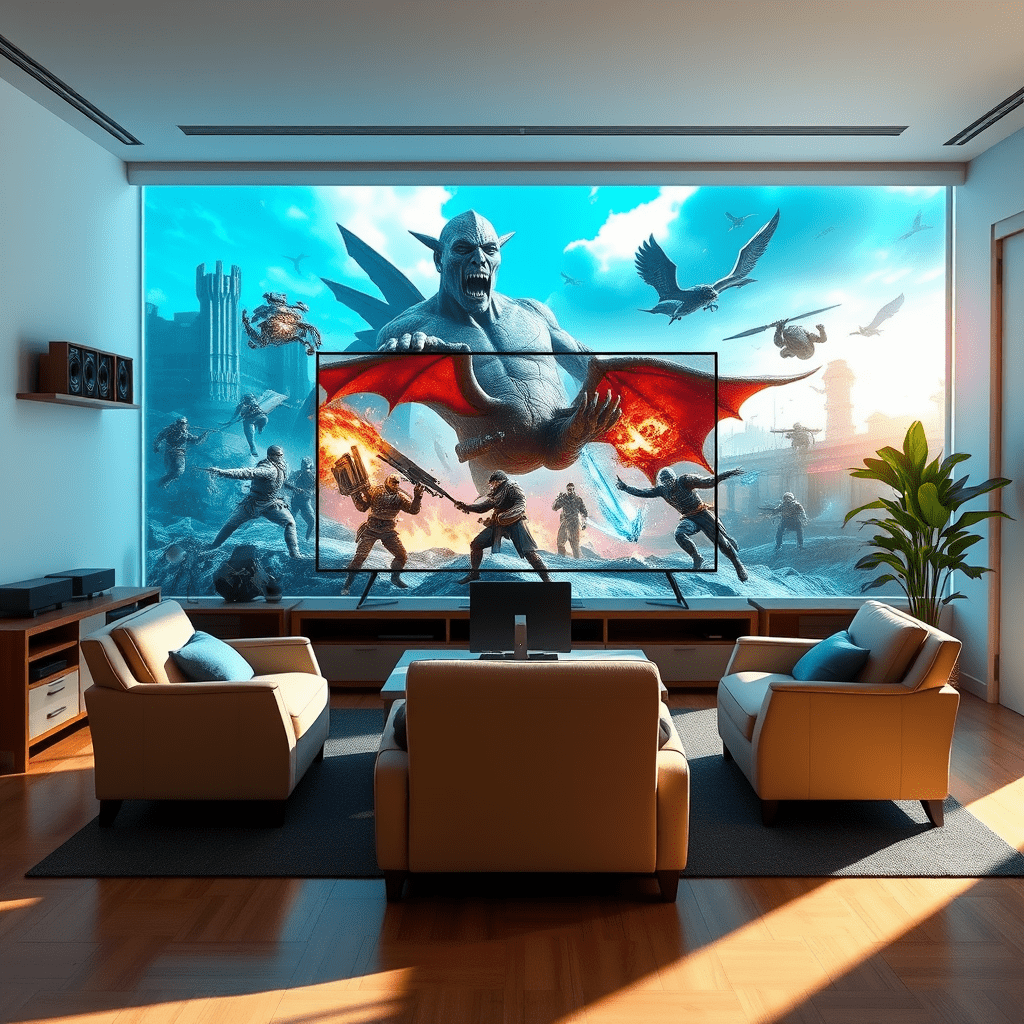
Holographic gaming is rapidly moving from speculative future tech to tangible consumer experiences. By projecting volumetric images that you can walk around and interact with, 3D displays are turning the screen into a physical space. This article explores the core technology powering holographic gaming, highlights the first consumer‑ready systems, and examines the challenges that still need to be overcome before the next generation of immersive play becomes mainstream.
The Core Technology Behind Holographic Gaming
Light Field Displays
Light field displays replicate the way light rays travel through space, allowing viewers to see different angles without switching lenses. The key is to render a dense grid of light rays from each pixel, which is achieved using micro‑lenses or spatial light modulators. This technology gives the illusion of depth and motion parallax, making objects appear solid even though they exist only in light. For gamers, this means you can tilt your head or move side‑to‑side and still perceive the same scene, creating a true 360° experience.
Volumetric Projection
Volumetric projection uses a physical or virtual “volume” where a 3D shape can be displayed. Techniques such as laser‑scanning, holographic plates, or even rotating mirrors generate light patterns that intersect at precise points. The resulting brightness is highest where the rays converge, making the object visible from multiple viewpoints. Because the image is not confined to a flat surface, players can interact with it from any angle, turning a simple game mechanic into a physically engaging event.
Spatial Light Modulators (SLMs)
SLMs, often called “digital micromirror devices” (DMDs), manipulate light at the pixel level. Each tiny mirror can tilt at millions of micro‑second intervals to reflect light in specific directions. By synchronizing these mirrors with a high‑speed projector, developers can create dynamic holograms that react to in‑game events. Coupled with a tracking system, SLMs enable real‑time interaction, such as grabbing an object or deflecting a virtual projectile, which is essential for a compelling holographic gameplay loop.
Consumer‑Ready Systems That Are Changing the Game
The Vivid Q2: A Portable Holographic Experience
The Vivid Q2 brings holographic displays to the living room. Its dual‑screen setup projects a 3D hologram into a defined space, while an integrated depth camera tracks the player’s movements. Key features include:
- High‑resolution light field projection (4K equivalent)
- Adaptive brightness up to 2000 lumens for daylight use
- Seamless Bluetooth connectivity with smartphones and PCs
- Pre‑loaded library of action, racing, and puzzle titles
- Compact footprint (35 cm × 20 cm × 15 cm)
With the Q2, gamers can jump straight into an immersive world without a headset, and the system’s portability means you can bring the hologram to any table or countertop.
NVIDIA’s Lattice: The Future of Cloud‑Based Holography
NVIDIA’s Lattice is a cloud‑centric solution that offloads rendering to powerful GPUs in the data center. The device then projects the final image onto a translucent screen, while AR glasses provide depth cues. The architecture boasts:
- Real‑time ray‑tracing at 8K resolution
- Ultra‑low latency (< 20 ms) through dedicated edge nodes
- AI‑driven upscaling to maintain sharpness on lower‑end hardware
- Cross‑platform support: Windows, Linux, and mobile
- Integrated voice and gesture controls via NVIDIA Omniverse
Lattice exemplifies how cloud computing can democratize holographic gaming, allowing even modest hardware setups to experience cinematic quality.
Microsoft HoloLens 3: Bridging Virtual and Physical Worlds
Microsoft’s HoloLens 3 extends beyond gaming into mixed‑reality productivity. Its new retinal tracking, advanced eye‑sensing, and hand‑tracking technologies make it ideal for both entertainment and collaboration. Highlights include:
- True 3D holographic rendering with a 52° field of view
- Integrated mixed‑reality audio for spatial sound immersion
- Dynamic hologram scaling based on user distance
- Seamless integration with Xbox Cloud Gaming for cross‑play
- Developer toolkit with Unity and Unreal Engine support
By blending game worlds with real environments, HoloLens 3 enables experiences such as “Battlefield in Your Backyard” or “Fantasy Sports on the Playground,” giving players unprecedented freedom.
Challenges That Still Hurdle Widespread Adoption
Display Resolution and Brightness
Holographic displays must project millions of light rays simultaneously, which requires advanced optics and high power consumption. Current consumer devices often compromise on resolution or brightness to stay affordable and portable. The trade‑off can lead to less crisp visuals, especially in high‑contrast scenarios, limiting the realism that gamers crave.
Latency and Real‑Time Interaction
Interaction fidelity hinges on low latency. Even a 30 ms delay between a player’s motion and the hologram’s response can break immersion. Achieving sub‑20 ms latency across the entire pipeline—from tracking sensors to rendering engines—remains a technical hurdle, particularly for cloud‑based systems where network jitter can be unpredictable.
Content Creation and Software Ecosystem
Developing for holographic platforms is currently niche. Existing game engines require significant modifications to handle volumetric rendering, depth sensing, and multi‑view outputs. Additionally, there is a scarcity of tools for artists to create 3D assets optimized for light field projection, meaning the content pipeline lags behind the hardware capabilities.
The Future Landscape of Holographic Gaming
As hardware matures, we can anticipate three major convergences: artificial intelligence, edge computing, and ubiquitous sensor networks. AI will streamline asset creation and real‑time adaptation, making it easier to generate high‑fidelity holograms on demand. Edge computing will reduce latency by processing data locally, while sensor networks will provide richer environmental context for mixed‑reality experiences. Together, these advances will usher in an era where holographic gaming is not just a novelty but a mainstream form of entertainment.
Beyond games, the same technology promises transformative applications in education, training, and design. Imagine a medical student interacting with a 3D hologram of a heart during a lesson, or architects walking through a virtual prototype in real space. The boundary between digital and physical will blur, creating new opportunities for both creators and players.
Conclusion
Holographic gaming is already reshaping the way we think about immersion, blending depth, interactivity, and realism into a single experience. While significant challenges remain—particularly in resolution, latency, and content creation—consumer‑ready systems like the Vivid Q2, NVIDIA Lattice, and Microsoft HoloLens 3 are proof that the technology is viable today. As AI, edge computing, and sensor networks mature, the next wave of holographic games will likely become as ubiquitous and compelling as console titles are today.
Explore the next dimension of play and stay tuned for the latest holographic gaming breakthroughs.