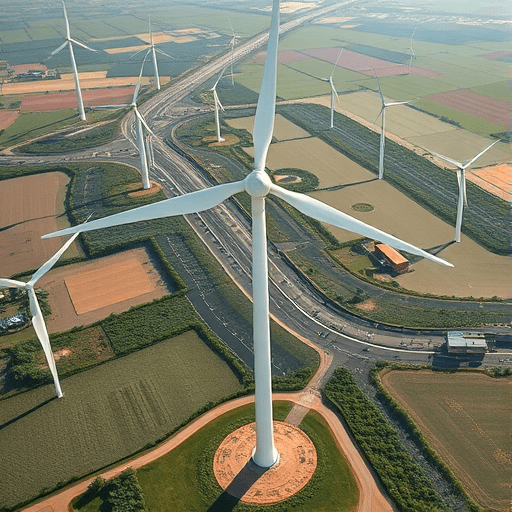
Wind turbine operators constantly balance the cost of downtime against the desire for maximum energy yield. In 2026, AI-driven predictive maintenance has become the key differentiator, enabling real-time turbine health monitoring that anticipates failures before they happen. By leveraging machine learning (ML) models trained on vast sensor datasets, operators can schedule maintenance proactively, reduce unplanned outages, and extend component life—all while keeping operating costs in check.
1. Understanding Predictive Maintenance in Wind Turbines
Predictive maintenance (PdM) shifts maintenance from a reactive or scheduled basis to a data-informed approach. In the context of wind turbines, PdM typically focuses on the blade, gearbox, pitch system, and generator—components that are expensive to replace and critical for uptime. The goal is to forecast degradation or failure events, enabling interventions that minimize energy loss and repair costs.
2. Why AI and ML Matter for Turbine Health Monitoring
- Complex Interactions: Turbines operate in dynamic environments, where wind speed, temperature, and mechanical loads interact in non-linear ways.
- Data Volume: Modern turbines generate terabytes of data daily from accelerometers, strain gauges, thermocouples, and acoustic sensors.
- Real-Time Decision-Making: AI models can process streaming data on the edge or in the cloud, delivering actionable insights within seconds.
- Continuous Improvement: As more data accumulate, models self-improve, capturing subtle degradation patterns that rule-based systems miss.
3. Step 1: Define Objectives & Key Performance Indicators
Before any code is written, clarify what success looks like. Typical objectives include:
- Reduce unplanned downtime by 20%.
- Increase energy capture by 3–5%.
- Extend gearbox life by 15%.
- Achieve 95% accuracy in fault classification.
Align these goals with your finance and operations teams, ensuring that KPIs are measurable and tied to business outcomes.
4. Step 2: Data Collection & Integration
4.1 Sensor Landscape
Typical turbine sensor arrays include:
- Accelerometers (vibration)
- Strain gauges (blade flex)
- Thermocouples (gearbox & generator temperature)
- Pressure transducers (hydraulic systems)
- Acoustic sensors (blade aerodynamics)
4.2 Data Pipelines
Choose between edge and cloud architectures:
- Edge: On-site gateways preprocess data, perform lightweight inference, and flag anomalies locally.
- Cloud: Central servers ingest high-resolution data, run heavy models, and store long-term analytics.
Implement a robust time-series database (e.g., InfluxDB, TimescaleDB) to handle continuous streams. Use MQTT or Kafka for real-time messaging, ensuring low-latency transmission to downstream services.
4.3 Data Quality & Governance
Establish protocols for:
- Missing data handling (interpolation, imputation)
- Timestamp synchronization (NTP alignment)
- Data retention policies (e.g., keep 5 years of raw data, 1 year of processed features)
- Security controls (encryption in transit and at rest, role-based access)
5. Step 3: Data Preprocessing & Feature Engineering
Raw sensor outputs must be transformed into actionable features before feeding them to ML models.
- Statistical Features: Mean, standard deviation, kurtosis, skewness over sliding windows.
- Frequency Domain: FFT, spectral energy, band power metrics.
- Domain-Specific Indicators: Gear mesh vibration patterns, blade twist rates.
- Temporal Features: Time since last maintenance, cumulative operational hours.
Normalize features using z-scores or min–max scaling, and encode categorical variables (e.g., turbine model, site location) with one-hot or embedding techniques.
6. Step 4: Model Selection & Training
6.1 Model Types
- Regression: Predict remaining useful life (RUL) for components.
- Classification: Detect fault types (e.g., bearing wear, blade erosion).
- Time-Series Forecasting: Prophet, LSTM, Temporal Convolutional Networks for future degradation trajectories.
6.2 Training Workflow
- Split data into training (70%), validation (15%), and test (15%) sets, ensuring no leakage across time.
- Use cross-validation with rolling windows to capture temporal dependencies.
- Employ hyperparameter optimization (Optuna, Ray Tune) to fine-tune model complexity.
- Evaluate with domain-relevant metrics: MAE for RUL, F1-score for classification, and prediction intervals for uncertainty.
Incorporate explainability tools (SHAP, LIME) to surface feature importance, aiding technician trust and regulatory compliance.
7. Step 5: Deployment Architecture
7.1 Edge Inference Layer
Deploy lightweight models (e.g., TensorFlow Lite, ONNX Runtime) on turbine gateways. These can flag anomalies locally, reducing data traffic and enabling immediate action (e.g., slowing down the turbine).
7.2 Cloud Inference & Analytics Layer
Run full-scale models on GPU-enabled instances. Expose inference endpoints via REST or gRPC, and integrate with a data lake for historical trend analysis.
7.3 Visualization & Alerting
Use dashboards (Grafana, Power BI) to display real-time health scores, predicted RUL, and anomaly alerts. Configure threshold-based notifications (email, SMS, SCADA alarms) for maintenance teams.
8. Step 6: Continuous Learning & Model Retraining
Adopt a feedback loop:
- Collect ground truth from maintenance records and post-failure inspections.
- Label new failure instances automatically using anomaly scores.
- Retrain models monthly, using incremental learning or transfer learning to preserve prior knowledge.
- Deploy updated models via A/B testing to ensure performance gains before full rollout.
Automate the pipeline with CI/CD tools (GitHub Actions, Jenkins) and container orchestration (Kubernetes) for scalability.
9. Step 7: Integration with Maintenance Operations
Seamless integration with existing Enterprise Asset Management (EAM) systems is critical. Use standard protocols (OPC UA, BACnet) to push maintenance tickets generated by the predictive system. Ensure that technicians receive context-rich data: component health score, predicted RUL, and recommended actions.
10. Step 8: Measuring ROI & Continuous Improvement
Track the impact of your AI deployment through:
- Reduced downtime hours
- Energy yield improvement (MWh saved)
- Maintenance cost savings (labor, parts)
- Return on Investment (ROI) and payback period calculations
Publish quarterly dashboards for stakeholders, highlighting key metrics and next improvement steps. Use insights to refine sensor placements and update the predictive model.
11. Challenges & Mitigation Strategies
- Data Heterogeneity: Standardize units and coordinate systems early.
- Model Drift: Monitor prediction performance; schedule retraining cycles.
- Regulatory Compliance: Ensure data privacy, maintain audit trails for model decisions.
- Skill Gap: Upskill field teams on AI fundamentals and data interpretation.
12. Future Trends for 2026 and Beyond
In 2026, hybrid AI models that fuse physics-based simulations with data-driven learning are gaining traction. By embedding turbine design equations into neural networks, operators can predict rare failure modes with fewer data points. Edge AI will become more sophisticated, enabling on-site anomaly detection with 99% accuracy and zero-cloud dependency, which is invaluable in remote wind farms.
Moreover, integration with smart grid platforms allows predictive maintenance decisions to be aligned with grid stability needs, optimizing not just turbine performance but also the broader renewable energy ecosystem.
Conclusion
Deploying AI-driven predictive maintenance for wind turbines is no longer an optional advantage—it is a strategic necessity for operators aiming to maximize efficiency and uptime. By systematically gathering high-quality sensor data, engineering meaningful features, training robust models, and embedding them into a real-time monitoring architecture, wind farms can anticipate failures, schedule maintenance proactively, and ultimately generate more clean energy at lower costs. As the technology matures, continued collaboration between data scientists, field technicians, and business leaders will unlock even greater gains, solidifying AI as the backbone of sustainable wind energy.