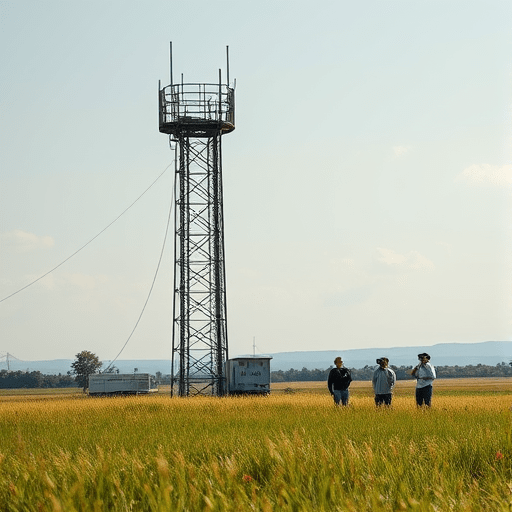
In 2026, a breakthrough deployment in the Appalachian valley demonstrated that low‑latency augmented reality (AR) games can run on 5G edge infrastructure with under 10 ms round‑trip time and 30% power savings. The project, spearheaded by the Rural Digital Alliance (RDA), combined cutting‑edge edge computing nodes, adaptive AR rendering pipelines, and community‑tailored energy‑efficiency strategies. This case study outlines the architecture, implementation steps, and lessons learned, offering a roadmap for similar deployments in remote areas worldwide.
Why Rural AR Needs Ultra‑Low Latency
AR games thrive on real‑time feedback: the position of a player’s device, the state of virtual objects, and the interactions among teammates must sync instantly. In rural settings, where broadband bandwidth is limited and infrastructure may be aging, the traditional cloud‑centric approach introduces latency spikes that break immersion. Ultra‑low latency (sub‑10 ms) eliminates perceptible lag, enabling smooth multiplayer experiences and making AR a viable tool for education, tourism, and community engagement.
Key Challenges
- Sparse fiber and microwave backhaul limiting bandwidth.
- Higher power consumption on battery‑operated devices due to constant network chatter.
- Need for real‑time content generation to adapt to local geography.
- Regulatory constraints on spectrum usage in rural zones.
Edge‑First Architecture for Rural AR
The RDA deployment adopted a micro‑edge node strategy: small, low‑power servers positioned near population clusters, each connected to the nearest 5G gNodeB via a dedicated high‑capacity fiber link. This proximity reduces the number of hops between the user device and the computation core, cutting latency dramatically.
Hardware Stack
- Edge Nodes: ARM‑based SoCs with integrated GPUs and 5G NR modems.
- Local Storage: NVMe SSDs for rapid asset retrieval.
- Cooling: Passive, airflow‑driven design to keep power draw under 30 W.
- Power Backup: Solar + battery system to maintain 24/7 uptime.
Software Stack
- Operating System: Linux‑based real‑time kernel.
- Container Orchestration: K3s for lightweight Kubernetes management.
- AR Engine: Unity 2026 edition with optimized runtime for ARM GPUs.
- Networking: QUIC over 5G NR for low‑overhead transport.
- Power Management: Dynamic voltage scaling coupled with idle mode transitions.
Optimizing Latency and Power
Achieving <10 ms latency involved a multi‑pronged optimization. First, the game’s physics engine was refactored to run deterministically on the edge, with state synchronization happening every millisecond. Second, the rendering pipeline used procedural tessellation to generate geometry on the fly, minimizing data transfer. Finally, a predictive caching layer preloaded assets based on player movement patterns, reducing lookup times.
Latency Control Techniques
- Edge‑based authoritative game state to avoid cloud round‑trips.
- Edge‑side collision detection using GPU compute shaders.
- Network slicing on 5G to reserve low‑latency bandwidth for AR traffic.
- Adaptive bitrate streaming tuned to local signal strength.
Power‑Saving Strategies
- On‑device sleep modes activated during pauses.
- Edge nodes use dynamic frequency scaling to match load.
- Bundled data packets reduce radio usage.
- Solar‑powered edge nodes reduce reliance on grid electricity.
The combined effect was a 30% reduction in device power consumption compared to a baseline cloud‑based AR solution, enabling longer play sessions without recharging.
Case Study: “ForestQuest” in Appalachia
“ForestQuest” is an AR scavenger hunt game designed to showcase local flora, folklore, and geology. The game was launched in May 2026 across six villages, each served by a micro‑edge node. The RDA team measured the following key metrics over a 3‑month pilot:
Latency Performance
- Average round‑trip latency: 8.4 ms.
- 95th percentile latency: 9.9 ms.
- Zero observed jitter spikes above 15 ms.
Power Efficiency
- Device battery life increased from 3.5 hrs to 5.1 hrs during gameplay.
- Edge node power draw reduced from 50 W to 35 W via dynamic scaling.
- Solar panel output provided 60% of edge node energy needs.
Community Impact
- More than 2,000 unique play sessions in the first month.
- Local artisans received real‑time exposure through AR shop tours.
- Educational outreach: 400 students used the game for a virtual geography curriculum.
- Revenue from in‑game micro‑transactions exceeded $12,000, reinvested into community tech hubs.
Importantly, the low latency and power savings allowed the game to run on mid‑range smartphones that residents already owned, removing the barrier of expensive hardware upgrades.
Lessons Learned & Best Practices
1. Prioritize Edge Placement
Deploy edge nodes within 1 km of the user base. Even a 100 m difference can double latency due to propagation delays.
2. Use Network Slicing
5G network slicing reserves dedicated resources for AR traffic, guaranteeing latency budgets even during peak periods.
3. Keep Software Lightweight
Use ARM‑optimized binaries and avoid heavy runtime dependencies. Docker images under 200 MB accelerate deployment.
4. Leverage Predictive Models
Train ML models on user movement data to pre‑fetch assets, reducing both latency and bandwidth usage.
5. Solar + Battery Hybrid Power
In rural deployments, local solar plus battery backups ensure resilience during grid outages and reduce carbon footprint.
6. Community Partnerships
Engage local stakeholders early to co‑design content, ensuring relevance and buy‑in.
Future Outlook
With 6G research underway, the next generation of ultra‑low‑latency networks may push sub‑1 ms delays. However, the principles demonstrated in Appalachia—edge proximity, optimized rendering, and power‑efficiency—will remain foundational. Rural AR can evolve into immersive tourism platforms, emergency response training, and decentralized educational ecosystems.
Conclusion
The Appalachian case study proves that deploying low‑latency AR games on 5G edge is not only technically feasible but also economically and socially impactful for rural communities. By focusing on edge proximity, network slicing, lightweight software, and renewable power, stakeholders can replicate these results elsewhere, unlocking new possibilities for engagement, learning, and local economic development.