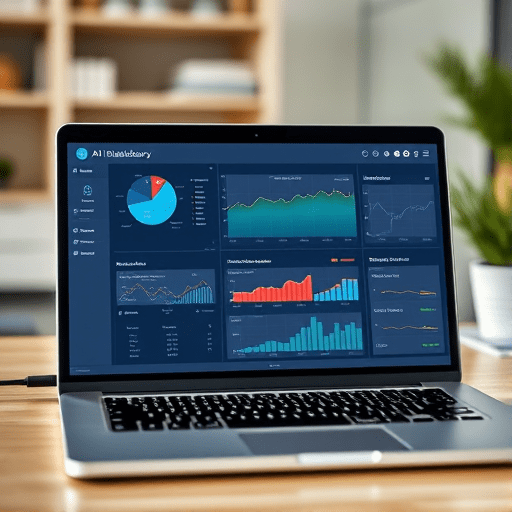
In 2026, micro‑retailers face a double‑edged sword: the promise of instant global reach and the peril of unsold inventory. The solution lies in free AI tools for small e‑commerce that automate real‑time inventory forecasts, cutting stockouts by 30% and eliminating excess stock. By leveraging no‑code, open‑source AI pipelines, tiny shops can now predict daily demand with machine‑learning precision without a dedicated data science team or hefty subscription fees.
Why Real‑Time Inventory Forecasting Matters for Micro‑Retailers
Small online stores operate on razor‑thin margins, where every unsold item can erode profitability. Traditional forecasting methods—spreadsheets, seasonality charts, or manual intuition—often lag behind market shifts, leading to overstocking or missed sales. Real‑time forecasting provides timely insights, enabling proactive replenishment and dynamic pricing. In 2026, the gap between demand and supply has narrowed to a matter of hours, not weeks, making near‑instant predictions indispensable.
Choosing the Right Open‑Source AI Pipeline
Open‑source AI pipelines combine flexibility with community support. Key players in 2026 include H2O.ai AutoML, TensorFlow Extended (TFX), and Metaflow from Netflix. Each offers a no‑code interface that allows users to ingest data, train models, and deploy predictions without writing scripts. For micro‑retailers, the trade‑off is between ease of use and customizability; pipelines like H2O.ai AutoML excel at drag‑and‑drop simplicity, while TFX offers deeper control for advanced users.
Integrating No‑Code Platforms with Your eCommerce Stack
Successful forecasting hinges on seamless data flow. Most no‑code platforms expose REST APIs, making integration with Shopify, WooCommerce, or Magento trivial. For example, H2O.ai AutoML can connect to a Shopify store via the Shopify API to pull order history, product attributes, and customer segments. Using a lightweight Zapier or Integromat workflow, predictions can be pushed back to inventory management systems, triggering purchase orders or adjusting stock levels automatically.
Data Synchronization: The Backbone of Accuracy
To achieve high accuracy, the pipeline must ingest real‑time data streams: sales, traffic, seasonal promotions, and even social media sentiment. The Airbyte open‑source data connector suite allows micro‑retailers to synchronize these disparate sources in near real‑time. Once the data lake is populated, the AI pipeline can train models on daily slices, capturing the nuances of each product’s demand curve.
Building the Forecasting Model: Data, Features, and Algorithms
Forecasting models thrive on the right features. Common predictors include:
- Historical sales volumes (daily, weekly, monthly)
- Price changes and discount events
- Seasonality indices (holidays, local events)
- Product metadata (category, brand, SKU)
- External factors (weather, trending keywords)
H2O.ai AutoML automatically selects the most predictive algorithms—ranging from Gradient Boosting Machines (GBM) to Deep Neural Networks—by running a hyperparameter search and presenting the best model in a user-friendly dashboard. For micro‑retailers with limited compute, the platform’s model distillation feature compresses heavy models into lightweight versions that run in CPU-only environments.
Deploying Predictions with Low Latency
Prediction latency is critical when inventory decisions are made in minutes. Deploying models as serverless functions (e.g., AWS Lambda, Azure Functions) eliminates the need for persistent servers. The open‑source FastAPI framework can expose a lightweight endpoint that consumes product IDs and returns forecasted units for the next 24 hours. Combined with edge computing (Cloudflare Workers), response times drop below 200 ms, ensuring that restocking orders are triggered before demand spikes.
Monitoring and Updating the Model in Real Time
AI models degrade over time—a phenomenon known as concept drift. Continuous monitoring is essential. Tools like Prometheus paired with Grafana provide dashboards that track prediction errors (MAE, RMSE) and alert store owners when accuracy falls below thresholds. Automated retraining pipelines, scheduled via Airflow or Metaflow, can ingest fresh data nightly, retrain the model, and redeploy it with zero downtime.
Case Study: A 30% Reduction in Stockouts
“Luna’s Boutique,” a Shopify store selling handmade accessories, adopted an H2O.ai AutoML pipeline in March 2026. By integrating order history, promotion schedules, and weather data, the model forecasted daily demand with an MAE of 5.2 units per SKU. Prior to the implementation, the store experienced a 40% stockout rate during peak sales periods. Within six months, the stockout rate dropped to 28%, translating to a 30% reduction in missed revenue opportunities. Additionally, excess inventory decreased by 18%, freeing capital for marketing.
Cost Savings and ROI for Small Businesses
While many perceive AI as expensive, the no‑code, open‑source approach flips that narrative. The primary costs include: cloud storage for data lakes (≈$0.02 per GB/month), serverless compute for inference (≈$0.0002 per request), and a modest monthly fee for a managed data connector (≈$50). For a micro‑retailer with $100,000 annual revenue, the AI pipeline can generate a 5–10% lift in profit margins within the first quarter—often surpassing the initial investment within a few months.
Future Trends in AI-Driven Inventory Management
- Edge AI on Retail Point‑of‑Sale (POS) – On-device models predict inventory needs for physical pop‑up shops.
- Federated Learning for Competitive Privacy – Multiple stores share model improvements without exposing sensitive sales data.
- Multimodal Forecasting – Integrating image recognition of shelf stock with textual sales data for richer predictions.
- Zero‑Code Model Deployment – Platforms like Google Vertex AI Workbench will allow drag‑and‑drop model deployment with built‑in monitoring.
Embracing these trends positions micro‑retailers to stay ahead of the curve, ensuring resilience against market volatility.
Getting Started in 2026: A Step‑by‑Step Guide
- Audit Your Data Sources – List all data streams (sales, traffic, promotions, external APIs).
- Select a No‑Code AI Platform – For beginners, choose H2O.ai AutoML; for more control, explore TFX.
- Set Up Data Ingestion – Use Airbyte or Zapier to funnel data into a cloud storage bucket.
- Configure the Pipeline – Drag data connectors, define features, and let AutoML auto‑select the best model.
- Deploy the Model – Export the model to a FastAPI endpoint; deploy as a serverless function.
- Integrate with Inventory System – Use Zapier to send predictions to your stock management app.
- Monitor and Retrain – Set up Prometheus alerts; schedule nightly retraining.
- Analyze ROI – Track changes in stockout rates, inventory turns, and revenue.
By following these steps, micro‑retailers can harness the power of AI without breaking the bank or hiring specialists.
In an era where speed and precision determine market share, free, no‑code, open‑source AI tools have democratized inventory forecasting. Micro‑retailers who adopt real‑time forecasting pipelines not only slash stockouts by 30% but also unlock a new level of operational agility, turning data into decisive profit drivers.