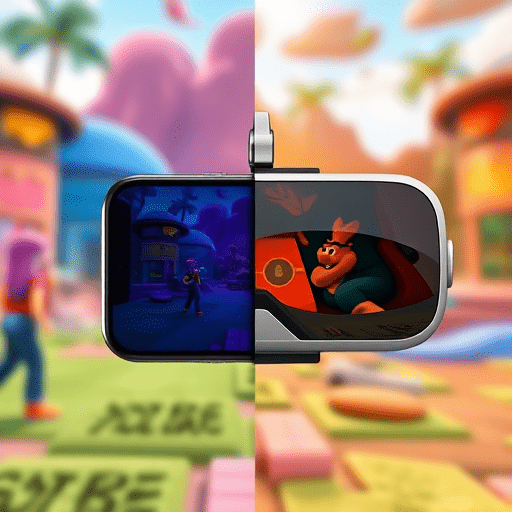
In 2026, the line between mobile and spatial computing blurs as Apple’s Vision Pro and iOS ARKit forge a new bridge to Android. The Vision Pro + iOS ARKit integration enables developers to create seamless 3D experiences that feel native on both ecosystems, offering a unified gameplay loop while leveraging each platform’s unique hardware strengths. Below we unpack the architecture, key technologies, and best practices that turn this vision into a playable reality.
Why Vision Pro Meets iOS ARKit: The New Cross-Platform Frontier
Unified Rendering Pipelines
Apple’s move to a Metal‑backed rendering core for Vision Pro aligns closely with iOS ARKit, while Android’s Vulkan and OpenGL ES offer comparable performance. By targeting a shared shader language (Metal Shading Language MSL for iOS and a Vulkan‑compatible equivalent on Android), developers can ship a single set of shaders that compile on both ends, reducing maintenance overhead.
Hardware Synergy and Performance
Vision Pro’s internal LiDAR, high‑resolution display, and six‑degree-of-freedom tracking provide depth cues that can be mirrored by ARKit’s ARWorldTrackingConfiguration. Android devices equipped with depth sensors (e.g., Google Pixel and Samsung Galaxy Fold) can feed similar data into the same world‑anchor system, allowing consistent spatial placement across devices.
Key Technical Building Blocks
Unified Engine: Unity 2026+ and Unreal Engine 5.3
Both Unity 2026 and Unreal Engine 5.3 have introduced platform abstraction layers that automatically handle API differences. Unity’s XR Interaction Toolkit and Unreal’s ARKit/ARCore Plugins expose a unified set of components for spatial anchors, input, and rendering.
Shared Asset Pipelines
- AssetBundles & Nanite Meshes: Use Unity’s AssetBundle system or Unreal’s Nanite to ship high‑poly meshes that load lazily on-demand.
- Texture Atlases & Compression: Adopt ASTC for iOS and ETC2 for Android, then use a conversion script to generate both within the same build pipeline.
- Animation Blending: Leverage the new Animation Rigging package in Unity to unify blend trees across platforms.
Cross-Platform Input Systems
The XRController abstraction in Unity handles Vision Pro’s eye‑tracking, hand gestures, and motion controls alongside Android’s touch, gyroscope, and external controller input. On Unreal, the Enhanced Input System serves a similar purpose, ensuring consistent input mapping.
Practical Architecture for a Vision Pro + iOS ARKit Game
Project Structure Overview
Structure your project with a clear separation:
/Core– Shared logic, services, and data models./Platform/Android– Android‑specific code and resources./Platform/iOS– iOS/ Vision Pro code, ARKit integration./Assets– Universal asset repository./BuildScripts– Automation for cross‑platform builds.
Platform‑Specific Modules
Encapsulate platform quirks behind interfaces. For instance, a IPointerProvider can expose either Vision Pro’s gaze pointer or Android’s touch screen pointer, allowing the same UI code to work on both.
Runtime Decision Logic
Detect platform capabilities at startup:
if (Device.IsVisionPro())
    InitVisionProFeatures();
else if (Device.HasARKit())
    InitARKitFeatures();
else
    InitStandardARFeatures();
This approach keeps the core logic clean and ensures that each platform only loads the modules it needs.
Optimizing for Vision Pro and ARKit
Spatial Mapping and Light Estimation
Use Vision Pro’s RealityKit for high‑precision mesh reconstruction, then pass that mesh to ARKit’s ARMeshAnchor on iOS. For Android, employ ARCore’s Depth API to fill in missing geometry. Light probes from Vision Pro’s ambient light sensor can be mapped to ARKit’s light estimation, producing consistent shadows and reflections across devices.
Latency Management
Implement a frame‑pacing buffer that synchronizes frame delivery between the engine and the platform compositor. On Vision Pro, a 4‑to‑5 ms latency is achievable with a 120 Hz refresh rate, while Android devices aim for 60 Hz. Adaptive quality scaling ensures that frame rates stay above 30 fps on all devices.
Battery and Thermal Considerations
Use asynchronous compute pipelines and GPU task queues to keep the CPU idle whenever possible. Offload heavy physics calculations to the GPU using Unity’s Burst compiler and Android’s RenderScript. For Vision Pro, enable the BatterySaver mode that limits background rendering to extend usage.
Testing and Deployment Strategy
CI/CD Pipelines
Set up GitHub Actions with separate jobs for iOS, Android, and Vision Pro builds. Use fastlane to automate code signing, provisioning profiles, and App Store Connect submissions. Incorporate Unity’s EditorUtility scripts to generate platform‑specific test builds.
Device Lab Simulation
Use cloud‑based device farms (e.g., AWS Device Farm) for Android and Apple’s XCTest suite for iOS. For Vision Pro, leverage Apple’s RealityKit Simulator to validate spatial placement before shipping to physical devices.
App Store & Vision Pro Store
Prepare two distinct listing pages: one for the Android Play Store and one for the Apple App Store, with cross‑promotions linking to each. For Vision Pro, submit a visionOS bundle that highlights spatial features in the preview video.
Case Study Snapshot: A Fantasy Adventure Game
Gameplay Flow
Players embark on a quest that blends first‑person combat in a fully rendered 3D world with AR‑driven treasure hunts in their real environment. Vision Pro users see enemies through the headset, while Android users battle on the phone’s screen.
ARKit Features Used
- ARWorldTrackingConfiguration – for stable positional tracking.
- Plane Detection & Alignment – to place virtual objects on real surfaces.
- Light Estimation – to match in‑game lighting with real‑world illumination.
Vision Pro Enhancements
- Eye‑tracked UI panels that follow the player’s gaze.
- Spatial audio that shifts with the player’s head movement.
- Hand gesture controls for spell casting.
Future Trends to Watch
Edge AI Integration
Running on-device machine learning models (e.g., on Vision Pro’s Neural Engine or Android’s Edge TPU) can enable real‑time environmental understanding, dynamic NPC behavior, and adaptive difficulty tailored to the player’s surroundings.
Cross‑Play Social Features
Integrating shared world anchors that sync across devices allows players on Vision Pro and Android to meet in the same virtual space, fostering a truly cross‑platform community.
By weaving together Vision Pro’s spatial strengths with iOS ARKit’s robust framework—and extending that synergy to Android—developers can deliver immersive 3D games that feel native, responsive, and exciting on every screen. The cross‑platform architecture outlined above provides a solid foundation for building the next generation of immersive mobile experiences.