Across cardiology clinics in 2025, a quiet shift is underway: patients arrive wearing a smartwatch that has already flagged an irregular rhythm, and the clinician must decide whether that single-lead tracing is a clinical signal or noise. The core question is no longer whether smartwatch ECG vs. Holter monitor comparisons matter, but where the wearable fits into a diagnostic pathway that, until recently, relied almost exclusively on continuous ambulatory monitors. With the FDA clearing more consumer electrocardiogram algorithms each year and payers loosening reimbursement for remote cardiac monitoring, cardiologists are recalibrating trust in real time.
The Short Answer Cardiologists Are Giving in 2025
For symptomatic, episodic arrhythmia detection over weeks, the Holter or its multi-day patch successor still wins on evidence depth. For asymptomatic or intermittent event capture between visits — and for patient-driven screening — the smartwatch ECG has matured into a useful adjunct, provided its limitations are documented in the note. The two technologies are converging in capability but remain separated by validation gaps that affect how their tracings should be interpreted.
What a Smartwatch ECG Actually Measures
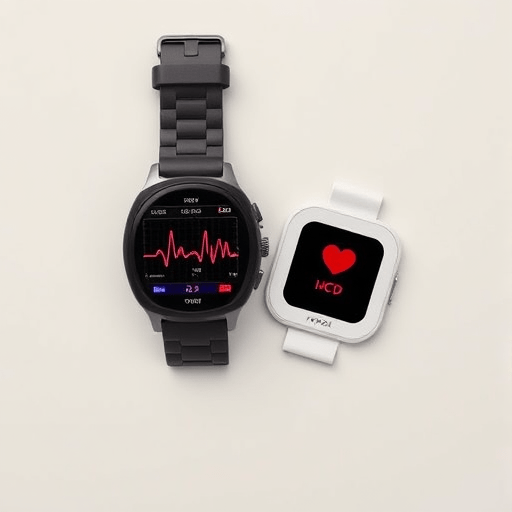
Consumer smartwatch ECGs in 2025 — including Apple Watch, Fitbit, Samsung, and Withings devices — capture a single-lead rhythm strip when the user touches the crown or bezel with the opposite hand. The recording is typically 30 seconds, sampled around 500 Hz on premium models, and analyzed by an on-device algorithm (and often re-analyzed in the cloud) for rhythm classification: sinus rhythm, atrial fibrillation, high or low heart rate, or inconclusive.
Modern algorithms claim sensitivities in the high 80s to mid-90s for AFib detection against a reference 12-lead ECG, with specificities often above 95%. Those numbers look strong on paper, but they are derived from controlled validation studies — usually in resting, seated patients who are already suspected of arrhythmia. Real-world performance, especially during motion, low perfusion, or in patients with bundle branch blocks or paced rhythms, is meaningfully lower.
The Persistent Validation Gaps
- Lead count. A single-lead recording cannot replace the spatial resolution of a 12-lead ECG. It is excellent for rhythm, weaker for morphology, and often ambiguous for ST-segment interpretation.
- Patient selection bias. Most pivotal studies enrolled adults without complex congenital disease, severe obesity, or tremor. Performance in elderly or comorbid populations is underreported.
- Triggering behavior. Algorithms are optimized for the moment a user chooses to record. Asymptomatic AFib, the subtype most linked to stroke, often goes unrecorded.
- Cloud adjudication opacity. Some manufacturers run multiple AI passes on the same tracing. Cardiologists rarely see the raw disagreement among classifiers, only the final label.
What a Holter or Patch Monitor Still Does Better
The contemporary Holter ecosystem spans 24-hour to 14-day continuous recorders, with adhesive patch monitors (Zio, Carnation Ambulatory Monitor, and similar) dominating long-duration prescriptions. The 2025 generation of patches uses single-channel or two-channel continuous recording with automated beat-by-beat annotation, often reviewed by certified technicians before physician overread.
Continuous monitoring catches what spot recordings cannot: paroxysmal AFib episodes that last minutes, nocturnal bradyarrhythmias, ventricular ectopy burden quantification, and heart rate trends under daily activity. For stroke workup, syncope evaluation, and post-ablation surveillance, Holter-class devices retain the strongest evidence base in cardiology guidelines.
Where Holter Monitors Show Their Age
- Patient adherence. Multi-day patches can itch, peel, or be removed early. Real-world wear time often falls short of prescribed duration.
- Diagnostic yield per day declines. The longer the recording, the lower the marginal benefit for episodic arrhythmias — a problem wearables partially solve through years of passive data.
- Delayed reporting. Holter data is reviewed days to weeks after the recording window. Wearables deliver a near-instant rhythm label, even if that label is provisional.
The 2025 Clinical Decision Framework
Cardiologists reporting on their workflows describe a de facto triage model that has emerged without formal guidelines endorsing it. Smartwatch ECGs are increasingly treated as screening-grade and Holter data as diagnostic-grade, with the patient’s clinical context deciding the threshold.
When Smartwatch ECG Is Sufficient on Its Own
A high-quality smartwatch tracing captured during symptoms, reviewed on a clinical PDF export, with a clear AFib or regular rhythm label, is generally accepted as confirmatory in an already-suspected patient. In a 2025 survey of electrophysiologists, roughly two-thirds said they would start anticoagulation discussions based on a clean smartwatch PDF if the patient’s CHA2DS2-VASc score and symptoms aligned.
When Holter Remains Non-Negotiable
For first-time AFib diagnosis in an asymptomatic patient, for cryptogenic stroke workup, for ablation pre-procedural mapping, and for any case where morphology matters (wide-complex tachycardia, ischemia suspicion), a Holter or patch monitor is still required. Smartwatch tracings may inform timing but should not replace the ambulatory study.
The Data Ownership and Workflow Problem
One underappreciated gap in 2025 is interoperability. Most consumer ECGs push data to proprietary clouds, not to the EHR. Cardiologists receive a screenshot, a PDF, or a patient’s verbal report. In contrast, modern Holter services integrate directly with major EHR vendors, with structured reporting that meets billing and quality requirements.
This asymmetry affects what clinicians can document, bill, and act on. Until FDA-cleared wearable ECG platforms offer standard HL7/FHIR export and structured rhythm codes, the Holter ecosystem will retain a workflow advantage that has nothing to do with sensor quality.
What Cardiologists Should Ask Before Trusting the Watch
A short checklist is emerging in clinic hallways as a practical filter before any smartwatch tracing is allowed to influence a treatment decision:
- Was the recording captured during symptoms, or passively?
- Is the device on the FDA-cleared list for the specific rhythm claim being made?
- Is the export a clinical-grade PDF, or a screenshot of a watch face?
- Has the patient been screened for conditions known to confuse single-lead algorithms?
- Is the tracing being used to replace a guideline-recommended test, or to time one?
Toward a Hybrid Standard by 2026
The trajectory points toward convergence rather than replacement. Continuous patch monitors are getting smaller, smarter, and more comfortable; smartwatch algorithms are gaining multi-lead prototypes, background rhythm surveillance, and tighter FDA claims. Within the next year, the more interesting question for cardiologists may not be which device to trust, but how to weight a dense stream of low-confidence wearable data alongside sparse, high-confidence Holter evidence without losing clinical signal in the noise.
Conclusion
In 2025, the smartwatch ECG is a credible screening and patient-engagement tool whose value depends almost entirely on context. The Holter monitor — in its modern patch form — remains the diagnostic backbone for arrhythmia workup, with the deepest validation, the cleanest clinical workflow, and the strongest guideline backing. Cardiologists who blend the two thoughtfully, rather than choosing one over the other, are reporting the best diagnostic yield, because each device fills a different blind spot the other leaves open.