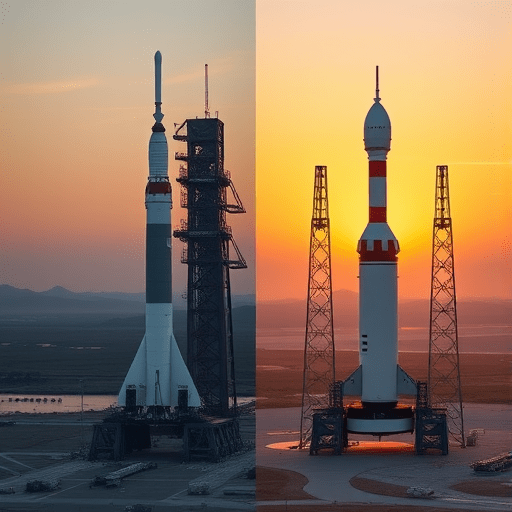
The race to lower the cost of reaching orbit no longer belongs only to the companies that fly the most rockets. In 2026, the conversation has shifted to how rockets are built, not just how often they fly. SpaceX, the long-standing price benchmark for commercial launch, now shares the spotlight with Relativity Space, a younger challenger whose entire vehicle is produced by metal 3D printers. For satellite operators shopping for small-sat launch competitors, the comparison between these two companies has become one of the most important in the industry.
Why Manufacturing, Not Rockets, Is the New Battleground
For most of the last decade, launch cost discussions centered on reusability, flight cadence, and engine efficiency. SpaceX pioneered that era with Falcon 9 booster landings and a growing Starship manifest. But a quieter revolution has been taking shape on the factory floor. Both SpaceX and Relativity have invested heavily in additive manufacturing, treating rocket parts the way a smartphone company treats circuit boards: print, iterate, print again.
This approach matters for small satellite customers because launch price is downstream of production price. A rocket built from hundreds of welded components and a long supply chain carries fixed costs that are hard to remove. A rocket built from a small number of printed structures can, in theory, compress months of assembly into days.
SpaceX: A Hybrid Approach to Additive Manufacturing
SpaceX never adopted a fully 3D-printed vehicle, but the company has aggressively folded printed components into its hardware. The Merlin engine used on Falcon 9 has long incorporated printed injector heads and combustion chambers, while the Raptor engines powering Starship rely heavily on printed regenerative cooling channels and turbopump housings. These parts have to survive extreme thermal and pressure cycles, which is why SpaceX prints them in proprietary superalloys and subjects them to thousands of hours of qualification testing.
For the small-sat market, the practical impact is that SpaceX can offer rideshare prices that no fully traditional launch provider can match. Recent Falcon 9 rideshare slots have priced small satellites into the low five figures per kilogram, a figure that would have seemed impossible ten years ago. Yet SpaceX still relies on a global ground infrastructure, a massive stage-recovery fleet, and a launch cadence that smaller rivals cannot replicate.
Relativity Space: The Fully Printed Rocket Experiment
Relativity took a different bet. Rather than mixing printed parts into a conventional rocket, the company set out to print the entire primary structure of a launch vehicle. Its Terran 1 rocket, which reached space on its second attempt, was more than 85 percent printed by mass, a record for an orbital-class booster. Its successor, Terran R, is designed as a fully reusable, medium-lift rocket whose tanks, domes, engine housings, and most of its avionics mounts will emerge from a single Stargate printer facility.
The promise is straightforward: fewer parts means a shorter assembly line, fewer points of failure, and faster iteration. If a printed tank wall is too thin, engineers can redesign it overnight and have a new tank in production the next morning. That loop simply does not exist in a traditional aerospace factory.
The challenge has been equally clear. Qualifying a fully printed rocket for commercial customers, including defense and national security payloads, requires a level of trust in non-destructive inspection that the wider industry is still building. Relativity has responded with extensive CT scanning and burst testing, but its flight history remains short compared to SpaceX’s hundreds of missions.
Side-by-Side: The 2026 Competitive Picture
For small satellite operators evaluating options this year, the comparison looks less like a clash of giants and more like a menu of tradeoffs.
Launch Cost per Kilogram
SpaceX still sets the floor here. Through rideshare programs and dedicated Falcon 9 missions, the company offers the lowest published small-sat prices in the industry. Relativity has not yet published a stable per-kilogram figure for Terran R, but internal targets aim to undercut Falcon 9 for dedicated small-sat missions, especially when full reusability is achieved.
Manufacturing Speed
Relativity’s headline advantage is throughput. The company has publicly discussed producing a Terran R in a fraction of the time SpaceX needs to build a Falcon 9. SpaceX counters with sheer scale: a production line that produces a Falcon 9 upper stage roughly every few weeks, supported by a supply chain refined over more than a decade.
Reusability and Flight Heritage
SpaceX’s record is unmatched in the commercial sector. Proven booster reuse, a documented turnaround cadence, and a manifest running well into the next year give customers a level of schedule confidence newer entrants cannot yet match. Relativity is still climbing that learning curve, and its first reused Terran R flight is expected later in 2026.
Payload Flexibility
Falcon 9 can deliver small satellites alongside larger rideshare payloads, a useful option for constellations that want to share a launch. Terran R, when fully operational, is being marketed toward medium-class dedicated missions, which may appeal more to constellation operators who want their own launch slot rather than a rideshare seat.
What This Means for Small Satellite Customers
The arrival of a serious 3D-printed competitor is already changing how satellite operators negotiate. Procurement teams that once treated launch as a commodity purchase are now asking whether a dedicated Relativity flight could shorten a constellation’s time-to-orbit, even if the per-kilogram price is not the absolute lowest. They are also weighing schedule risk more carefully, since a single vehicle pause at a young launch company can ripple across an entire constellation deployment.
Meanwhile, SpaceX’s dominance forces the conversation. Even a company that printed its entire rocket still has to compete on price, on cadence, and on reliability. That pressure is healthy for the industry, because it pushes every small-sat launch competitor to find savings, whether in the factory, on the pad, or in how hardware is recovered and reused.
The Bigger Picture for Commercial Space
The deeper story is that 3D-printed rockets have moved from a curiosity to a credible business strategy. Five years ago, analysts questioned whether printed structures could survive launch. Today, printed engines are powering the most powerful operational rocket ever flown, and an entire vehicle has reached orbit using primarily printed components. The technology has crossed a threshold, and 2026 is the year its commercial consequences are starting to show up in actual invoices.
For SpaceX, this is motivation to keep squeezing cost out of every stage of production. For Relativity, it is validation that the long road to a fully printed orbital rocket was worth walking. For the rest of the launch industry, it is a signal that the next decade of price competition will be fought as much in metal powder and printer time as in thrust and payload capacity.
The small-sat launch market is no longer a one-horse race, and it is no longer a race run on a single kind of track. With SpaceX continuing to drive down costs through scale and Starship, and Relativity pushing the limits of what additive manufacturing can do for an entire vehicle, satellite operators now have a richer set of options than at any point in the history of commercial spaceflight.