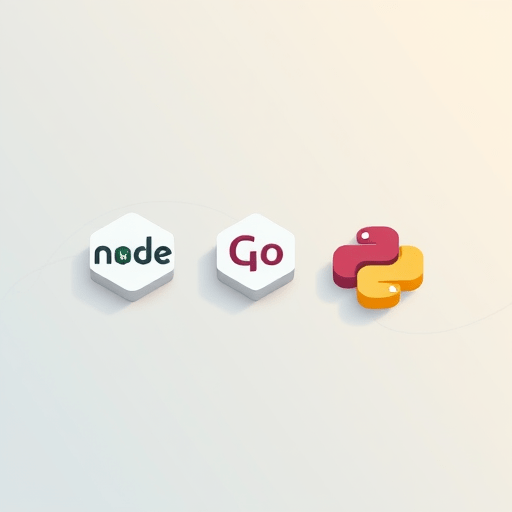
Choosing a single language for every microservice is comfortable. It is also, increasingly, a mistake. In 2026, mature teams ship polyglot microservices that pair Node.js, Go, and Python in the same platform, each language doing the job it was built for. The hard part is not the technical integration, since gRPC, OpenTelemetry, and service meshes have made cross-language calls almost boring. The hard part is deciding which language deserves which service. This guide offers a decision framework grounded in latency budgets, team expertise, and maintenance cost, so you can justify every polyglot choice on your architecture board.
Why Polyglot Stopped Being a Heresy
For most of the 2010s, “polyglot” was a polite way of saying “mess.” Shared libraries duplicated, observability fragmented, and hiring multiplied. What changed is the surrounding platform. OpenTelemetry now instruments every major runtime identically. Protobuf and gRPC give you a contract-first interface that compiles into idiomatic clients for any language. Container base images are tiny. Service meshes like Istio and Linkerd handle retries, mTLS, and traffic shaping without the application caring which runtime sits beneath them. In other words, the cost of language diversity collapsed, while the cost of forcing one language to do everything quietly climbed. CPU is more expensive. Latency budgets are tighter. AI-assisted workloads pull Python into the stack whether you planned for it or not.
The Three Forces That Should Drive Your Choice
- Latency budget: p99 target in milliseconds, and how much jitter you can tolerate.
- Team expertise: not “do we have anyone who knows Go,” but “who can own this service at 2 a.m. for the next three years.”
- Maintenance cost: dependency churn, memory footprint, cold-start behavior, and the operational tax of each runtime.
The Latency Lens: Match the Runtime to the Tail
Latency is where the polyglot case becomes undeniable. Benchmarks from the last twelve months consistently show that for CPU-bound request-response paths, Go’s net/http with fasthttp-style routing lands p99 in the 2–6 ms range on commodity hardware. Node.js, running on modern V8 with worker threads, sits closer to 8–18 ms for the same workload, but it shines on I/O-bound paths because the event loop keeps memory flat and throughput high. Python, even on PyPy or with the new 3.13 JIT, trails both for raw synchronous work, typically 25–60 ms p99, but its async story has matured enough that purely I/O-bound fan-out services run comfortably under 30 ms.
The practical rule: if the user is waiting on this request, and the work is CPU-bound, reach for Go. If the work is fan-out I/O with occasional blocking calls, Node.js is the sweet spot. If the bottleneck is iteration speed on data, ML inference, or glue logic, Python is fine, just keep it off the synchronous critical path.
A Latency Budget Worksheet You Can Actually Use
Map each service to a tier before you write code:
- Tier 0 (user-facing, synchronous): budget 50 ms end-to-end. Strong default for Go.
- Tier 1 (user-facing, asynchronous): budget 200 ms. Node.js is competitive and cheaper to staff.
- Tier 2 (background, batch, ETL): budget uncapped or minutes. Python wins on developer hours.
The Team Expertise Lens: Skills Are a Hard Constraint
A language choice that ignores your team is a six-month rewrite waiting to happen. In 2026, the labor market tells a clear story. Node.js and TypeScript remain the most widely deployed skills in product engineering, and the hiring pool for senior Node engineers is roughly three times deeper than for senior Go engineers in most regions. Python remains the default for data, ML, and automation roles, which means a Python microservice will often be owned by a different team entirely, the data platform or ML ops group, not your core product engineers.
Go expertise is scarcer, but the engineers who know it well tend to stay with it. They are also disproportionately expensive. The polyglot decision therefore has a hidden salary line item. If you adopt Go for two services and you have one internal Go expert, you have created a bus factor of one. That is acceptable for a payment path; it is reckless for a notification service that could just as easily live in Node.
Ownership Mapping, Not Skill Inventory
Do not ask “who knows Go?” Ask “who will own this service in 2027, and what language do they want to maintain?” Run a quick survey. The answers will quietly redraw your stack.
The Maintenance Cost Lens: The Tax You Pay Every Quarter
Maintenance cost is the dimension teams underestimate most. It shows up as CPU bills, memory bills, patch Tuesdays, and the slow drip of dependency rot. Here is how the three runtimes compare on the metrics that hit the budget:
- Memory footprint at idle: a minimal Go binary with net/http sits around 8–15 MB RSS. A Node.js service with Express typically lands at 60–90 MB. A Python service using FastAPI and uvicorn usually starts north of 120 MB. At scale, the difference is the difference between running 200 pods and 40 pods for the same throughput.
- Cold start: Go and Node start in well under a second. Python with PyOxidizer or a frozen dependency tree can match them, but most teams never bother, which means serverless Python workloads get throttled by cold-start penalties.
- Dependency churn: Node’s npm ecosystem still moves fastest, which is both an advantage and a tax. Python’s PyPI is more stable, but ML libraries have their own release cadence that can pull the whole service along. Go’s standard library covers so much that dependency churn is the lowest of the three.
- Observability cost: all three export OpenTelemetry, but high-cardinality tracing in Python tends to balloon storage bills because of how async context propagates. Budget for this.
A Reference Pattern: One Product, Three Languages, Clean Boundaries
Consider a realistic 2026 product: a B2B analytics dashboard with embedded AI insights. A clean polyglot split might look like this.
The API gateway and BFF runs on Node.js with TypeScript. It handles authentication, request shaping, GraphQL aggregation, and fan-out to downstream services. Latency tolerance is high (100–150 ms), the team is large, and the dependency story is the richest of the three.
The billing and metering service runs on Go. It is synchronous, writes to Postgres, and cannot tolerate p99 above 30 ms because it sits behind a checkout flow. The two-person platform team owns it; they have written Go for six years and have no interest in switching.
The insight generation worker runs on Python. It pulls events from Kafka, calls an LLM or a fine-tuned model, and writes summaries back to the data warehouse. Latency is irrelevant, the ML platform team owns it, and the bottleneck is iteration speed on prompts and models, not raw throughput.
These three services share a protobuf schema, emit the same OpenTelemetry traces, and talk over gRPC. The team did not need a polyglot framework. They needed a contract.
When NOT to Go Polyglot
The framework above has a clear inversion point. If your team is smaller than roughly fifteen engineers, the operational tax of multiple runtimes will eat the latency benefits alive. At that scale, pick one language, ideally the one your strongest engineers enjoy, and invest the saved complexity budget in better observability and deployment automation.
Similarly, if your domain is genuinely uniform, say, a CRUD-heavy internal tool where every service does the same thing, polyglot adds cost without adding value. Reserve it for organizations that have crossed both a scale threshold and a domain-diversity threshold.
Conclusion
Polyglot microservices are no longer a stunt. They are a deliberate trade between language fit and operational complexity, and in 2026 the trade is increasingly favorable, provided you decide service by service rather than platform by platform. Anchor every choice in a latency tier, a named owner, and a maintenance-cost estimate you can defend. When those three lenses line up, mixing Node.js, Go, and Python in the same production fleet stops being a risk and starts being a competitive advantage.