Infrastructure teams have spent years shuttling between Ansible for configuration management and Pulumi for cloud provisioning. The smarter pattern now is to wrap Ansible playbooks in Pulumi’s Automation API, creating a unified event-driven provisioning blueprint that reacts to changes in real time. This approach retains the idempotency and simplicity of your existing playbooks while adding the programmatic control, drift detection, and auditability that enterprise infrastructure demands.
Why the Traditional Ansible Workflow Hits a Ceiling
Ansible is excellent at ensuring a server ends up in the desired state. However, it is typically driven by cron jobs, manual SSH invocations, or CI pipelines. The problem is that these triggers are time-based, not event-based. When a new server is added to a load balancer pool or a database connection string rotates, you do not want to wait for the next scheduled run. You need dynamism, and that requires an orchestration layer that can be invoked programmatically and embedded directly into your operational logic.
Pulumi’s Automation API provides exactly that. It lets you embed infrastructure as code inside your own applications and services. By wrapping Ansible playbooks in the Automation API, you get a self-contained provisioning engine that can be called from webhooks, message queues, or serverless functions whenever a relevant event occurs.
The Core Blueprint: Pulumi Automation API as the Orchestration Layer
The central idea is to treat an Ansible playbook not as an external command, but as a step inside a Pulumi program. The Automation API manages the full lifecycle of the stack, including updates, refreshes, and outputs, so you can reuse all your existing Ansible logic within a modern infrastructure delivery pipeline.
A minimal Python implementation looks like this:
from pulumi.automation import create_stack
from ansible_runner import run

def ansible_step(server_details):
    run(playbook="playbooks/configure_server.yml", extravars=server_details)

def deploy(event):
    def program():
        ansible_step(event["server"])
    stack = create_stack("production-web", program, work_dir="./infra")
    stack.up(on_output=print)

# Triggered by an event, such as a cloud webhook
deploy({"server": {"host": "10.0.0.4", "role": "web"}})
Notice that the Automation API is the control plane while Ansible remains the configuration engine. Pulumi handles state, locking, and concurrency concerns; Ansible handles package installation, template rendering, and service restarts.
What This Changes Operationally
- Dynamic inputs: Playbook variables are supplied at runtime from the triggering event, not hard-coded in a static inventory file.
- Lifecycle control: Pulumi provides a single interface for previewing, deploying, and destroying resources.
- State management: Pulumi records what a stack did, making environmental changes far easier to audit and collaborate on across teams.
Designing a Resilient Event-Driven Provisioning Blueprint
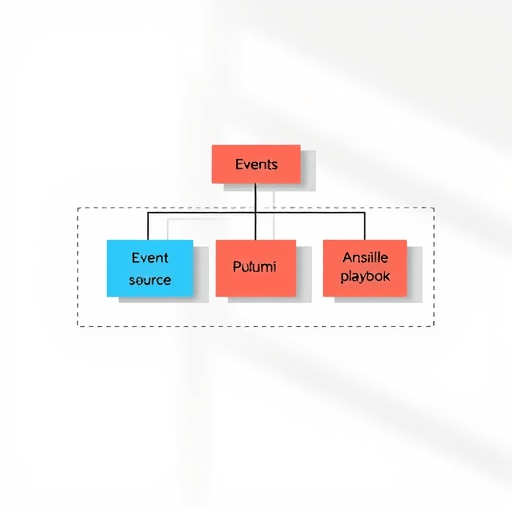
To make the system truly event-driven, you need to map infrastructure events to Automation API calls. This event-driven provisioning blueprint consists of a few core components: a trigger source, a handler, and a target stack.
Choosing the Right Event Triggers
Your choice of event source matters more than the automation layer itself. The most robust patterns in current infrastructure include:
- Cloud provider webhooks: When a new instance is launched, a webhook fires and invokes the Automation API with the instance ID and metadata.
- Message queues: Services such as SQS, RabbitMQ, or NATS carry events such as “new deployment requested” and act as a durable buffer between producers and the automation layer.
- In-band API requests: A user or internal service makes a request, the application validates it, and the Automation API is invoked synchronously with a preview step before the update.
Handling Concurrency and Idempotency
One challenge with wrapping Ansible playbooks in Pulumi’s Automation API is that you now have two sources of idempotency. Ansible modules are already idempotent, so re-running a playbook is safe. Pulumi stacks also support concurrent operations, but updates to the same stack must be serialized to avoid state conflicts. A solid blueprint uses a per-stack lock, either through a database row or a distributed lock such as Redis. This ensures that two simultaneous events for the same server do not result in two competing Automation API runs.
Making Dynamic Updates Feel Routine
Dynamic updates are the main payoff of this architecture. Consider a scenario where a security group is updated to allow inbound traffic on a new port. The corresponding Ansible playbook needs to adjust firewall rules on every host in the group. Without an event-driven blueprint, you would write a script to iterate over hosts, loop through inventory, and hope SSH connections succeed. With the Automation API wrapper, you simply trigger the stack for each affected host, and Pulumi handles the orchestration, logging, and state tracking.
Another common example is scale-out events. An auto-scaling group sends a notification, the webhook handler calls the Automation API, and the playbook configures the new node, sets its hostname, and joins it to a cluster. When the group scales in, a second Automation API run drains connections and safely removes the node, reusing the same roles with different variables. The system never relies on stateful SSH sessions or manually maintained inventory files, so it behaves predictably even when events arrive in bursts.
Guardrails for Production Use
Moving this pattern from a demo to production requires discipline. The following guardrails should be part of any serious implementation.
Centralize State Storage
Make sure the Automation API uses remote state storage, such as an S3 bucket, Azure storage account, or a self-hosted object store. Local state files cause conflicts when multiple events trigger updates simultaneously. Centralized state also provides an audit trail and makes it possible to roll back a failed run by referring to the recorded outputs.
Version the Wrapper and the Playbooks
The code that wraps Ansible should be versioned alongside the playbooks. If a playbook changes, the wrapper still points to the correct version. If the wrapper itself changes, you know exactly which run logic was used for any given update. Tagging the Automation API program in your repository with the same version as the playbook repository simplifies debugging and helps maintain predictable behavior over time.
Define an Explicit Error Policy
When an Automation API run fails, decide in advance whether to retry, roll back, or simply alert. Ansible’s task output should be streamed into logs rather than hidden in a terminal. Because the Automation API supports streaming callbacks for output, pipe those logs directly into your observability stack. This gives your on-call team the exact task that failed and the full context of the event that triggered it.
From Blueprint to Live Delivery
Putting it all together, the implementation path is straightforward. First, extract your existing Ansible plays into modular roles that accept a small set of runtime variables. Second, create a Pulumi program that calls the appropriate role based on the event payload. Third, expose that program through a lightweight service: a serverless function, a containerized REST API, or a Kubernetes controller. Finally, connect your event sources to that service and let the automation flow.
Each incoming event becomes a structured payload, and each payload becomes a stack update. Over time, SSH bastions and cron-driven playbooks become unnecessary. Your operations team no longer talks to servers directly; they interact with the automation layer, which coordinates all the cloud resources and the Ansible playbooks that configure them. The result is a platform that feels less like a collection of scripts and more like a product with an API.
The Payoff of Wrapping Ansible Playbooks in Pulumi’s Automation API
The goal is not to replace Ansible with something newer. It is to make Ansible more responsive, safer to operate, and easier to embed into a wider automation culture. By wrapping Ansible playbooks in Pulumi’s Automation API for dynamic updates, you get the maturity of a proven configuration management tool and the flexibility of a modern infrastructure automation framework. In an industry where change is constant, this event-driven provisioning blueprint is the practical way to keep infrastructure aligned with the pace of your business.
Teams that adopt this pattern quickly discover that their infrastructure no longer needs to be pre-provisioned for every possible scenario. Instead, it can react, adapt, and heal itself through the same automation that delivers applications. That is the ultimate value of a unified, event-driven approach: it turns infrastructure maintenance from a scheduled chore into a real-time capability.