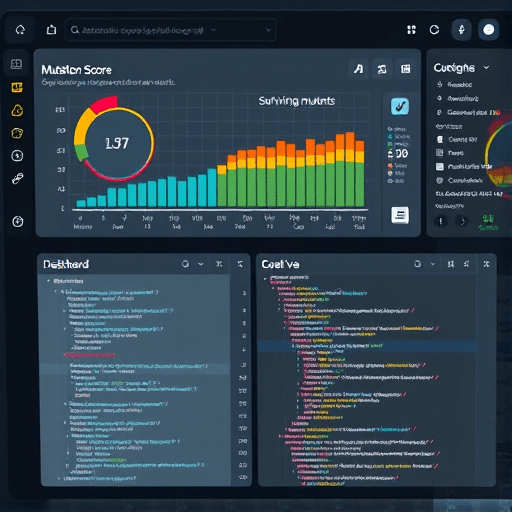
Coverage is a seductive metric. A green report, a high percentage, and the CI pipeline gives its approval. But any developer who has deleted an assertion and watched the test still pass knows the truth: coverage measures execution, not protection. If you have ever needed to find gaps in your unit test suite that coverage reports simply cannot reveal, mutation testing is the technique you are looking for. By injecting small faults into production code and checking whether your tests detect them, mutation testing exposes weak assertions and blind spots that make a suite fragile. In 2026, as AI assistants churn out unit tests at an unprecedented pace, that distinction matters more than ever.
Why Code Coverage Overstates Test Suite Quality
Line coverage and branch coverage answer one question: “Was this line or branch executed during the test run?” They do not answer the more important question: “Would this test fail if the behavior changed?” A test can execute every line in a method and still be embarrassingly shallow.
Take a simple Calculator.add method. A test might call it with two numbers and assert that the result is not null. That test covers the method, but it would not notice if the implementation changed from addition to subtraction. The assertion only verifies that some object came back. The actual behavior of the method is never checked. This is the classic weak assertion problem, and it is exactly where code coverage leads you astray.
Coverage encourages quantity. It rewards tests that run more code, not tests that verify more behavior. As a result, teams can celebrate 90% coverage while their most important business logic remains effectively untested. Mutation testing cuts through this illusion by focusing on what tests can actually detect.
How Mutation Testing Exposes Weak Assertions
Mutation testing works by creating slightly changed versions of your source code, called mutants. A mutant might flip a comparison, remove a method call, change a logical operator, or return a default value. The test suite is then run against each mutant. If one or more tests fail, the mutant is “killed.” If the tests still pass, the mutant “survives.” That survivor is a signal: something about the code’s behavior changed, and your tests did not notice.
This process directly targets weak assertions. For example, consider a method that calculates a discount. Your test verifies that the method returns a value above zero but never checks the exact discount for a given input. A mutant that changes the discount rate from 0.2 to 0.1 would survive, because any positive number still passes. The test looks useful, but it does not protect the actual business rule.
Some common weak assertion patterns that mutation testing will catch include:
- Asserting only that a value is not null instead of checking the value itself.
- Asserting that a boolean method returns true without testing the cases where it should return false.
- Comparing an actual result against a variable computed using the same faulty logic.
- Checking that an exception was thrown but not verifying the exception type or message.
- Using a single hard-coded input that cannot expose changes to the algorithm.
When a mutant survives, you have not necessarily found a bug in your production code. You have found a gap in your test’s ability to detect a behavior change. That is the first step toward fixing it.
The New Mutation Testing Landscape in 2026
Mutation testing used to be classified as too slow and too academic for everyday development. That reputation is outdated. Modern tools such as Stryker, Pitest, Infection, and other language-specific frameworks have made mutation testing practical in real CI pipelines. Incremental mutation analysis, test filtering, and parallel execution have dramatically reduced runtime.
At the same time, AI-generated unit tests have made mutation testing more valuable than ever. Generated tests are often built to satisfy coverage thresholds. They usually contain generic assertions, such as checking that a call returns something or that no exception is thrown. Mutation testing acts as a behavior-based reviewer for these tests, quickly identifying which AI-generated tests deserve to stay and which are merely decorative.
The goal is not to run mutation testing on every commit. The goal is to make it a reliable part of your quality strategy, especially for modules where correctness is critical.
How to Make Mutation Testing Work Without Slowing Down Your Build
Mutation testing can be expensive if you treat it like a unit test run. The trick is to apply it strategically. A sensible approach looks like this:
- Start with a single module or package instead of the entire codebase. Focus on code that handles money, security, permissions, or complex business rules.
- Set a mutation score threshold that is achievable and meaningful. Many teams find 70% to 80% a useful starting point before raising the bar.
- Run mutation tests on a schedule, in a pre-merge pipeline, or as a separate CI stage rather than on every local save.
- Use incremental mutation testing when your tool supports it. This only tests mutants in code that has changed, which cuts runtime significantly.
- Configure your tool to ignore trivial mutants that add little value, such as constant string changes or formatting-only mutations.
Even a small mutation testing rollout will expose surprising weaknesses. Teams often discover that their most critical service classes have far lower mutation scores than their coverage reports suggested.
A Practical Strategy for Catching Weak Assertions with Mutation Testing
Mutation testing is more than a report to glance at. It is a diagnostic tool that should change how you write tests. When a mutant survives, ask a simple question: “What behavior did I fail to lock down?” Then strengthen the test to kill that mutant, not by weakening the mutation, but by strengthening the assertion.
For example, if a mutant survives because a collection method returns items in the wrong order, your test should assert the exact expected sequence. If a mutant survives because an error message changed, your test should verify the message content. If a mutant survives because a method returns a default value instead of calculating a result, your test should compare the result to a concrete, hand-computed value.
This practice naturally leads to a clearer test suite. Tests become less about “does the code run?” and more about “does the code behave as specified?” It also creates a feedback loop: every surviving mutant documents a specific gap in test coverage, and every kill builds confidence in the suite.
Common Pitfalls to Avoid When Adopting Mutation Testing
Like any powerful technique, mutation testing can be misused. The most common pitfall is chasing a perfect score by spending hours on equivalent mutants, which are mutants that change the code but not its observable behavior. These are rarely worth the effort. Use your tool’s equivalent mutant detection or simply accept a reasonable threshold.
Another pitfall is applying mutation testing uniformly across the codebase. Generated getters, simple data transfer objects, and trivial utility methods are not where weak assertions cause serious damage. Prioritize the parts of your system where a silent behavior change would be costly. The point of mutation testing is not to achieve 100% mutation score; it is to focus attention on the tests that actually protect your application.
Finally, resist the urge to use mutation score as a performance-review metric. It is a diagnostic signal, not a target. Teams that treat it as a strict KPI often end up gaming the system with weaker mutations or over-filtering. The real value comes from the conversations it starts about what your tests are verifying and why.
Conclusion
The goal of unit testing is not to hit a coverage number. It is to feel confident that your code behaves correctly and that regressions will not go unnoticed. Mutation testing helps you find gaps in your unit test suite by exposing where assertions are too weak to matter. It turns test suite quality from guesswork into evidence, and in a world where tests can be generated faster than ever, that evidence is exactly what you need.