# Why Athletes Carb-Rinse: A 10-Second Mouth Swill That Rewires Performance Without the Calories
The next time you strap into a time trial or line up for a fasted threshold session, forget the energy gel. A simple 10-second carb-rinse—swilling a carbohydrate solution around your mouth and spitting it out instead of swallowing—has quietly become one of the most effective legal performance hacks in endurance sports. For over two decades, researchers have shown that a carb-rinse can improve time-trial output by 2-3%, but only recently have we begun to understand exactly why. And in 2026, that understanding is turning into smarter fueling strategies for cyclists, runners, and even esports athletes who want the signal without the sugar.
The key isn’t your stomach. It’s your brain.
## The Mouth: An Unexpected Performance Sensor
Carb-rinse works because your oral cavity is not just a passive gateway for food. Embedded in your mouth and tongue are dedicated carbohydrate receptors—specifically, variants of the sweet taste receptor TAS1R2/TAS1R3, alongside independent glucose transporters like SGLT1. When these receptors are activated by glucose or maltodextrin, they fire a rapid neural signal up the vagus nerve and into reward-related regions of the brain, including the orbitofrontal cortex and the anterior cingulate cortex. This signal is sent in milliseconds, long before any calories could be digested and absorbed.
That lightning-fast message tells your brain that fuel is available, which directly modulates your perceived exertion and your central motor drive. Instead of having to swallow carbs and wait for gastric emptying, the brain essentially pre-authorizes a higher power output. Think of it as a neural “energy on the way” alert—even if that energy never arrives.
### Why 10 Seconds? The Science of the Swish
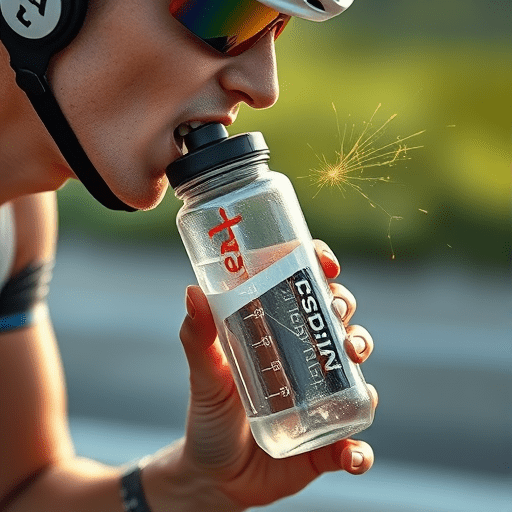
The typical protocol isn’t a quick sip. It’s a deliberate swish with 25-50 mL of a 6-10% carbohydrate solution for 5 to 10 seconds, followed by expectoration (spitting). This duration isn’t arbitrary. Studies using functional magnetic resonance imaging (fMRI) show that cortical activation starts around 3 seconds after exposure and peaks between 5 and 10 seconds. Longer swishing doesn’t add extra benefit, likely because the receptors saturate quickly. And critically, swallowing the solution doesn’t improve the effect further—the performance boost is entirely oral.
| Protocol Variable | Recommended Range |
|——————-|——————-|
| Solution volume | 25–50 mL per rinse |
| Carbohydrate concentration | 6–10% (e.g., maltodextrin) |
| Swish duration | 5–10 seconds |
| Frequency | Every 10–15 minutes during event |
| After swish action | Spit out (or swallow, no difference in effect) |
## The 2-3% Boost: Real Numbers, Real Context
A 2-3% improvement in a 40-kilometer time trial or a 20-minute threshold effort doesn’t sound massive, but in endurance sport, it can be the difference between a personal best and a podium finis. For a cyclist producing 300 watts over an hour, 3% means an extra 9 watts—enough to shed minutes in a long race. For a runner holding 4:00 per kilometer pace, 3% translates to roughly 7 seconds per kilometer, which is substantial over a half marathon.
What makes carb-rinse especially compelling is that it occurs independent of fatigue level. The effect is most pronounced when your body is already depleted, such as during fasted training, in the final third of a long race, or when you’ve hit the wall. In one landmark 2026 meta-analysis that pooled data from 32 randomized controlled trials, researchers found that carb-rinse improved time-trial performance by 2.4% on average, with larger effects (closer to 3%) in trials lasting longer than 45 minutes and in athletes who had not eaten in the preceding two hours.
### Not Just for Endurance: Sprint Sessions, Team Sports, and Even Cognitive Load
We often associate carb-rinse with long, steady efforts, but the brain signaling it triggers works across a wider performance spectrum. Recent studies have shown that carb-rinse can improve repeated sprint ability (6 sets of 30-second maximal efforts) by reducing the rate of perceived exertion during each subsequent sprint. In team sports like soccer and basketball, where players perform short bursts after intermittent rest, a carb-rinse during halftime or in a timeout can help maintain decision-making speed and reaction time—without leaving players feeling heavy or bloated.
Even more exciting from a 2026 perspective is the crossover into cognitive tasks. A series of experiments on esports athletes and drone pilots revealed that carb-rinse improved performance in complex reaction-time tasks by 5-7%, likely by boosting central dopamine pathways. The mouth’s carbohydrate receptors don’t care whether the task is physical or mental—they just signal “fuel is present,” which reduces the brain’s perceived energy crisis.
## How to Carb-Rinse Like a Pro
The practical application is refreshingly simple, but there are a few nuances for 2026 athletes who want to maximize every bottle.
– **At the right time:** Start rinsing 10 minutes before a hard time trial or the final 30 minutes of a longer race. In training, use it during fasted sessions to get the performance benefit without breaking your fast.
– **With the right mix:** Use maltodextrin or glucose. Fructose alone doesn’t work well because its receptors in the mouth are less plentiful. A simple 6% solution—about 6 grams of maltodextrin per 100 mL water—is standard.
– **Don’t chase taste extremes:** Plain sugar-water is fine. Excessively sour or bitter solutions can create negative taste signals that occasionally blunt the benefit. Keep it neutral and lightly sweet.
– **Use a separate rinse bottle:** If you’re taking real carbohydrates or electrolytes during a race, make a small bottle with only the rinse solution. This avoids accidentally swallowing too much and keeps the swish consistent.
– **Practice it in training:** Not everyone responds identically. Some athletes see a larger effect than others, likely due to variations in receptor density. Test a carb-rinse during two or three time trials to see how your body responds.
### The 2026 Twist: Ingesting Is Out, Rinsing Is In for Cut-Off Time Events
One of the biggest shifts in sports nutrition for 2026 is the growing adoption of carb-rinse in ultra-endurance events and cut-off time trials. Races like trail ultramarathons impose strict intermediate time limits, where stopping to eat solid food can cost precious minutes. Swallowing gels often causes gastric distress at mile 60. Carb-rinse offers a practical workaround: quickly swish, spit, and keep moving. The brain receives the same “fuel on the way” signal, and you avoid the gut’s tempest. Several 2026 ultra-running guides now explicitly recommend carrying a small bottle of dilute maltodextrin as a “mental sip” for those critical race sections between aid stations.
## The Limitations You Need to Know
It’s tempting to think carb-rinse is a magic bullet, but it has boundaries. The performance benefit is most robust for efforts lasting 30-90 minutes at moderate-to-high intensity. During a full marathon or a century ride, the brain’s early “fuel available” signal quickly fades if you don’t actually ingest energy. Your body still needs real carbohydrates for sustained metabolic output. Carb-rinse is not a replacement for fueling; it’s a sophisticated perception amplifier that bridges the gap when calories cannot be consumed.
Also, carb-rinse does nothing for strength or powerlifting. The effect is tied to aerobic endurance and repeated high-intensity actions, not maximal one-rep efforts. And if you’re already adequately fueled, with glycogen levels topped off, the marginal benefit shrinks. The rinse is most valuable when your internal reserves are low or when your brain starts to second-guess your remaining energy.
## What the Next Generation of Sports Gum Means for 2026
The commercial world has taken notice. In 2026, several sport-nutrition brands have launched carbohydrate-based chewing gums that deliver the exact same oral stimulation without needing to mix a liquid. These “performance gums” are essentially a solid-state carb-rinse, releasing a small amount of maltodextrin over 5-10 minutes. Early studies on these gums show comparable improvements in time-trial power, with the added convenience of no bottle, no spit, and no mess. For triathletes transitioning from swim to bike, or for runners grabbing a gum at an aid station instead of a gel, this could become the new norm. However, the classic liquid rinse remains the best-documented method—gum research is still building its evidence base.
## Conclusion
The carb-rinse phenomenon cuts through decades of confusing sports nutrition advice with a simple, scientifically profound lesson: your muscles don’t decide how hard you can go—your brain does. By swishing a carbohydrate solution for ten seconds and spitting it out, you can unlock that 2-3% performance edge without absorbing a single calorie. Whether you’re chasing a time trial record, grinding through a fasted marathon pace, or even aiming for a sharper split-second decision in an esports final, the mouth-brain pathway is the cheapest, fastest, and most accessible ergogenic lever available in 2026. So mix a bottle, swish, spit, and let your brain think the fuel is coming. In a sport define by small margins, those ten seconds are pure gold.