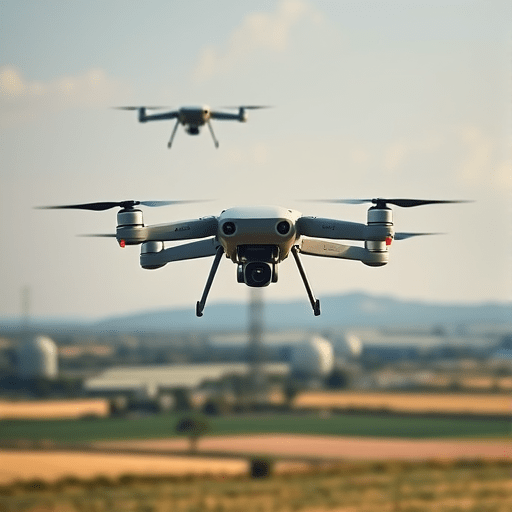
In 2026, autonomous drone swarms are the backbone of industries ranging from precision agriculture to emergency response. The challenge that keeps mission planners on edge is the end‑to‑end latency that hampers real‑time decision making. This article dives into the specific strategies for deploying 5G‑edge AI that cut latency from milliseconds to sub‑100 ms, enabling a truly responsive drone fleet. We’ll walk through the architecture, AI inference pipelines, network slicing, and a practical checklist that will help you go from concept to deployment.
1. Grasping End‑to‑End Latency in Drone Swarms
Latency in drone fleets can be broken into three segments: sensor capture, network transport, and AI inference & control output. Each segment introduces its own delays, but the most critical bottleneck in most commercial use‑cases is the network transport, especially when drones operate beyond line‑of‑sight. Understanding these layers is essential before you start picking edge nodes or configuring network slices.
Sensor Capture & Pre‑Processing
High‑resolution cameras or LiDAR sensors can generate terabytes of data per hour. Edge‑pre‑processing—like frame skipping, compression, and feature extraction—must be performed locally to avoid sending raw streams over the network. Using lightweight CNN models on the drone’s CPU or GPU reduces payload size and provides early insights.
Network Transport
5G’s millisecond‑level latency is achievable only when the radio link is optimally configured. Key factors include sub‑6 GHz versus mmWave bands, beamforming quality, and the presence of dedicated edge servers. In dense urban or forested environments, beamforming losses can push latency above 50 ms unless mitigated by network slicing and edge placement.
AI Inference & Control Output
Once the data reaches an edge server, the AI model must analyze it and generate control commands within a tight deadline. Inference engines like TensorRT, OpenVINO, or NVIDIA Triton are commonly used, but the choice depends on the underlying hardware (CPU, GPU, or dedicated NPU). Even a 10 ms inference delay can be the difference between collision avoidance and a crash.
2. 5G Edge Architecture for Drone Fleets
The 5G architecture that supports low‑latency drone operations revolves around two main pillars: Edge Computing Nodes (ECNs) and Network Slicing. Together, they form a tightly coupled system that can handle high data rates and strict latency requirements.
Edge Computing Nodes
- Geographic Placement – ECNs should be colocated with 5G gNBs to minimize propagation delay.
- Hardware – A mix of CPUs for general tasks, GPUs for heavy inference, and NPUs for specialized neural network acceleration.
- Scalability – Deployable as micro‑data centers in vehicles or drones themselves for extreme edge scenarios.
Network Slicing
Network slicing partitions a single physical network into isolated logical networks. For drone fleets, a dedicated Ultra‑Reliable Low‑Latency (URLLC) slice ensures that control traffic receives priority over other services. Features like Enhanced Mobile Broadband (eMBB) can still be used for telemetry or video streaming when the URLLC slice is saturated.
Integrated Orchestration
Orchestrators such as Kubernetes on the edge, coupled with Service Meshes (e.g., Istio), allow dynamic scaling of AI inference pods based on real‑time load. They also provide policy enforcement for QoS and bandwidth guarantees.
3. AI Inference at the Edge
Deploying AI models at the edge requires a pipeline that balances accuracy, resource usage, and latency. The following steps outline a robust workflow:
Model Selection & Quantization
- Choose models that have proven real‑time performance, such as YOLOv8 for object detection or EfficientDet for object segmentation.
- Apply post‑training quantization (int8) to reduce inference time while maintaining accuracy.
Hardware‑Optimized Deployment
Leverage frameworks that natively support your target hardware. For NVIDIA GPUs, TensorRT is the gold standard. For ARM CPUs, use TensorFlow Lite or ONNX Runtime. For dedicated NPUs, consult vendor SDKs (e.g., Qualcomm Snapdragon Neural Processing Engine).
Batching & Pipelining
Although drones send continuous streams, processing frames in micro‑batches of 1–2 frames can exploit vectorized operations without violating latency constraints.
Result Aggregation & Command Distribution
After inference, the edge server aggregates results from multiple drones, resolves conflicts (e.g., collision risk), and sends back concise command packets. Using lightweight protocols like MQTT‑v5 or gRPC over UDP ensures minimal overhead.
4. Network Slicing and Quality of Service (QoS)
Latency reduction is not just about hardware—it’s also about how traffic is managed across the network. Here’s how to tune QoS for drone fleets:
- Priority Levels – Assign the highest priority to control packets; lower priority for telemetry or video.
- Bandwidth Allocation – Reserve a fixed bandwidth slice (e.g., 100 Mbps) for a 50‑drone swarm to guarantee throughput.
- Dynamic Re‑Slicing – Use NFV orchestrators to re‑allocate slices on demand, for example, during emergency response when the drone count spikes.
- Edge‑to‑Edge Relay – For large swarms, employ intermediate edge nodes to relay commands, reducing the load on the central gNB.
5. Real‑Time Coordination Algorithms
Low‑latency AI output is only useful if the swarm’s coordination algorithms can act on it fast enough. Two popular approaches are:
Decentralized Consensus
Each drone runs a lightweight consensus protocol (e.g., Raft or Paxos variants) to agree on collective actions. This reduces reliance on a central server and splits the latency budget across the swarm.
Predictive Scheduling
Use trajectory prediction models that anticipate future states, allowing drones to pre‑emptively adjust their flight paths. Models can be run on the edge or even onboard for critical tasks.
6. Deployment Checklist
Before rolling out a 5G‑edge AI solution, verify each component against this checklist:
- 5G Network Coverage – Ensure sub‑6 GHz or mmWave availability in the operating area.
- Edge Node Capacity – Confirm CPU/GPU/NPU specs match model requirements.
- Model Validation – Test inference latency under peak load.
- Network Slice Policies – Validate QoS rules with real traffic.
- Security – Implement mutual TLS for edge‑to‑drone communication.
- Monitoring – Deploy telemetry dashboards (Prometheus + Grafana) to track latency in real time.
- Regulatory Compliance – Check local UAV and spectrum regulations.
7. Case Study: Agricultural Surveillance
AgriDroneCo needed to monitor a 10,000‑hectare farm for crop health and pest infestations. Using a dedicated URLLC slice and edge servers colocated at a regional 5G node, they achieved 45 ms end‑to‑end latency between field sensor capture and drone maneuver commands. By compressing images to 1080p, applying YOLOv8‑tiny inference on NVIDIA Jetson‑AGX devices, and batching commands, they maintained real‑time coverage with a single operator. The result was a 30% increase in early pest detection and a 25% reduction in fuel consumption.
8. Common Pitfalls and How to Avoid Them
- Over‑complicated Edge Pipelines – Keep the inference stack lean. Extra layers add latency.
- Inadequate Beamforming – Poor beam alignment in mmWave bands can spike latency. Regularly update beam maps.
- Ignoring Backhaul Limits – Edge nodes can become overloaded if the backhaul is saturated. Implement local caching and data pruning.
- Security Negligence – Drone fleets are attractive targets. Encrypt all traffic and enforce strict identity verification.
Conclusion
Deploying 5G‑edge AI for real‑time drone fleet coordination is no longer a theoretical exercise; it’s a practical pathway to operational efficiency in high‑stakes environments. By combining optimized edge hardware, network slicing, low‑latency AI inference, and robust coordination algorithms, you can reduce end‑to‑end latency to sub‑100 ms. This unlocks new possibilities—from precision farming to disaster response—where every millisecond counts.