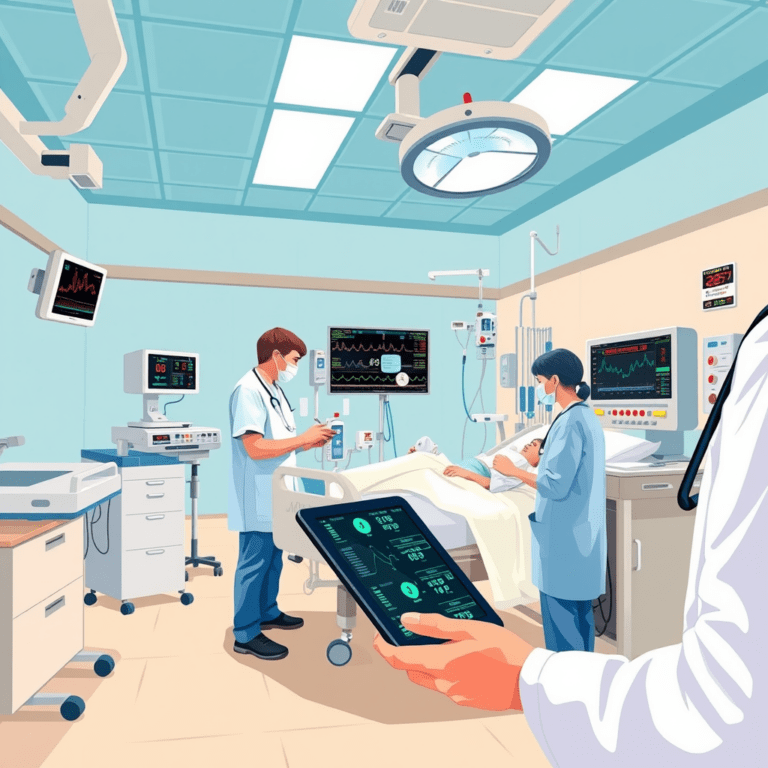
Clinical Workflow Twins are rapidly moving from experimental concept to operational tool in hospitals; by combining EMR logs, medical device telemetry, and scheduling systems, Clinical Workflow Twins create digital replicas of care processes that reveal where delays, crowding, and errors are most likely to occur.
What is a Clinical Workflow Twin?
A Clinical Workflow Twin is a digital model that mirrors patient flow and clinician activity across care pathways. Unlike single-purpose dashboards, these twins simulate interactions between people, systems, and devices—so teams can run “what-if” scenarios, forecast delays, and test mitigations without risking patient safety.
Core capabilities
- Event-level replication from EMR timestamps, device logs, and operational systems.
- Near-real-time monitoring and scenario simulation to predict downstream effects of a delay.
- Actionable alerts and prioritization recommendations integrated into clinical workflows.
How pilot programs turn EMR and device data into workflow replicas
Pilots typically begin by ingesting three classes of data: transactional EMR events (orders, meds, nurse notes), device telemetry (ventilator states, infusion pump logs), and operational inputs (bed assignments, OR schedules). The challenge is stitching these asynchronous, heterogeneous streams into a single timeline for each patient and resource.
Data ingestion and alignment
- Normalize timestamps (time zone, device clock drift) and resolve patient identifiers across systems.
- Use event-sourcing pipelines to capture granular actions rather than aggregated snapshots.
- Apply lightweight ontologies to map device states and EMR events to standardized workflow states.
Modeling approaches
Pilots use a mix of discrete-event simulation, Markov-process models, and machine learning-based sequence models. Discrete-event simulation excels at resource contention scenarios (e.g., ED beds), while sequence models predict the probability distribution of next events (e.g., likelihood a lab delay leads to delayed antibiotic administration).
Validation and clinical sign-off
Validation combines historical back-testing (did the twin reproduce known bottlenecks?), prospective shadowing (compare twin predictions to observed outcomes), and clinician review panels to verify clinical face validity.
Measurable reductions in delays and errors
Pilot programs across diverse hospitals report measurable improvements when clinical workflow twins are used to inform interventions. While outcomes vary, published pilots and vendor case studies commonly show:
- ED boarding time reduction of 10–30% after workflow-informed bed-assignment changes.
- 30–50% reduction in time-to-antibiotic for sepsis pathways when predicted bottlenecks trigger prioritized lab or transport actions.
- Decreased medication administration errors and omitted doses when device telemetry is correlated with EMR medication events, with error rates falling in single-digit percentage points.
- Improved OR utilization and fewer last-minute cancellations through scenario planning of downstream staffing or equipment constraints.
These gains are typically reported in pilot-to-pilot ranges rather than as universal guarantees, because impact depends on data fidelity, clinical workflow maturity, and the organization’s capacity to act on insights.
Integration hurdles: technical, organizational, and regulatory
Translating pilots into production faces predictable obstacles.
Technical
- Data silos and incompatible formats: legacy devices and closed EMR modules complicate end-to-end timelines.
- Latency and reliability: real-time decision support requires robust streaming pipelines and fallbacks.
- Model drift: process changes (new policies, staffing models) reduce predictive accuracy unless models are continuously retrained.
Organizational
- Clinician trust and workflow fit: alerts must be precise and context-aware to avoid alert fatigue.
- Cross-department governance: operations, IT, clinical safety, and legal must align on responsibilities for simulation-suggested changes.
- Change management: pilots that show ROI still fail if frontline staff aren’t part of design and deployment.
Regulatory and privacy
- PHI handling across streaming pipelines requires strict access controls and encryption-in-transit/at-rest.
- Auditability: every recommendation should be traceable to inputs and model state for safety reviews and regulatory inspection.
Playbook for scaling Clinical Workflow Twins across hospitals
The following playbook condenses lessons from successful pilots into replicable steps for scaling.
- Define a focused use case. Start with one high-value pathway (ED throughput, sepsis, or OR turnover) to limit scope and maximize measurable outcomes.
- Assemble a cross-functional team. Include clinical champions, operations leads, data engineers, and safety/compliance officers.
- Establish a minimal viable data contract. Identify required EMR events, device logs, and schedule inputs; agree on identifiers and timestamp normalization rules.
- Build a reproducible pipeline. Use event streaming (Kafka, FHIR Subscriptions) and containerized processing for portability and observability.
- Model iteratively and validate continuously. Shadow the twin, back-test, then run in “advisor” mode before enabling automated actions.
- Design clinician-facing actions. Translate predictions into prioritized tasks, not raw probabilities—embed into existing workflows or order sets.
- Measure and publish KPIs. Track time-based metrics, safety events avoided, and clinician satisfaction; iterate based on feedback.
- Govern and scale. Establish an operating model for updates, data access, and model governance as new pathways are added.
Vignette: A medium hospital pilot
A 350-bed community hospital piloted a clinical workflow twin for sepsis recognition and ED-to-ward transitions. The team normalized EMR nursing observations, lab timestamps, and infusion pump logs, then trained a sequence model to flag patients at high risk for delayed antibiotic delivery. Over six months the twin’s dashboard and targeted transport/prioritization protocol lowered median time-to-antibiotic by 22% and reduced ED boarding by 15% when combined with bed-management playbooks. The pilot succeeded because of daily huddles between ED, lab, and bed management that acted on twin recommendations.
Conclusion
Clinical Workflow Twins are proving they can convert messy EMR and device data into practical, predictive replicas of hospital processes—delivering measurable reductions in delays and errors when pilots are carefully designed, validated, and paired with clinician-led change management.
Ready to pilot a Clinical Workflow Twin at your facility? Contact clinical leaders, data engineering, and operations partners to scope a focused 90-day use case and start turning your EMR and device data into actionable foresight.