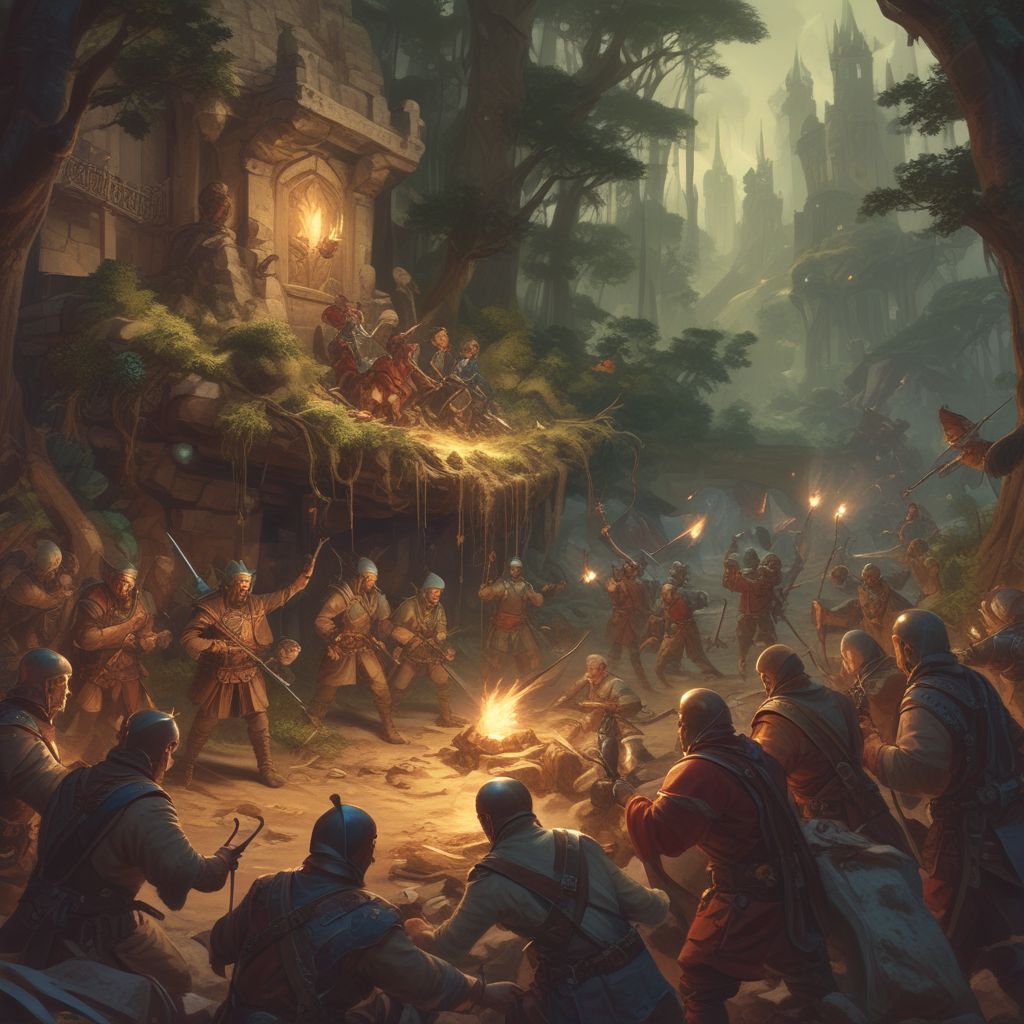
Campaign chaining—the practice of linking portable mini-conflicts into an overarching meta-campaign—reframes how players experience strategy RPGs by letting discrete tactical skirmishes ripple into a living geopolitical saga. In this article, discover how nested campaigns can be designed, balanced, and tuned so that small, repeatable encounters accumulate into meaningful longform stories shaped by player choices, emergent systems, and procedural design.
Why Nested Campaigns Matter
Traditional strategy RPGs often present a single long campaign or a set of static missions. Nested campaigns, by contrast, treat each skirmish as a modular narrative atom that can be repeated, recombined, and chained. The value of this approach is threefold:
- Player-driven narrative: Each tactical result feeds the meta-layer, allowing players to feel the weight of small victories and losses.
- Replayability: Portable encounters can be procedurally varied and recombined into fresh chains.
- Scalability: Developers can design many short modules and let procedural logic create thousands of unique campaign arcs.
Core Mechanics of Campaign Chaining
At its heart, campaign chaining is an engine that maps the outcome of a mini-conflict onto state changes in a meta-world. The pipeline usually follows three steps:
- Encounter resolution: Tactical skirmish ends with a result (victory, stalemate, retreat, critical loss).
- State application: Outcome applies modifiers to factions, territories, resources, reputations, or trigger flags.
- Next-scenario selection: A procedural selector chooses the next skirmish using the updated state, constraints, and narrative hooks.
Portable Mini-Conflicts
Portable mini-conflicts are small scenarios designed to be plug-and-play. They include:
- Clear objectives (capture, defend, raid, escort)
- Variable parameters (terrain seed, enemy composition, time of day)
- Attachable meta-tags (strategic value, political sensitivity, resource type)
Because they are parameterized and tagged, these modules can be slotted into different regions or contexts, producing emergent meaning without bespoke scripting for every permutation.
Design Patterns for Emergent Longform Stories
1. State Persistence and Translation
Define which tactical elements persist: casualty tallies, commander experience, captured assets, or reputational damage. Translate these into meta-layer variables (e.g., “Frontline Pressure +2,” “Trade Goods -10%”). Keeping the mapping transparent to players improves narrative coherence.
2. Branching Reputation and Politics
Let factions and NPCs react. A raid might increase a faction’s paranoia, close trade routes, or elevate a warlord. These political shifts create new campaign opportunities—ambushes, negotiations, betrayals—that feel consequential and human.
3. Temporal Chaining
Time can be discrete turns or an in-game calendar. Use time to introduce decay, seasonal effects, and strategic windows. For example, a failed siege in winter might amplify supply starvation, changing subsequent skirmishes’ parameters.
4. Narrative Anchors
Anchor the emergent flow with a handful of fixed events—rituals, major battles, or political congresses—that act as checkpoints. They provide rhythm and allow developers to inject handcrafted setpieces without breaking procedural variety.
Player Agency and Emergence
Campaign chaining excels when players can see a causal thread between skirmish-level choices and geopolitical outcomes. Design affordances that amplify agency:
- Visible consequences: Simple UI cues that show how an outcome changed the meta-state.
- Multiple meaningful paths: Offer strategic trade-offs (e.g., press an advantage to seize territory now vs. consolidate forces for long-term stability).
- Hero persistence: Let notable units or commanders survive and carry legacies—wounds, renown, rivalries—across chains.
When players can pursue personal goals (salvage for a hometown, revenge against a rival) while the larger political tapestry evolves, stories emerge that feel authored by players rather than prewritten scripts.
Blueprints and Example Flows
Example 1: Frontier Campaign
- Start: Border skirmish module with resource tag “Iron Mine.”
- Outcome: Player captures the mine → faction economy +5 → neighboring bandits’ hostility increases.
- Chain: New module spawns—“Bandit Siege of Supply Caravan”—with higher difficulty and political stakes.
Example 2: Political Dominoes
- Start: Diplomatic mission mini-conflict (protect envoy).
- Outcome: Envoy dies → ally reputation drops → ally refuses reinforcements.
- Chain: Territory becomes vulnerable, spawning opportunistic raids and a larger coalition response if the player chooses to intervene.
Balancing Replayability and Coherence
Procedural chaining must balance novelty with narrative sense. Too randomized, and the chain feels chaotic; too fixed, and it becomes linear. Strategies to find equilibrium:
- Constraint systems: Use soft rules to limit improbable sequences (e.g., two catastrophic defeats can’t occur back-to-back without an interlude).
- Themed seeds: Generate chains from high-level themes (insurgency, resource rush, dynastic war) so modules align tonally.
- Difficulty pacing: Scale threats based on cumulative player performance, not raw time, to maintain challenge and avoid grind.
Implementation Tips for Developers
- Model the meta-state as a small set of interpretable variables (stability, economy, morale, diplomatic tension) to keep reasoning tractable.
- Tag scenario modules richly—both mechanical tags and narrative tags—so the selector can make semantically meaningful choices.
- Expose debugging views during development to visualize chain logic and catch jarring transitions.
- Playtest with story-focused players and systems-focused players to identify where chains produce resonant narratives vs. mechanical churn.
Common Pitfalls and How to Avoid Them
- Neglecting feedback: If players can’t trace consequences, emergent stories feel random—add logs and clear cause-effect messaging.
- Over-optimizing for variety: Excessive permutations without thematic cohesion dilute emotional impact—use themed seeds and narrative anchors.
- Ignoring pacing: Chains that escalate too quickly or plateau remove tension—tune event frequency and stakes growth carefully.
Campaign chaining and nested campaigns open fresh design space for strategy RPGs: they let designers create ecosystems of modular encounters that produce unique, player-authored sagas through accumulation rather than scripting. When done well, small tactical choices become the seeds of grand narratives, and every skirmish feels like a chapter in a living chronicle.
Start prototyping mini-conflict modules, define a compact meta-state model, and iterate on how outcomes translate into new scenarios—campaign chaining turns clever mechanics into memorable stories.
Ready to experiment with campaign chaining in your next project? Try building three portable mini-conflicts and a simple state machine to see what emergent stories appear.