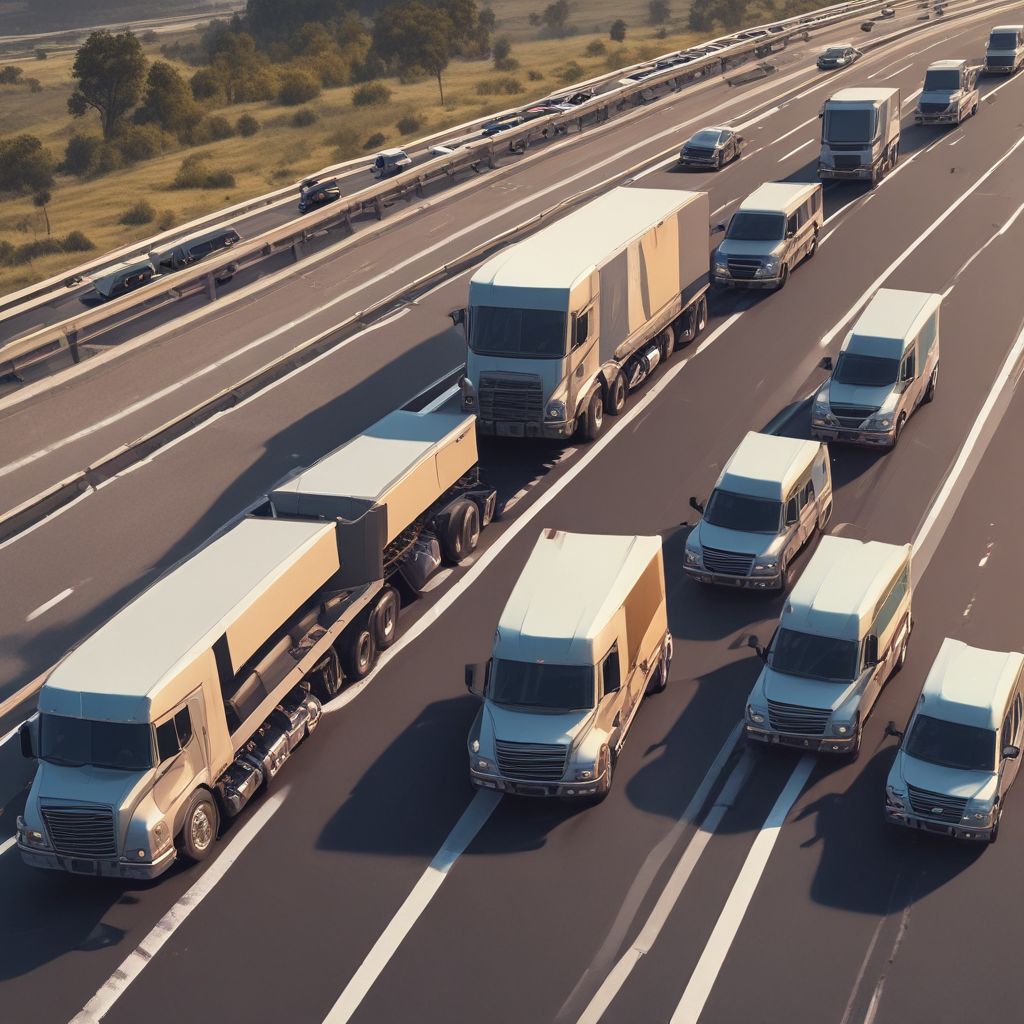
Simulating Driverless Platoons with Digital Twins: Accelerating Autonomous Fleet Deployment
In the race toward fully autonomous freight and public transport, the ability to simulate driverless platoons with digital twins is proving to be a game‑changer. By creating virtual replicas of entire vehicle fleets and their operating environments, engineers can test, tweak, and validate platooning algorithms at scale—without ever setting a wheel on a public road. This article explores why digital twin technology is critical for platoon deployment, how it works in practice, and what the future holds for autonomous swarm intelligence.
Why Platooning Matters for Autonomous Fleets
Platooning—the formation of tightly coupled convoys of autonomous vehicles—offers a suite of benefits:
- Fuel Efficiency: Reduced aerodynamic drag can cut fuel consumption by 10–15% for heavy trucks.
- Road Capacity: Shorter headways increase lane throughput, mitigating congestion.
- Safety: Coordinated braking and acceleration reduce the likelihood of rear‑end collisions.
- Operational Cost: Shared data and cooperative control lower maintenance and energy expenses.
Real‑world tests of these advantages require massive fleets, expensive road trials, and risk‑averse regulatory approvals. Digital twins sidestep these constraints, allowing rapid iteration and validation.
What Is a Digital Twin in the Context of Platooning?
A digital twin is a dynamic, data‑rich virtual model that mirrors a physical system in real time. For driverless platoons, the twin comprises:
- Vehicle dynamics models (mass, inertia, tire characteristics).
- Sensor and communication stack simulations (lidar, radar, V2V/V2X links).
- Environmental conditions (weather, traffic, road geometry).
- High‑definition maps and route planners.
These elements are fed by telemetry from testbeds or existing fleets, ensuring that the virtual behavior aligns closely with reality.
Key Technologies Enabling Accurate Twins
Physics‑Based Simulation Engines
Modern simulators such as CARLA, PreScan, and Simulink use finite element methods and multi‑body dynamics to capture vehicle motion precisely. They support customizable chassis models, enabling testing across a range of truck configurations.
Digital Twins for Communication Networks
Platooning depends on low‑latency, high‑reliability V2V links. Network simulators (ns-3, OMNeT++) model radio propagation, interference, and protocol stacks, allowing designers to validate safety‑critical message timing before hardware deployment.
AI‑Driven Behavior Models
Machine learning frameworks (TensorFlow, PyTorch) integrate with the twin to generate adaptive driving policies. Reinforcement learning agents can discover efficient platoon formations and adaptive spacing strategies in virtual environments that mirror real traffic.
Cloud‑Based Multi‑Agent Platforms
Distributed simulation environments, often built on Kubernetes, let teams run hundreds of concurrent vehicle instances, scaling from a single truck to a 30‑vehicle convoy. Cloud analytics collect metrics on fuel usage, latency, and safety incidents in real time.
Building a Digital Twin: Step‑by‑Step
- Define Scope: Decide which vehicle types, routes, and environmental scenarios to model.
- Collect Data: Use telematics, LIDAR, and onboard diagnostics from test vehicles.
- Create Vehicle Models: Parameterize dynamics and sensor suites.
- Model the Road Network: Import HD maps and traffic datasets.
- Integrate Communication Layers: Simulate V2V protocols and latency profiles.
- Implement Platooning Logic: Encode coordination algorithms (e.g., leader‑follower, distributed consensus).
- Validate with Benchmarks: Run unit tests and compare with real‑world data.
- Iterate & Optimize: Use analytics to tweak control gains, spacing policies, and failure handling.
Case Study: Reducing Fuel Costs for a Long‑Haul Fleet
A mid‑size logistics company sought to cut fuel consumption across its 80‑vehicle fleet. By creating a digital twin of its entire convoy, engineers tested various platooning strategies:
- Baseline: Conventional lane‑by‑lane driving.
- Static Platoon: Fixed inter‑vehicle spacing at 30 ft.
- Adaptive Platoon: Spacing adjusted based on speed, wind, and traffic density.
The adaptive strategy, validated in simulation over 10,000 virtual miles, projected a 12% fuel reduction. After a short pilot on a 200 km stretch, the real fleet achieved a 10% savings, confirming the twin’s predictive power. Deployment was completed in under six months—a fraction of the typical two‑year development cycle.
Regulatory and Safety Benefits
Digital twins help meet stringent safety standards by:
- Providing exhaustive test logs for safety case documentation.
- Enabling scenario coverage beyond the limits of physical testing (e.g., extreme weather).
- Allowing rapid response to incidents by replaying exact conditions in the virtual environment.
Regulators increasingly recognize virtual evidence as part of the certification process, reducing the barrier to market entry.
Challenges and How to Overcome Them
Data Fidelity
Accurate twin behavior hinges on high‑quality sensor data. Regular calibration and sensor fusion pipelines are essential.
Computational Demand
Simulating dozens of vehicles with high‑fidelity physics can be resource‑intensive. Leveraging GPU acceleration and cloud scaling mitigates this overhead.
Algorithm Transferability
Policies trained in simulation may not generalize perfectly. Incorporating domain randomization and sim‑to‑real adaptation techniques helps bridge the gap.
Cybersecurity
Digital twins expose networked systems to potential cyber threats. Implementing secure communication channels and isolation layers is critical.
Future Directions: Swarm Intelligence and Beyond
As vehicle connectivity matures, digital twins will evolve from isolated platoons to multi‑fleet swarms, integrating freight, passenger, and emergency vehicles. Emerging concepts include:
- Edge‑AI Twins: Running lightweight twin models directly on vehicle edge devices for real‑time validation.
- Hybrid Human‑AI Twins: Allowing human operators to intervene in simulations, accelerating mixed‑traffic testing.
- Cross‑Domain Twins: Combining road, rail, and maritime simulations for integrated logistics planning.
These advances promise even greater efficiency gains and safer autonomous ecosystems.
Conclusion
Simulating driverless platoons with digital twins is no longer a futuristic concept—it’s an essential toolkit for anyone looking to launch autonomous fleets rapidly, safely, and cost‑effectively. By harnessing realistic physics, robust communication models, and AI‑powered behavior, companies can validate platooning algorithms, satisfy regulatory bodies, and achieve tangible operational benefits before a single truck hits the road.
Ready to accelerate your autonomous fleet deployment? Dive into digital twin technology today and turn virtual trials into real‑world triumphs.