When traffic spikes hit an ecommerce platform, the checkout flow is usually the first system to buckle. That is exactly what happened to a mid-sized lifestyle retailer in late 2025, right before a flash sale campaign. Despite years of stable operation, the platform ground to a halt the moment daily orders crossed the 10,000 mark. The culprit was not the web servers, nor the payment gateway. It was the database layer. This case study walks through how a hybrid SQL-NoSQL architecture rescued the checkout flow, and why the lessons apply to any ecommerce resilience strategy in 2026.
The Day Everything Froze
The retailer had been running on a traditional relational setup. PostgreSQL handled inventory, users, orders, and sessions, all on a single primary node with a read replica. For two years, it worked beautifully. Then a viral social media moment drove 40,000 concurrent visitors into the storefront within a single hour.
Cart creation slowed, payment confirmations timed out, and inventory checks began returning stale data. Worst of all, abandoned carts spiked because customers saw a generic error at the final step. Post-mortem analysis revealed three pressure points: cart state contention on a single row, slow aggregate queries against the orders table, and session lookups that scanned millions of rows per second.
The team realized that scaling up the PostgreSQL instance vertically would only delay the problem. They needed a structural redesign.
Diagnosing the Real Bottleneck
Before re-architecting anything, the engineers profiled the failing queries. Three patterns emerged:
- Write amplification on the cart table. Every keystroke triggered an UPDATE on a single cart row. Under heavy concurrency, row-level locks piled up and latency climbed past two seconds.
- Aggregate pressure on orders. Reporting queries that calculated daily revenue and inventory burn rates were starving transactional queries.
- Session sprawl. Anonymous visitor sessions were bloating a shared table, causing the buffer pool to thrash.
The team also noticed something subtle: not all data behaved the same way. Cart data was ephemeral and high-write. Session data was semi-transient. Order data was durable and relational. That distinction became the foundation of the hybrid design.
Designing the Hybrid SQL-NoSQL Stack
The goal was not to abandon relational databases. It was to put each workload on the storage engine best suited for it. The new architecture introduced three tiers.
Redis for Cart State and Session Cache
The team moved active cart state into Redis using a hash per cart ID, with a TTL of 24 hours. Because Redis handles atomic increments and partial updates without row locks, cart writes remained sub-millisecond even at peak. Sessions were stored the same way, keyed by cookie value, with automatic eviction policies managing memory.
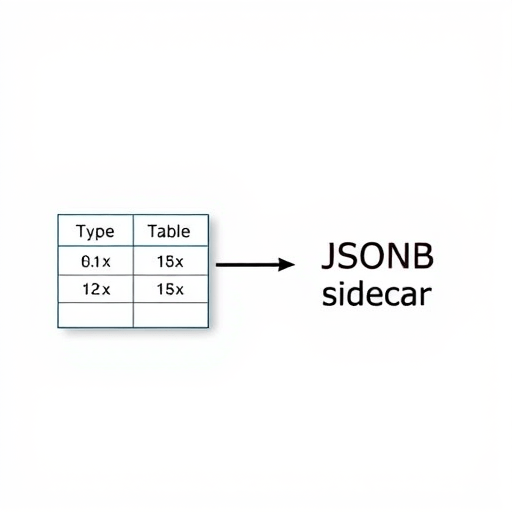
The crucial detail was durability. Every 30 seconds, the application flushed Redis cart state into PostgreSQL as a serialized JSON blob. If a customer closed the tab, the persisted record ensured the cart could be restored on the next visit. This gave the team the speed of in-memory storage with the safety of relational persistence.
PostgreSQL for Orders, Inventory, and Financial Truth
Orders remained in PostgreSQL because correctness mattered most. Inventory deductions, tax calculations, and payment reconciliation required ACID guarantees that a document store could not provide. To reduce contention, the team partitioned the orders table by month and introduced covering indexes for the most common access paths. They also implemented a write-through cache using logical replication, which kept a denormalized order summary in Redis for quick retrieval on confirmation pages.
MongoDB for Product Catalog and Browse Analytics
The product catalog was migrated to MongoDB because catalog content is naturally hierarchical, with variations, media, and localized descriptions. Document storage simplified schema evolution and let the team serve browse traffic from a separate read path, isolating it from checkout entirely.
Browse analytics, the third workload, was offloaded to MongoDB as a write-only collection. These events were high volume and low value, perfect for a flexible document model that could later feed a data warehouse.
The Migration Without Downtime
Re-platforming a live checkout is terrifying, so the team staged the rollout carefully. They began with a dual-write phase: every cart write hit both Redis and PostgreSQL for two weeks, with shadow reads comparing results. After confidence built, they flipped reads to Redis and kept PostgreSQL as the source of recovery.
Inventory migration was trickier. The team used a change data capture stream to replicate inventory changes into MongoDB in near real time, allowing the storefront to display stock from MongoDB while the checkout continued to reserve inventory through PostgreSQL transactions. This dual-source pattern is now a standard playbook for ecommerce resilience.
What Actually Changed After Launch
The numbers told a clear story. During the next flash sale, the platform absorbed 18,000 orders in a single hour, nearly double the previous peak, with zero checkout errors. Median cart-write latency dropped from 1,800 milliseconds to 9 milliseconds. Abandoned cart rate fell by 38 percent because customers could finally complete purchases without retries.
Behind the scenes, PostgreSQL CPU utilization stayed below 60 percent even at peak, because Redis absorbed the write storm and MongoDB served the browse path. The team also gained a new capability: real-time personalization. With cart state in Redis, they could trigger cross-sell recommendations within 50 milliseconds, something that had been impossible with the old single-row cart table.
Lessons for Other Engineering Teams
Every ecommerce architecture is unique, but the principles from this case study translate broadly.
- Match storage to workload. Cart and session data are hot, write-heavy, and disposable. Redis excels here. Orders need relational integrity. MongoDB is best for flexible catalogs and analytics.
- Keep the source of truth in SQL. NoSQL should accelerate the path, not replace financial records. Persist transactional data in a relational engine.
- Migrate with dual writes, not big bangs. Shadow reads and parallel pipelines let teams validate behavior without risking revenue.
- Partition hot tables early. Monthly partitioning on the orders table paid for itself within weeks.
- Watch for write amplification. If a single row sees thousands of updates per second, it is a sign that the data belongs in a key-value store.
One underappreciated lesson was cultural. The team had to stop thinking of SQL as the default and start treating storage as a toolbox. Hybrid SQL-NoSQL patterns are not about chasing trends. They are about assigning each workload to the engine that handles it best, then wiring them together with clear contracts and recovery paths.
The 2026 Reality for Ecommerce Platforms
As we move further into 2026, traffic spikes are no longer rare events. They are a permanent feature of digital commerce. Influencer campaigns, livestream shopping, and AI-driven personalization all generate unpredictable surges. Platforms built on a single relational database will continue to crack under that pressure.
Hybrid architectures are no longer experimental. They are the baseline for serious ecommerce resilience. Retailers that adopt them early gain not just uptime, but the ability to ship features faster, because engineers no longer fear database contention. The teams still clinging to monolithic SQL setups will find themselves rebuilding under duress, exactly as this retailer nearly did.
Conclusion
The crash at 10,000 orders was not a failure of engineering talent. It was a failure of architecture to match reality. By splitting cart state, sessions, catalog, and analytics into specialized stores while keeping orders anchored in PostgreSQL, the team turned a fragile checkout into a resilient system that scales gracefully. The hybrid SQL-NoSQL patterns used here are not silver bullets, but they represent a pragmatic, battle-tested path for any ecommerce platform preparing for the traffic surges of 2026 and beyond.