If your team builds with Flutter, React Native, or another cross-platform framework, the most painful app store rejection in 2026 is rarely about crashes or broken UI. It is about privacy. App review teams now run bots and static analyzers that compare your binary against the privacy promises you made in Apple’s privacy manifests and Google Play’s data-safety forms. When those promises don’t match the code, rejection follows. Fixing cross-platform app store rejections in 2026 means treating privacy manifests, data-safety forms, and SDK compliance as part of the build pipeline rather than a pre-submission chore.
Why 2026 Rejections Are Different: Privacy as a Compliance Surface
The era of vague privacy policies is over. Apple and Google now expect machine-readable declarations that align with actual SDK behavior. Apple’s privacy manifest requirement has expanded beyond major SDK winners; even small utility libraries need to declare required reason APIs and tracking practices. Google Play, meanwhile, has tightened its data-safety form enforcement by cross-referencing submissions against its Play SDK Index and a growing list of flagged dependencies. If an SDK you embedded is known to collect certain telemetry, but your data-safety form says “no data collected,” the mismatch is easy to detect.
Cross-platform apps are especially vulnerable because they hide privacy-related code behind several layers of abstraction. A single plugin can pull in a native Android SDK and an iOS framework with different privacy characteristics. In 2026, rejection messages often cite the exact SDK and data type, proving that app review is no longer looking only at your app’s surface. They are looking at the dependency graph underneath.
The Cross-Platform Blind Spot: SDK Transparency
The root cause of most cross-platform privacy rejections is not malicious intent. It is lack of SDK transparency. Developers declare what they believe the app does, not what every third-party pod, module, and plugin does in production. When you add an analytics plugin to your React Native app, it may include a native SDK for mobile attribution that uses advertising identifiers. On Android, that SDK might route data through Google’s certifiability stack; on iOS, it might trigger Apple’s tracking rules. Unless you map each SDK branch, your privacy manifest and data-safety form are guesses.
Build an SDK and Plugin Inventory
Start by creating a privacy-focused inventory of every dependency, including transitive dependencies. Look at pubspec.lock, package-lock.json, Podfile.lock, and the Gradle dependency graph. For each package, identify the native SDKs it embeds. Popular cross-platform plugins often bundle several native libraries, and one innocuous crash reporter can be the reason your privacy declaration needs to mention crash logs and device diagnostics.
Once you have the list, classify each SDK according to the data categories used by Apple and Google: location, contacts, identifiers, purchase history, usage data, diagnostics, and so on. This inventory becomes the source of truth for both privacy manifests and data-safety forms. It also gives you a clear answer when the app review team asks a follow-up question.
Privacy Manifests: Apple’s Required Declaration File
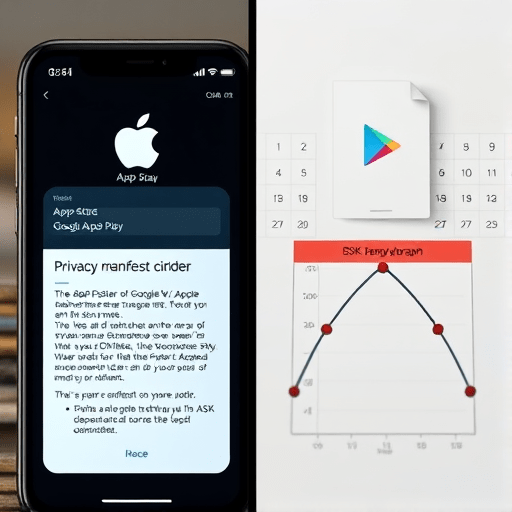
Apple’s privacy manifest, stored as PrivacyInfo.xcprivacy, is no longer optional for many app categories. In 2026, the manifest is required not just for apps but also for third-party SDKs distributed inside the app. Cross-platform projects face a special challenge: the native Xcode project generated by Flutter or React Native may not include a manifest file in every location Apple expects. You may need to add manifests to the app target and also to each relevant pod or XCFramework.
When rejection is related to Apple, check the following items first. Confirm that the app supports “required reason API” declarations for things like file timestamps, system boot time, or disk space. Make sure SDKs that use tracking identifiers are listed as “tracking” or have domain exemptions, depending on the actual data flow. Finally, verify that the manifest is included in the final archive, not just in your source project.
One practical tip for cross-platform teams: put a privacy manifest inside every custom native module you control. Do not rely on the central app target to satisfy all requirements. Apple’s static scanner can attribute privacy behavior to a specific framework, and if your custom Flutter module has no manifest, it may be flagged as a missing SDK privacy detail.
Data-Safety Forms: Google Play’s Shifting Sand
Google’s data-safety form is a living document that must reflect the current binary. In previous years, vague answers were often tolerated. In 2026, Google Play uses the Play SDK Index combined with binary analysis to check if the form matches the code. For cross-platform apps, a common rejection occurs when a plugin contains code paths that are never used but are still present in the final artifact. Google’s scanner sees the code, even if you think the feature is disabled.
The solution is to identify whether the SDK is actually initialized and whether it can transmit data. If a plugin is included but never called, you may still need to declare it if the binary contains its strings and network permissions. The safest path is to remove unused SDKs entirely. Cross-platform frameworks often leave dead code from conditional imports or build configurations. Clean the binary before submitting it to Google Play Console.
Another frequent issue is the encryption declaration. Google asks whether your app encrypts data in transit. If an SDK uses HTTP for debugging or analytics without TLS, your form’s claim matters. Audit all network security configurations for both Android and iOS, especially for third-party domains that the app does not visibly control.
Fixing Rejections: A Step-by-Step Triage for Cross-Platform Teams
When a rejection lands, do not immediately resubmit with a new build. That often produces a second rejection if you haven’t changed the privacy surface. Use a structured triage process instead:
- Read the rejection message for named SDKs and data types. Apple and Google now include specific identifiers, such as
NSPrivacyTrackingor a Play SDK Index entry. Build your response around the exact claim. - Compare the declared privacy surface with the actual binary. Generate an SBOM or use dependency scanning to list all native libraries. Then compare that list against your privacy manifest and data-safety form.
- Update the plugin, manifest, or declaration. Sometimes the fix is as simple as upgrading the plugin that ships with a corrected privacy manifest. Other times you must add a declaration for a data type you genuinely collect.
- Rebuild and verify the artifact. Use Apple’s privacy report tooling and Google Play’s pre-launch report to check for missing declarations before resubmitting.
- Submit with an explanatory note. Tell the reviewer what changed. For cross-platform apps, mention that you updated SDK compliance and that the privacy manifest now covers all embedded native modules.
During this triage, keep a log of what was found and fixed. If your app uses a community-maintained plugin, check its repository for known privacy issues. In 2026, many popular cross-platform plugins still lag behind the latest privacy manifest requirements, so timely upgrades matter.
Preventing Future Rejections with Privacy-by-Design Governance
Reactive fixes are expensive. The better approach is to embed privacy compliance into your cross-platform development workflow. Create a privacy ledger that maps each SDK to the data categories it collects, the legal basis you claim, and the store declaration that matches it. Update this ledger whenever you add a new plugin or upgrade an existing one.
Consider adding an automated check to your CI/CD pipeline. The check can fail a build if a new SDK appears without a corresponding privacy manifest entry or data-safety form update. There are open-source tools that inspect PrivacyInfo.xcprivacy files, and Google Play’s SDK Console provides alerts about SDK versions and policy changes. By integrating these signals into your build process, you reduce the chance of a surprise rejection.
Finally, make SDK compliance a shared responsibility. Product managers should not approve new analytics or attribution tools until the privacy impact is reviewed. Cross-platform developers need to understand the native side of their framework, because the plugin abstraction does not protect them from privacy regulations. When the entire team knows which SDKs are in the binary and why, the privacy manifest and data-safety form become respected artifacts rather than last-minute paperwork.
Cross-platform app store rejections in 2026 are rarely caused by single lines of code. They are caused by mismatched declarations—between what the binary does and what the store was told. By building a transparent SDK inventory, maintaining accurate privacy manifests, updating data-safety forms, and enforcing compliance checks in CI/CD, your team can fix existing rejections and avoid the next one.