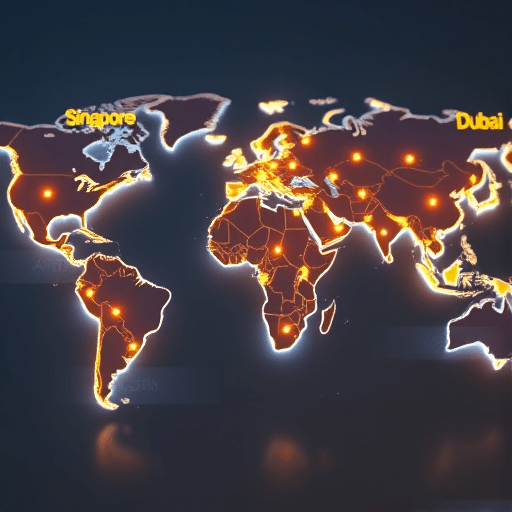
For the past decade, the default answer to “where should we incorporate?” was a binary choice between Delaware and the Cayman Islands. In 2026, that static decision-making feels like an anachronism. The modern expansion playbook relies on startup hub arbitrage—the practice of strategically sequencing your legal and operational presence across multiple jurisdictions to maximize growth. But choosing where to incorporate first for global scaling is not a coin toss; it requires reading two critical signals: the density of the ecosystem and the lag of the local regulator.
While tax incentives and incorporation fees still matter, they rarely dictate long-term success. What actually moves the needle is how quickly a founder can iterate, hire, and raise capital in a given jurisdiction. This article explores how to structure a staggered entry plan using these two underrated signals, helping you avoid the classic mistake of planting your flag in a location that looks good on paper but kills your operational speed.
Ecosystem Density: The Gravitational Pull of Talent and Capital
Ecosystem density is not just a buzzword. It represents the velocity of information exchange, the proximity of decision-makers, and the availability of specialized talent. A high-density hub like San Francisco, London, or Singapore offers founders a distinct margin of safety when navigating uncertain markets. The sheer number of peers, mentors, and institutional investors means that problem-solving happens in days, not months.
However, the 2026 landscape is far more multipolar. Austin has become a serious force for climate tech and defense startups. Bangalore is unmatched in SaaS product engineering. Miami has established itself as the gateway for Latin American fintech. For a founder, the question shifts from “where is the cheapest place to register?” to “where does my specific operational bottleneck get solved fastest?”
The Self-Reinforcing Advantage of Proximity
When you physically embed your core team in a dense ecosystem, you gain access to what sociologists call “peripheral vision.” You hear about potential enterprise clients, key hires, and shifting investor sentiment before they hit the news. This is why fragmented incorporations often fail. If your legal entity is in a low-density jurisdiction but your team is scattered, you lose the gluing effect that makes early-stage scaling possible. Density is a force multiplier for serendipity, and serendipity is still the primary driver of high-stakes partnerships.
Regulatory Lag: Exploiting the Temporal Safe Harbor
Regulation is inherently reactive. Legislators cannot draft rules for technologies that have not yet reached the market. This creates a time gap between innovation and compliance—a phenomenon known as regulatory lag. In the world of startup hub arbitrage, this lag is not a bug; it is a feature. It provides a temporary sandbox where founders can experiment, hit product-market fit, and gather consumer data before the heavy machinery of regulation arrives.
Take the recent divergence in AI and cryptocurrency policy. While the European Union worked to finalize comprehensive AI legislation, jurisdictions like the United Arab Emirates and specific Asian hubs deliberately liberalized their licensing frameworks to attract blockchain and AI startups. These locations used their regulatory agility to pull in ambitious builders, creating a cluster of high-tech talent that would not have existed under slower, more cautious regimes.
Why Regulatory Arbitrage Is About Efficiency, Not Evasion
It is crucial to distinguish between using regulatory lag as a strategic operational window and engaging in outright regulatory evasion. The former involves finding jurisdictions with clear, predictable, and flexible rulemaking that aligns with your business model. The latter involves concealing activities from authorities. The smartest founders in 2026 use regulatory lag to run controlled experiments, generating revenue and user data that will later be used to lobby for sensible rulemaking in their home markets.
For example, a payments startup struggling with banking partner constraints in the United States might find immediate utility in the Monetary Authority of Singapore’s regulatory sandbox. By establishing a presence there first, the startup can refine its risk models and compliance infrastructure in a supportive environment before re-entering the U.S. market.
The Staggered Entry Strategy: A Tiered Approach to Global Expansion
Once you understand the power of ecosystem density and regulatory lag, the next logical step is to sequence your market entries. A “staggered entry” strategy mitigates risk while preserving optionality. Instead of creating five legal entities on day one, founders should think in terms of tiers, each serving a distinct purpose.
Tier 1: The Capital and Compliance Heavyweight
This is your “airlock” for raising global capital. For most startups, Delaware remains the gold standard for a Tier 1 entity. Its legal system is highly predictable, and venture capital funds across the globe are familiar with its incorporation documents. If your goal is to raise a large priced round from prominent U.S. or global VCs, you will likely need a Delaware C-Corp as your parent entity. Even if you operate elsewhere, this entity provides the stability that institutional investors demand.
Tier 2: The Operational Sandbox
The second incorporation should be your go-to-market machine. This is where regulatory lag and ecosystem density intersect. If you are in deep tech, this might be Dubai or Abu Dhabi, where the government actively funds frontier technology and offers golden visas for specialized talent. If you are in fintech, Singapore or Hong Kong offers deep capital pools and rapid licensing pathways. This entity should be thin—holding only the specific licenses and intellectual property required to operate in that region.
Tier 3: The Ecosystem Tax
Finally, you have your market-access entities. These are the jurisdictions where you simply must be to capture a large user base, regardless of how painful the regulatory environment is. Entering Germany or Brazil, for instance, involves significant tax bureaucracy and labor law complexity. However, the density of consumers and the local talent pool make it a necessary step. This is where you pay your “tax” to access the ecosystem, and you should only do so after validating your product in Tiers 1 and 2.
Constructing Your 2026 Incorporation Playbook
So, how do you decide where to hang your hat first? The answer lies in aligning your incorporation sequence with your risk profile and growth milestones. Here is a practical framework to guide your decision:
- Map your primary user base: Are your earliest adopters concentrated in a specific geography? If so, your Tier 2 entity should be located there, regardless of tax implications.
- Identify your nearest regulatory bottleneck: What specific activities are considered gray area? Find the jurisdiction that has addressed these activities with clear, permissive rules.
- Model the cost of compliance versus the cost of being blocked: A 10% tax rate means nothing if the local regulator forces you to halt operations for six months. Factor in the velocity of your business.
- Sequence your commitments carefully: Do not integrate your internal management contracts or cloud infrastructure into a jurisdiction until you have confirmed it works operationally. Maintain simplicity for as long as possible.
- Create a review schedule: Regulatory lag is dynamic. Re-evaluate your entity structure every 12 to 18 months to ensure you are still benefiting from the arbitrage you initially identified.
In the fiercely competitive landscape of 2026, the companies that scale successfully are not necessarily those with the most skilled lawyers. They are those with the clearest mental map of the global chessboard. They know that the physical location of their HQ is shrinking in relevance, while the location of their operational empathy is growing.
Startup hub arbitrage is not about jurisdictional hopping on a whim. It is about building an intentional, temporal map of global expansion—one where you move fluidly from a stable capital foundation into a regulatory sandbox, and finally, into a dense consumer market. By using ecosystem density as your engine and regulatory lag as your steering wheel, you can navigate the complexities of global scaling with far more precision and far less friction.
The winners of the next decade will be the founders who view incorporation not as an annual paperwork chore, but as a powerful, dynamic instrument of competitive strategy. The question is not merely “where am I registered?” but “where does my presence unlock the most momentum at the exact moment I need it?”