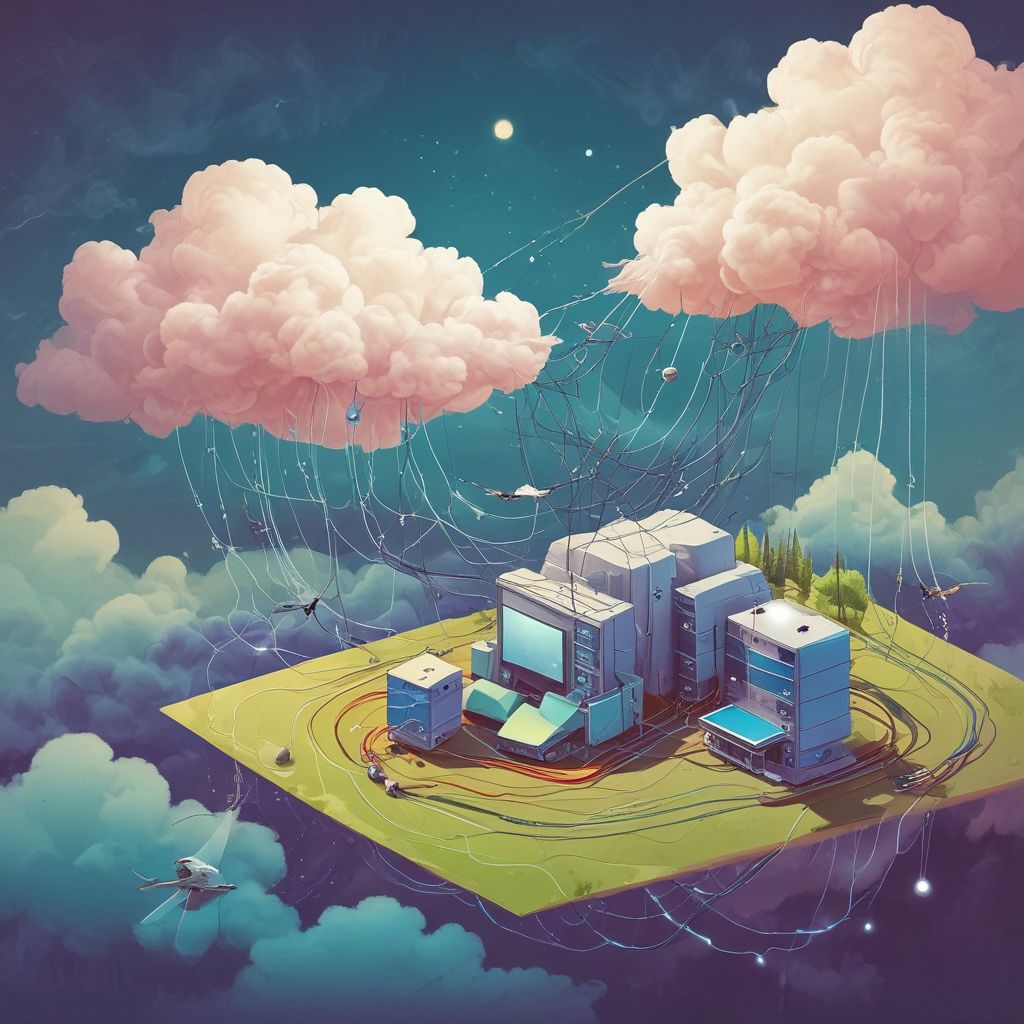
The idea of a Quantum Internet for Privacy-Preserving AI is rapidly moving from theoretical diagrams to laboratory demonstrations: researchers are now distributing entanglement across nodes, running quantum key distribution across cities and satellites, and exploring protocols that let multiple parties train models without sharing raw data. This article explains how those early experiments work, why entanglement matters for privacy-preserving machine learning, and what hardware, standards, and policy hurdles must be cleared before “entangled clouds” become real-world infrastructure.
Why a Quantum Internet matters for privacy-preserving AI
Conventional privacy-preserving approaches—federated learning, secure multiparty computation (MPC), homomorphic encryption—reduce data sharing but remain vulnerable to certain attacks and to the long-term threat of quantum computers breaking classical cryptography. A quantum internet adds new capabilities:
- Information-theoretic secrecy: Quantum key distribution (QKD) can generate keys whose secrecy is guaranteed by physics rather than computational assumptions.
- Entanglement-enabled protocols: Entangled states enable primitives like quantum teleportation, blind quantum computing, and protocols for secure function evaluation that can reduce information leakage during distributed training.
- Post-quantum resilience: Combining quantum link-layer security with post-quantum algorithms strengthens AI pipelines against future adversaries with quantum computers.
Early experiments: from satellites to metropolitan testbeds
Over the past decade, a string of experiments has proven core building blocks of the quantum internet.
Long-distance entanglement and satellite links
Satellite-based experiments have shown that entanglement can be distributed across very long distances, enabling intercontinental quantum links that bypass fiber loss limits. These demonstrations validate the possibility of wide-area, low-trust quantum key exchanges between remote research centers and could one day stitch regional quantum networks into a global fabric.
Metropolitan QKD networks and entangled-node tests
Cities and research labs have run multi-node QKD testbeds and point-to-point entanglement links, integrating quantum channels with classical control networks. Such testbeds are the natural place to trial privacy-preserving AI workflows where hospitals, banks, or research institutions jointly train models without exchanging raw datasets.
Prototype repeaters and quantum memories
Quantum repeaters and quantum memories remain experimental but essential: they allow entanglement to be extended across chained segments, enabling scalable networks. Recent lab prototypes demonstrate the components working together for short chains, a crucial step toward distributed ML across multiple sites.
How quantum networking can enable privacy-preserving ML
There are several promising approaches that leverage quantum links to improve privacy in distributed AI:
- Quantum-secured federated learning: QKD-secured channels protect model updates in transit and enable stronger authentication between participants.
- Secure aggregation with entanglement: Entangled resources can be used to implement aggregation primitives where only an aggregate (and not individual updates) is revealed, reducing exposure of participant data.
- Blind and verified quantum computing: Clients can delegate computation to quantum servers while hiding their inputs (blind quantum computing) and verifying correct execution—important if future AI workloads run on quantum co-processors.
Hardware building blocks and current limits
Turning laboratories into robust entangled clouds requires progress across multiple hardware fronts.
Key components
- Single-photon sources and detectors: High-rate, indistinguishable photons are needed for reliable entanglement distribution.
- Quantum memories: Coherent storage of quantum states to synchronize multi-hop entanglement.
- Quantum repeaters: Devices that extend entanglement by stitching shorter links together via entanglement swapping and error correction.
- Interfaces and transducers: Efficient links between stationary qubits (atoms, NV centers, ions) and telecom photons for fiber transmission.
Current bottlenecks
- Loss and decoherence over fiber and free-space channels.
- Limited memory lifetimes and low entanglement generation rates compared to classical networking speeds.
- Engineering complexity and cost for deploying repeaters and hybrid classical-quantum control planes.
Standards, interoperability, and the ecosystem
Technical progress is necessary but not sufficient—standards and interoperable stacks will determine whether quantum links integrate with AI infrastructure.
Emerging standards activity
Standards bodies and research consortia are beginning to define interfaces, security models, and testing regimes for quantum links and QKD devices. Coordinated specifications for quantum network control planes, key management integration with cloud platforms, and compliance testing will be essential to move from bespoke testbeds to interoperable entangled clouds.
What standards must solve
- Common representations for quantum key lifecycle and integration with classical key management systems.
- APIs for hybrid classical-quantum orchestration so AI training pipelines can request, reserve, and verify quantum-secured channels.
- Interoperability tests and certification for devices (repeaters, transducers, detectors) across vendors.
Policy, governance, and societal considerations
Deploying a Quantum Internet for Privacy-Preserving AI is not just technical; it raises governance questions that must be resolved early.
- Trust frameworks: Who operates quantum backbone nodes and how are trust anchors governed? Centralized control could reintroduce privacy risks.
- Export controls and dual-use concerns: Quantum technologies can be sensitive; export and research restrictions may slow international collaboration.
- Regulatory harmonization: Data protection laws, cross-border key exchange rules, and certification regimes need alignment so privacy-preserving AI can operate across jurisdictions.
Roadmap: from demo to deployment
A practical sequence to scale entangled clouds could look like:
- Wider metropolitan testbeds combining QKD and entanglement with pilot AI workloads (healthcare, finance).
- Standard APIs and certified hardware for bridging quantum links with cloud ML platforms.
- National and regional backbone deployment with repeaters and satellite integration to connect disparate testbeds.
- International governance agreements for cross-border quantum key exchange and node trust models.
Risks, trade-offs, and integration with classical methods
Quantum networking complements, not replaces, classical privacy methods. Until quantum repeaters and high-rate links are practical, hybrid architectures—post-quantum cryptography plus QKD where available—offer the most pragmatic path. Organizations must weigh costs, maturity, and the sensitivity of workloads when adopting quantum-secured AI.
Ultimately, entangled clouds promise a qualitatively different security model for distributed AI—one rooted in physics rather than computation—but realizing that promise requires coordinated advances in hardware, interoperable standards, and thoughtful policy.
Conclusion: The Quantum Internet for Privacy-Preserving AI is an emerging, multidisciplinary effort that blends entanglement experiments, prototype hardware, evolving standards, and careful governance. Early testbeds show feasibility and point the way to hybrid deployments that can protect sensitive AI workflows today while preparing for tomorrow’s quantum threats.
Interested in experimenting with quantum-secure AI or learning how to prepare your organization for entangled clouds? Contact your research or cloud provider to explore pilot programs and standards working groups.