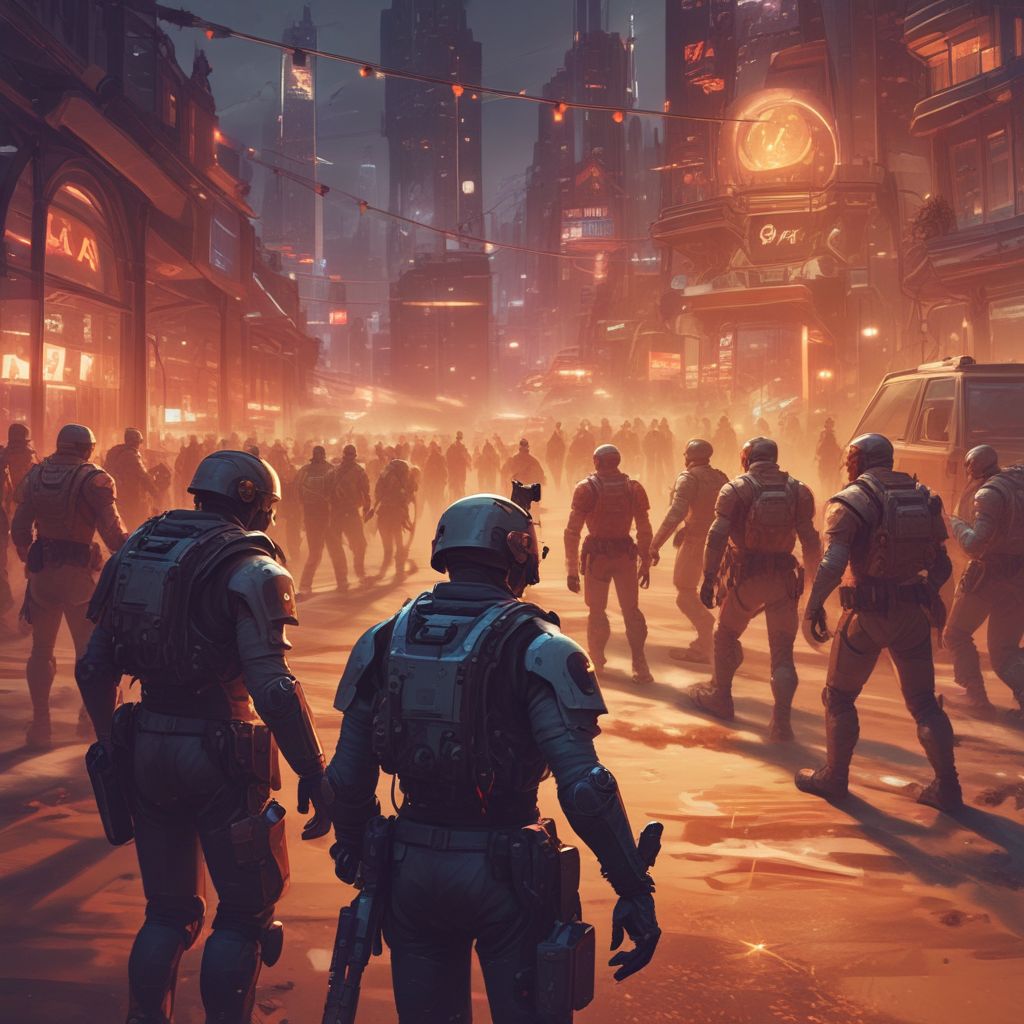
The emergence of AI Squad Leaders promises to change how players approach large‑scale battles in FPS‑MMOs by acting as in‑game AI officers that coordinate squads, issue tactical guidance, and reduce reliance on voice comms for synchronized action. AI Squad Leaders blend procedural decision‑making with player intent to turn chaotic 100+ player raids into coordinated, accessible strategy sessions that welcome casual and competitive players alike.
Why coordination breaks down in huge FPS‑MMOs
Massive first‑person shooters with persistent worlds create thrilling emergent moments, but when numbers swell past a dozen players per side, coordination often collapses. Common problems include:
- Voice comms bottleneck: Not every player has a mic or is comfortable speaking, and public voice channels become noisy and ineffective.
- Fragmented intent: Players chase different objectives because there’s no shared, comprehensible plan.
- Information overload: The fog of war and rapid changes make it hard for any single human leader to keep everyone updated.
- Onboarding friction: Newcomers struggle to join coordinated plays without prior clan ties or lengthy tutorials.
What are AI Squad Leaders?
AI Squad Leaders are procedural commanders embedded in the game world that act as localized, tactical officers for groups of players. They are not replacement AIs for player combat; rather, they augment human decision‑making by translating high‑level strategic goals into actionable orders, coordinating positioning, and adapting dynamically to battlefield events.
Core capabilities
- Real‑time objective prioritization: Analyze live telemetry (enemy movements, objective timers, resource status) and recommend the next best actions.
- Squad composition management: Balance roles and suggest loadouts to fill gaps or counter enemy tactics.
- Micro‑coordination: Call synchronized maneuvers like breaches, flanks, or retreats with millisecond‑timed cues.
- Adaptive messaging: Deliver concise visual or text cues for players without voice comms, and optional synthesized voice for those who opt in.
Design principles for successful integration
Building effective AI Squad Leaders requires purposeful design choices that respect player agency and server constraints.
1. Player intent first
AI should interpret and amplify the squad leader’s or team’s intent rather than impose rigid plans. Allow players to set strategic directives (e.g., “secure north lattice” or “hold choke for 2 minutes”) and let the AI handle the tactical how.
2. Lightweight, non‑intrusive UI
Use subtle HUD markers, contextual pings, and short textual prompts instead of long modal dialogs. A clear three‑tier message system (urgent, recommended, optional) helps players triage AI guidance without distraction.
3. Explainability and trust
Players trust systems they can understand. Offer quick rationales for major decisions (e.g., “flank suggested — enemy staging at east gate”) and an easy override where squads can reject or modify AI orders.
4. Accessibility and fairness
Make AI assistance optional and configurable to avoid competitive imbalance. Offer an accessibility mode where newcomers can follow AI directives as a learning tool without giving undue advantage in ranked play.
How AI Squad Leaders reduce dependence on voice comms
By converting complex battlefield data into intuitive, actionable cues, AI Squad Leaders create a shared operational picture for players who don’t—or can’t—use voice comms.
- Automatic synchronized pings: When the AI calls an assault, it marks rally points on every squad member’s HUD at the same time.
- Role‑aware instructions: The medic sees a “hold and heal” prompt while assault classes receive a “breach now” cue, all with consistent timing.
- Nonverbal victory conditions: Visual progress bars and objective checks replace the need for constant verbal updates.
Technical and social challenges
Integrating AI Squad Leaders at scale introduces both server‑side and community challenges that must be addressed thoughtfully.
Latency and computation
Processing decisions for hundreds of players requires distributed, low‑latency inference. Solutions include edge‑optimized models, deterministic rule layers for time‑critical calls, and batching non‑urgent analyses to conserve resources.
Preventing exploitation
Clear anti‑abuse rules are needed so players cannot trick AI into revealing fog‑of‑war info or feeding it false commands. Rate limiting, audit logs, and sandbox simulation for training data help maintain integrity.
Player culture and adoption
Some veteran communities may resist AI guidance. Gradual rollout, opt‑in settings, and visible logs showing AI benefits in win rates or reduced friendly fire can help build acceptance.
Practical rollout plan for developers
A phased approach helps gather feedback and refine behavior:
- Phase 1 — Localized trials: Deploy AI Squad Leaders in small objective maps and gather telemetry and player surveys.
- Phase 2 — Role‑aware tuning: Introduce role differentiation and personalization settings based on early metrics.
- Phase 3 — Social features: Add squad‑level analytics, leaderboards for AI‑guided squads, and integrative tutorials.
- Phase 4 — Competitive ruleset: Finalize opt‑in/opt‑out rules for ranked play and address balancing concerns.
What this means for players
For casual players, AI Squad Leaders lower the barrier to coordinated play and make large raids feel purposeful and less chaotic. For organized teams, AI becomes a force multiplier—automating tedious coordination and freeing humans to focus on higher‑order strategy and reflexive play.
Conclusion
AI Squad Leaders are a powerful design idea that can turn fragmented 100+ player arenas into cohesive theaters of strategy without forcing voice comms or sacrificing player agency. When built with transparency, configurability, and fairness in mind, procedural in‑game officers can make FPS‑MMOs more accessible, strategic, and enjoyable for every player.
Ready to see AI Squad Leaders in action? Try advocating for a pilot mode in your favorite FPS‑MMO or tag a developer with this article to start the conversation.