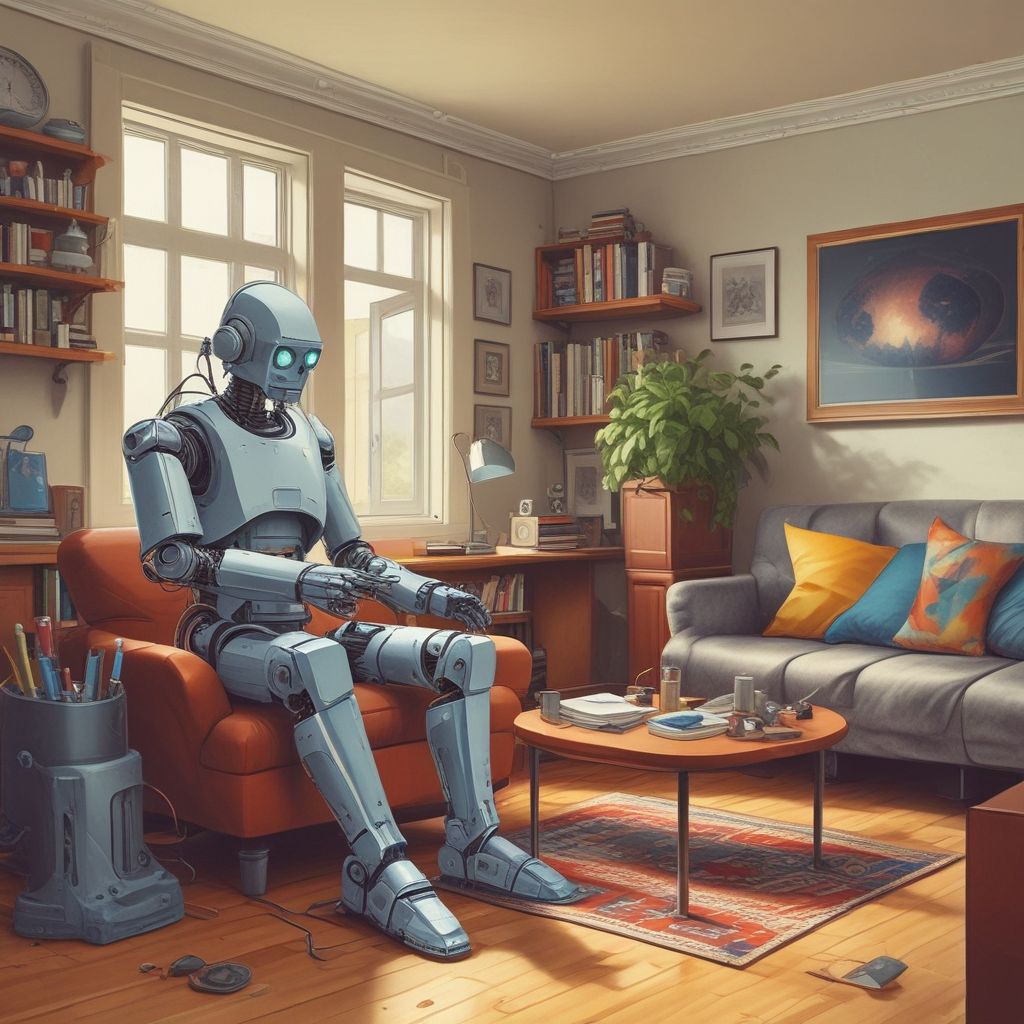
Household robots that learn your home’s physics are shifting the way smart devices interact with domestic spaces by continuously building personalized models of how objects move, where people and pets tend to be, and which surfaces are safe or fragile. Instead of relying on rigid maps or explicit programming, these robots infer physical rules from repeated observations—allowing them to adapt when a couch moves, a rug is added, or a child leaves toys on the floor.
Why a Physics-Aware Robot Is Different
Traditional home robots often depend on static floor plans or preprogrammed behaviors: follow a schedule, avoid obstacles detected in real time, and repeat the same cleaning pattern. Robots that learn a home’s physics go beyond obstacle avoidance; they form probabilistic models of mass, friction, typical motion flows, and hidden constraints. That means they can predict what will happen when they nudge a chair, estimate whether a surface will support a heavy appliance, or infer that an oddly shaped shadow is actually a stair edge covered by a runner.
Core capabilities
- Continuous physical learning: building models of surfaces, object dynamics, and human movement patterns over time.
- Context-aware planning: selecting approaches that minimize risk—e.g., slower navigation near unstable items.
- Implicit adaptation: learning from everyday interactions rather than requiring manual reprogramming after every layout change.
Sensors and Algorithms: How They Build a Home’s Physics
These robots use a combination of sensors—depth cameras, LIDAR, tactile skins, force sensors, and audio—to collect multimodal evidence. Machine learning models then fuse that data into a compact, evolving “physics map” of the home. Key techniques include:
- Probabilistic state estimation: maintaining distributions over object positions and stability rather than single rigid points.
- Inverse dynamics learning: inferring mass and friction parameters by observing how objects move when contacted.
- Sim-to-real refinement: using lightweight physical simulations to test hypotheses quickly, then updating models with real-world feedback.
Real-World Adaptation: Furniture, Rugs, and Hidden Hazards
One major strength is graceful adaptation to everyday changes. When furniture is rearranged, the robot doesn’t require a system reset: it recognizes new collisions, updates its model of likely reachable paths, and learns how the new table responds to a gentle nudge. Rugs that cause slip or hide stair edges are detected by differences in traction and visual cues; robots then flag these locations as high-risk and change locomotion style or cleaning approach.
Detecting hidden hazards
- Soft-but-dangerous: thin glass or loose trays that look solid—identified by subtle deformations detected by tactile sensors.
- Occluded drop-offs: stair edges under fabric or clutter—inferred from inconsistent depth readings combined with motion expectations.
- Pet and child zones: dynamic regions with unpredictable motion patterns, treated conservatively to avoid collisions.
Personalized Cleaning and Caregiving Without Explicit Programming
Because these robots learn from observation, they can provide bespoke services. For cleaning, they learn which zones accumulate crumbs (kitchen the day after breakfast), which surfaces are rarely touched (top of bookshelf), and adapt suction, brush speed, or path density accordingly. In caregiving, robots learn a resident’s mobility constraints: they anticipate where someone prefers to sit, how they transfer from bed to chair, and how to assist without disrupting fragile objects.
Examples of personalized behaviors
- Automatically widening aisle passes around a walker or wheelchair by learning typical placement.
- Gentle transport modes when carrying a mug—reducing acceleration based on inferred liquid slosh dynamics.
- Timing reminders and delivery routes to avoid interrupting rest or therapy sessions identified in the model.
Privacy, Safety, and Trust
Adaptive robots require sensitive data; homes are private. Designers must balance utility with privacy by processing physics models locally, storing only anonymized summaries, and giving owners explicit control over what is learned and when it can be shared. Safety is equally crucial: learning systems should default to conservative behaviors in uncertain situations, log decisions for transparency, and provide simple override controls for occupants.
Design principles for trustworthy deployment
- Local-first computation: keep raw sensor data and physical models on-device wherever possible.
- Explainable behavior: provide human-readable explanations for why the robot avoided or moved an object.
- Fail-safe defaults: when the model’s confidence is low, switch to slower, more cautious actions.
Challenges and the Road Ahead
Despite strong progress, several obstacles remain: robust tactile sensing at low cost, long-term model drift when houses undergo seasonal changes, and gracefully handling adversarial conditions (pets that move objects on purpose). Research into lifelong learning algorithms, lightweight on-device simulation, and hybrid human-in-the-loop systems is accelerating to address these gaps.
What homeowners can do now
- Place chargers and docking stations in stable, uncluttered areas to give robots consistent calibration points.
- Label or teach fragile zones once to speed up learning in delicate areas (e.g., glass cabinets).
- Keep an eye on early model logs and adjust trust thresholds—many systems offer “learning mode” and “operate mode” toggles.
Household robots that learn your home’s physics represent a step change: rather than fitting the home to the machine, machines fit themselves to the home. As these systems mature, expect domestic robots that clean smarter, assist more sensitively, and avoid surprises by understanding the subtle physics of everyday life.
Conclusion: Embracing context-aware, physics-learning robots can make homes safer and more comfortable while reducing the friction of constant reconfiguration; thoughtful deployment, privacy-conscious design, and sensible defaults will be the keys to widespread adoption.
Ready to explore a physics-aware robot for your home? Learn more about models, privacy settings, and hands-on demos from trusted vendors.