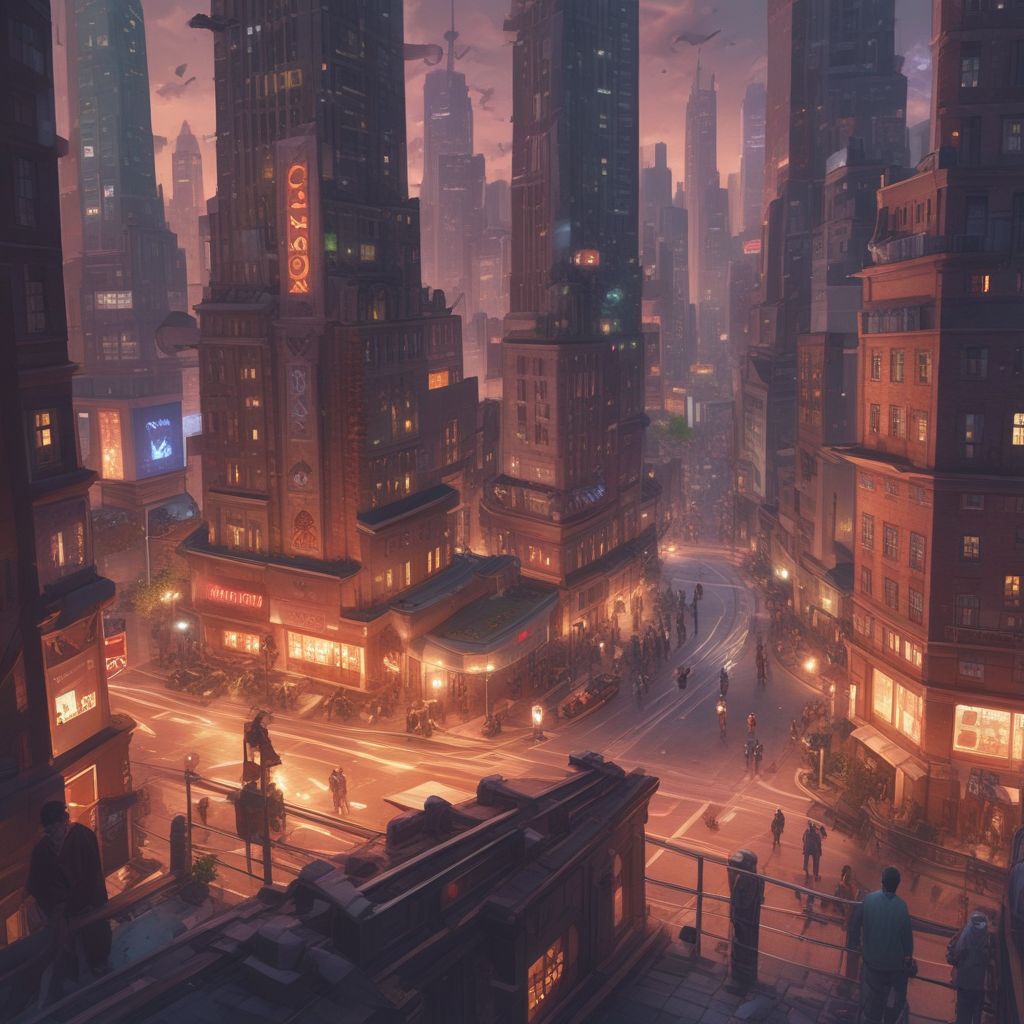
The rise of Persistent AR NPCs is reshaping how people experience public space: these are augmented reality characters that remember player actions, hold grudges, and actively reshape narratives across city blocks, turning the urban environment into a living gameboard. In this article we explore how memory-enabled AI characters enable emergent storytelling at city scale, the technologies that make it possible, real-world design implications, and the social questions that follow.
What are Persistent AR NPCs?
Persistent AR NPCs are augmented reality non-player characters that persist beyond a single session or device. Unlike ephemeral AR overlays that vanish after a user looks away, persistent NPCs retain a state—memories, goals, relationships—and can behave differently for different players based on past interactions. They can be anchored to physical locations, move across neighborhoods, and coordinate story arcs that evolve as communities play.
Core characteristics
- Memory: NPCs record player actions, choices, and local events.
- Continuity: Their state persists over time and across devices.
- Context awareness: They adapt to location, weather, time, and social data.
- Emergence: Interactions between players and NPCs produce unscripted narratives.
How memory changes play
Memory transforms AR encounters from one-off spectacles into serialized experiences. An NPC who remembers a player’s previous kindness might unlock a secret route down an alley the next time they pass, while an NPC slighted in one district could spread rumors that alter how other NPCs treat the player in a nearby plaza. These ripple effects enable emergent gameplay: small choices accumulate into meaningful reputations, alliances, and city-scale myths.
Examples of emergent mechanics
- Reputation networks: neighborhood NPCs update their behavior based on aggregated player reputations.
- Dynamic quests: tasks spawn in different locations because NPCs remember prior outcomes and adapt goals.
- Collective narratives: community actions trigger city-wide events, like a virtual parade or a contested “territory” in AR overlays.
Turning the city into a gameboard
When persistent NPCs are distributed across a city, each public space becomes a node in a sprawling, interactive network. Urban fixtures—bench, fountain, statue—can host story beats or act as “memory anchors” where NPCs store local lore. Over time, neighborhoods develop distinct personalities shaped by recurring player behaviors and NPC interactions, turning the city into an organic tapestry stitched by play.
Design patterns for city-scale storytelling
- Anchor-and-propagate: Start stories at fixed anchors and let NPC memory propagate consequences outward.
- Layered persistence: Keep short-term, player-specific memories separate from long-term, communal lore.
- Visibility gradients: Decide which memories are private, social, or public to support different play styles.
Technologies that enable persistent AR NPCs
Several technical building blocks combine to make persistent AR NPCs feasible: spatial anchoring systems that map virtual content to physical locations; edge and cloud compute for low-latency AI; federated and privacy-preserving storage models for distributed memory; and multimodal models that let NPCs perceive voice, gesture, and location. Together these allow NPCs to behave believably and consistently across devices and over time.
Key components
- Spatial anchors and SLAM for reliable placement.
- Edge computing for real-time responses in dense urban environments.
- Memory fabrics—databases tuned for versioning, conflict resolution, and privacy.
- AI models for dialogue, intent, and narrative planning at scale.
Social and ethical considerations
Pervasive, memory-enabled characters raise meaningful concerns. Who owns the shared memory of a plaza? How are sensitive interactions protected? When NPCs influence real-world movement, how do designers avoid exclusion or manipulation? Addressing equity, consent, and data governance is as important as technical polish.
Policy and practice checklist
- Consent-first design: Clear opt-ins and visible cues when memory is recorded.
- Transparent data policies: Explain what NPCs store, for how long, and who can access it.
- Moderation: Human oversight for emergent behaviors that could harass or mislead players.
- Inclusive narratives: Avoid reinforcing harmful stereotypes or privileging certain neighborhoods.
Real-world use cases
Cities and creators are already testing prototypes: historical NPCs that remember which plaques players have visited and add new anecdotes; community-driven mystery games where clues persist across players until collectively solved; and public art installations where AR characters record the city’s “mood” based on cumulative interactions and display changing overlays. Each use case demonstrates how memory creates depth and encourages repeated visitation.
Designing for emergent, sustainable experiences
To foster enduring play, designers should think in systems: build lightweight memories that scale, design for serendipity so non-players still benefit, and enable tools for communities to curate and shape NPC lore. Allowing residents to author or moderate NPCs turns spectators into stewards, aligning digital narratives with local identity rather than an imposed novella from a distant studio.
Conclusion
Persistent AR NPCs promise to make cities feel alive in a new sense—inhabited not only by people but by characters that remember, react, and contribute to ongoing stories. When thoughtfully designed, these systems can create playful, shared experiences that deepen community ties while raising important questions about privacy and governance.
Ready to explore how persistent AR NPCs could transform your neighborhood? Start a small memory-based pilot today and watch the city tell a new story.