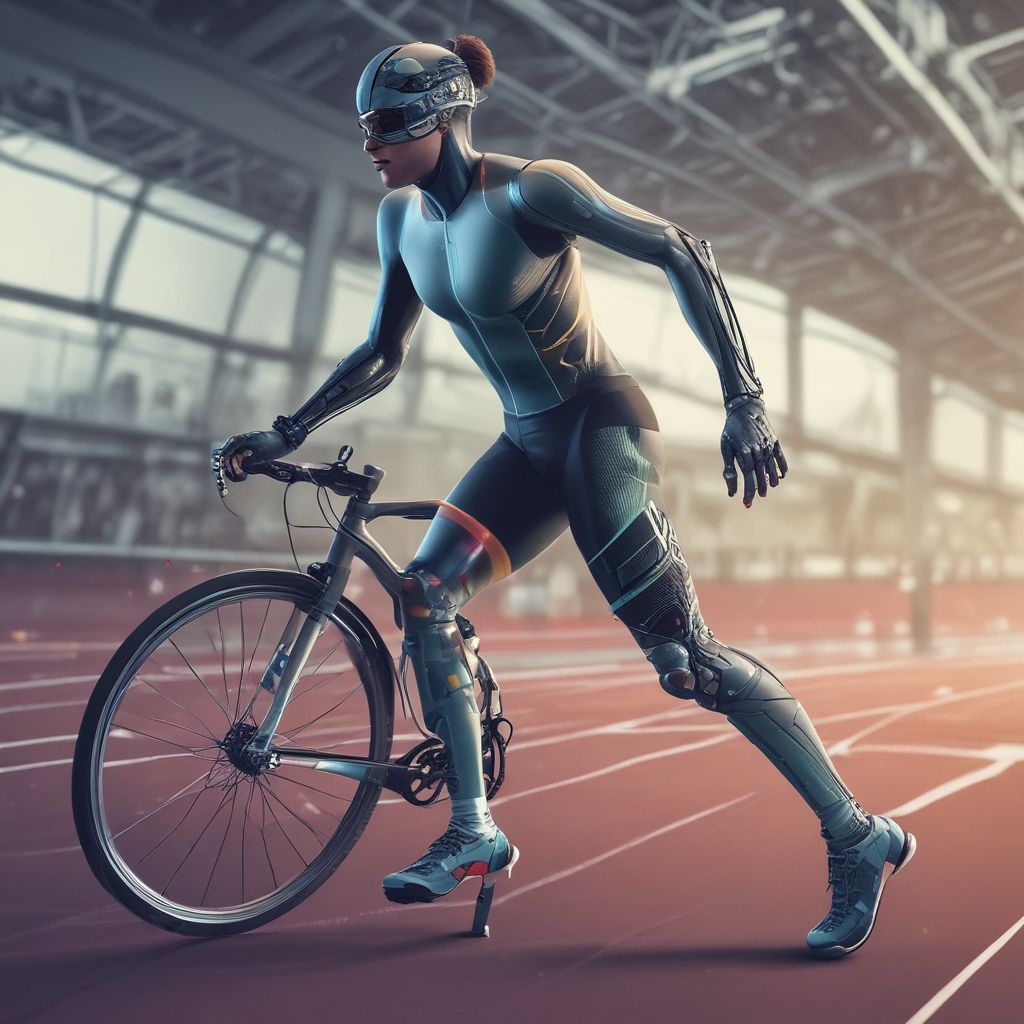
The rise of machine learning is personalizing prosthetic tuning for Paralympic athletes, turning raw sensor data into actionable adjustments that improve gait, lower injury risk, and unlock new performance gains. Inside labs around the world, engineers and clinicians are pairing neural nets with biomechanics to build prosthetic systems that learn an athlete’s signature—how they land, push off, and adapt during fatigue—and recommend or automatically apply individualized tuning in near real time.
Why personalization matters for Paralympic performance
Traditional prosthetic tuning relied on clinician expertise, trial-and-error, and static lab measurements. For elite Paralympic athletes, however, marginal gains make the difference between standing on the podium or missing the final. Personalization matters because:
- Every athlete’s residual limb, muscle activation pattern, and running style are unique; a one-size-fits-all setting wastes potential.
- Small changes to stiffness, damping, or alignment can change metabolic cost, stride symmetry, and peak loading on joints—factors that affect both speed and injury risk.
- Athletes train in variable conditions and fatigue states; adaptive tuning that reacts to changing conditions preserves performance across a season.
What data fuels ML-driven prosthetic tuning?
Machine learning systems draw from a rich multi-modal dataset collected in labs and in the field:
- Inertial sensors (IMUs): Track orientation, acceleration, and angular velocity across each stride.
- Pressure insoles and force plates: Measure ground reaction forces and pressure distribution to reveal loading asymmetries and push-off timing.
- Surface EMG: Records muscle activation patterns that correlate with intent and fatigue.
- Video and motion capture: Provide kinematic context and alignment metrics for training computer vision models.
- Subjective reports and performance outputs (race times, sprint splits, perceived comfort) used as labels for supervised learning.
Core machine learning approaches being used
Different ML techniques solve different parts of the tuning problem:
- Supervised neural nets map sensor inputs to optimal parameter settings (e.g., stiffness or microprocessor response curves) learned from historic tuning sessions and performance outcomes.
- Reinforcement learning (RL) creates agents that iteratively adjust prosthetic control policies to maximize objective functions like speed, stability, or reduced joint loading during simulated or controlled trials.
- Transfer learning allows models trained on larger datasets (able-bodied gait, scaled biomechanics) to be adapted to individuals with limited data.
- Unsupervised algorithms cluster gait signatures to identify hidden states (fatigue, terrain change) that trigger different tuning modes.
Example workflow in a gait lab
In a typical research lab, an athlete completes a battery of runs while wearing instrumented prosthetics. Data are streamed to an on-site server where a neural network predicts a tuning vector—changes to damping, spring constants, or control thresholds. Clinicians review suggested adjustments, apply them, and collect post-adjustment performance metrics. Over successive iterations, the system refines its predictions, converging on settings that balance speed, symmetry, and comfort.
Real-world benefits seen so far
Early trials and pilot programs report a range of measurable benefits from ML-enabled tuning:
- Improved stride symmetry and reduced contralateral overloading, lowering risk factors associated with hip or back injuries.
- Faster adaptation to fatigue—automatic mode switching preserves form during later race stages.
- Objective tuning guidance reduces clinic time and gives athletes quantifiable feedback they can trust.
For coaches and prosthetists, these systems transform qualitative “feel” into quantitative improvements: measurable reductions in ground reaction impulse imbalances, tighter timing between foot strike and push-off, and modest but meaningful accelerations in sprint splits during controlled tests.
Challenges and ethical considerations
While promising, deploying ML for prosthetic tuning raises practical and ethical challenges:
- Data scarcity and diversity: Paralympic athletes represent highly heterogeneous anatomies and pathologies; models must be robust to small sample sizes and avoid overfitting to one athlete type.
- Safety and verification: Automated adjustments to hardware must be fail-safe—changes that feel better immediately could increase long-term injury risk if not validated.
- Transparency: Neural nets can be black boxes; clinicians and athletes need interpretable recommendations to trust and accept adjustments.
- Access and equity: High-tech labs are concentrated in wealthy countries; ensuring global access to personalized tuning is vital for fair competition opportunities.
Design principles for trustworthy prosthetic ML systems
Leading labs are converging on best practices to address risk and ensure effectiveness:
- Human-in-the-loop design: clinicians retain final authority and review model suggestions in controlled settings.
- Explainable models: provide visualizations and simple metrics that show why a tuning change is recommended.
- Rigorous validation: multi-site trials, longer-term follow-ups, and safety constraints embedded in RL reward functions.
- Privacy-preserving data pipelines: anonymization and federated learning to pool insights without exposing sensitive athlete data.
Looking ahead: where innovation is headed
Future directions point to lighter, faster, and more context-aware systems:
- Edge ML on microcontrollers embedded in prosthetic pylons will enable in-situ adjustments without a lab connection.
- Augmented reality dashboards will let athletes and coaches visualize gait trade-offs and simulate tuning outcomes before committing changes.
- Cross-disciplinary datasets combining metabolic, cognitive load, and environmental factors will allow multi-objective optimization—tuning for speed without sacrificing long-term joint health.
Case vignette: adaptive tuning in sprint training
In one pilot program, a sprinter using an ML-enhanced blade ran a series of 60m sprints while the system suggested micro-adjustments to toe angle and blade stiffness between reps. Over a two-week tuning cycle the athlete reported better push-off consistency and the coaching staff logged tighter split variability—outcomes that translated into improved confidence and a marginal competitive advantage that mattered at elite levels.
Practical advice for athletes and coaches
If you’re an athlete or coach interested in ML-assisted tuning, consider these steps:
- Partner with research labs or prosthetists experienced in sensor integration and data-driven tuning.
- Start with supervised, clinic-based evaluations before adopting any automated or on-device self-tuning systems.
- Insist on transparent metrics, safety checks, and a plan for long-term monitoring to spot delayed effects.
Machine learning is not a magic wand, but when combined with expert clinical judgment and careful validation, it gives Paralympic athletes a new, evidence-based path to shave fractions of seconds and reduce injury—both of which add up to career-changing outcomes.
Conclusion: Personalizing prosthetic tuning with machine learning is reshaping how Paralympic athletes prepare, perform, and protect their bodies, offering a future where prosthetic settings evolve with the athlete rather than against them.
Ready to explore ML-driven tuning for peak performance? Contact a specialized lab or prosthetist to learn about safe, evidence-based options for your training program.