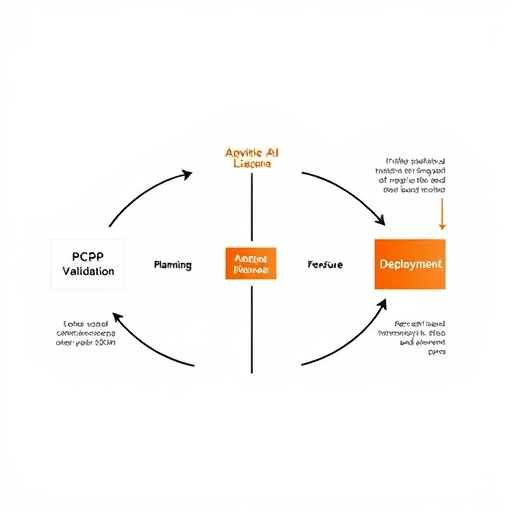
FDA AI/ML SaMD compliance for adaptive algorithms in 2026 requires manufacturers to manage change across the entire product lifecycle, not simply document a locked model at the time of submission. The agency’s 2024 guiding principles support a Predetermined Change Control Plan (PCCP) that can describe planned model modifications, their methods, and how risks will be evaluated before deployment. This roadmap explains how teams can translate those expectations into repeatable processes for design, validation, release, and post-market monitoring.
Why Adaptive SaMD Changes the Compliance Strategy
Traditional software often changes through explicit releases. A machine-learning model may also change when it is retrained on new data, recalibrated, fine-tuned, or used in a new clinical setting. Even when the source code stays the same, updated training data, preprocessing logic, thresholds, or deployment infrastructure can alter performance.
That distinction matters because FDA assesses the device as a complete system. For AI-enabled medical device software, intended use, input sources, algorithm architecture, user interface, clinical workflow, and monitoring controls all influence safety and effectiveness. An adaptive component therefore needs controls that can show not only what the model does, but also why a proposed change is permitted and how the team will know when performance has moved outside an acceptable range.
Start with a precise intended-use statement
The intended-use statement should identify the patient population, clinical purpose, users, input data, output type, and decision context. A model intended to prioritize radiology worklists has different risks from one that provides a diagnosis or recommends treatment. Teams should avoid broad wording that could unintentionally cover multiple clinical functions.
Document the model’s role within the larger SaMD. Explain whether results are informational, time-sensitive, advisory, or intended to trigger a specific action. Identify human review requirements and specify what happens when the software cannot process an input, produces low-confidence output, or encounters data outside the validated distribution.
Build the PCCP as an Operational Control System
A useful PCCP is more than a regulatory attachment. It should function as a controlled agreement defining which changes the sponsor expects, how each change will be implemented, and what evidence will be evaluated before release. The plan should also preserve traceability to the device’s risk management file, design history, and clinical evaluation.
Define a narrow list of anticipated modifications
List concrete modification types rather than relying on broad statements such as “future model improvements.” Examples may include retraining on additional data, updating demographic balance, adjusting decision thresholds, adding a data source, or changing the preprocessing pipeline.
For each modification, specify:
- The purpose of the change and the performance or clinical problem it addresses
- The affected model, data, code, interface, and deployment components
- Permitted ranges, data characteristics, or implementation methods
- Potential hazards introduced or affected by the change
- Verification and validation methods that will be applied
- Update procedures for labeling, versioning, and release records
The description should be bounded enough that reviewers can understand the expected scope. If a proposed update falls outside the planned change, methods, or impact assessment, it should be treated as a new regulatory change rather than silently processed under the PCCP.
Make change protocols testable
A change protocol should identify the datasets, acceptance criteria, comparator methods, and statistical procedures used to evaluate a modification. It should explain how the team will test generalization across relevant subgroups and clinical sites. Where appropriate, include silent evaluation, shadow deployment, retrospective testing, and prospective monitoring before a model update affects patient care.
Acceptance criteria should cover more than average accuracy. Depending on the device, teams may need to evaluate sensitivity, specificity, calibration, false alerts, time to alert, subgroup performance, data drift, workflow burden, and failure recovery. Thresholds should be justified in relation to clinical risk and the device’s intended use.
Use a Lifecycle Checklist for Continuous Learning Systems
The following checklist can support a structured adaptive AI/ML SaMD compliance program. Teams should tailor the depth of evidence to the device’s risk and regulatory classification.
Design and change-control checklist
- Maintain a stable intended-use statement and documented clinical workflow.
- Define the model’s adaptive boundaries, including permitted data sources and modification types.
- Map each change to hazards, mitigations, verification activities, and validation evidence.
- Separate routine operational updates from changes that could affect safety or effectiveness.
- Use immutable model, dataset, configuration, and deployment version identifiers.
- Require documented approval before any production model update.
- Maintain traceability from the PCCP to requirements, test results, and release records.
Data and validation checklist
- Define eligibility criteria for new training and testing data.
- Check for leakage between training, tuning, validation, and test datasets.
- Document data provenance, collection period, clinical setting, and preprocessing steps.
- Evaluate performance across relevant demographic, clinical, and operational subgroups.
- Test performance under distribution shifts, missing inputs, and out-of-range conditions.
- Use independent datasets and clinically meaningful comparators where feasible.
- Document known failure modes and the evidence supporting residual-risk acceptance.
Deployment and post-market checklist
- Validate that the deployed model matches the approved configuration and software version.
- Monitor input drift, output drift, subgroup performance, and clinically relevant failures.
- Set predefined thresholds for investigation, rollback, correction, and regulatory assessment.
- Preserve audit logs for model versions, data snapshots, parameter changes, and release approvals.
- Monitor changes in clinical practice, site mix, referral patterns, and connected data systems.
- Establish complaint, medical-device-reporting, and correction-and-removal processes for model events.
- Review whether labeling, training materials, and user instructions remain accurate after updates.
- Periodically reassess whether the PCCP reflects current evidence and intended use.
Connect Continuous Learning to Human Oversight
Continuous learning does not mean unrestricted retraining. It means a controlled process in which the system can evolve within predefined boundaries while preserving safety, performance, and accountability. Human oversight should be designed into that process, not added as a general warning in the user interface.
Determine which users can approve an update, review an alert, override an output, or pause a model. Specify the information they need to make a decision, such as confidence ranges, model version, data quality indicators, and known limitations. Training should address appropriate use, interpretation of results, escalation steps, and the limitations of automated outputs.
For high-risk clinical decisions, teams should consider a staged release process. A new model version can be tested offline, evaluated in shadow mode, piloted at selected sites, and then expanded only when predefined acceptance criteria are met. The same evidence thresholds should apply regardless of whether an update is described as routine maintenance or model improvement.
Document Monitoring as Clinical Evidence, Not Only IT Telemetry
Infrastructure metrics can reveal availability problems, but they do not establish clinical performance. A monitoring plan should combine technical and clinical indicators. Technical measures might include missing-data frequency, distribution shift, latency, and failed inferences. Clinical measures might include sensitivity, calibration, alert burden, subgroup outcomes, and confirmed false-positive or false-negative cases.
Every metric should have an owner, collection method, evaluation frequency, alert threshold, and response action. If performance falls outside a threshold, the response may include pausing the update, investigating data quality, restoring the prior model, notifying regulators, or initiating a formal risk assessment. The response should reflect the severity and reversibility of the issue rather than depend on a single universal trigger.
Preserve an auditable learning record
Maintain records for each model release, including the PCCP section used, data sources, training and evaluation procedures, test results, risk evaluation, approval decision, deployment location, and rollback instructions. A robust audit trail helps a manufacturer explain not only the model version in use, but also why that version was considered within the approved change plan.
Cybersecurity controls should also be integrated into the learning process. Protect model artifacts, training datasets, configuration files, and update channels from unauthorized access. Verify software dependencies, record checksums or other integrity measures, and ensure that compromised updates cannot be deployed without appropriate validation.
Common Compliance Gaps to Avoid
- Using a PCCP that describes general future improvements without defined change boundaries
- Retraining on new data without documenting representativeness or subgroup impact
- Relying on aggregate performance while ignoring clinically meaningful failures
- Failing to distinguish model drift from changes in the surrounding clinical workflow
- Updating the model without synchronized updates to labeling and user training
- Treating a software rollback as a substitute for investigating the root cause
- Assuming that post-market monitoring can replace premarket evidence
What a 2026 Readiness Review Should Produce
A readiness review should leave the organization with a controlled set of artifacts: a clearly defined intended use, a bounded PCCP, traceable risk controls, validated change protocols, versioned datasets, documented testing results, deployment procedures, and a post-market monitoring plan. The review should also identify who has authority to pause or release a model and how decisions are recorded.
Teams can then test the system using a realistic change scenario. Select a proposed model modification, trace it through the PCCP, execute the validation protocol, review subgroup results, document the risk decision, and simulate deployment or rollback. The exercise often reveals gaps that are difficult to identify when the PCCP is reviewed only as a standalone document.
Conclusion
In 2026, FDA AI/ML SaMD compliance for adaptive algorithms is best managed as a lifecycle discipline. A narrow PCCP, strong data governance, clinically meaningful validation, human oversight, and continuous monitoring work together to make continuous learning controlled rather than unpredictable. Manufacturers that treat every model update as a traceable safety decision will be better positioned to support innovation while maintaining confidence in patient-facing software.